


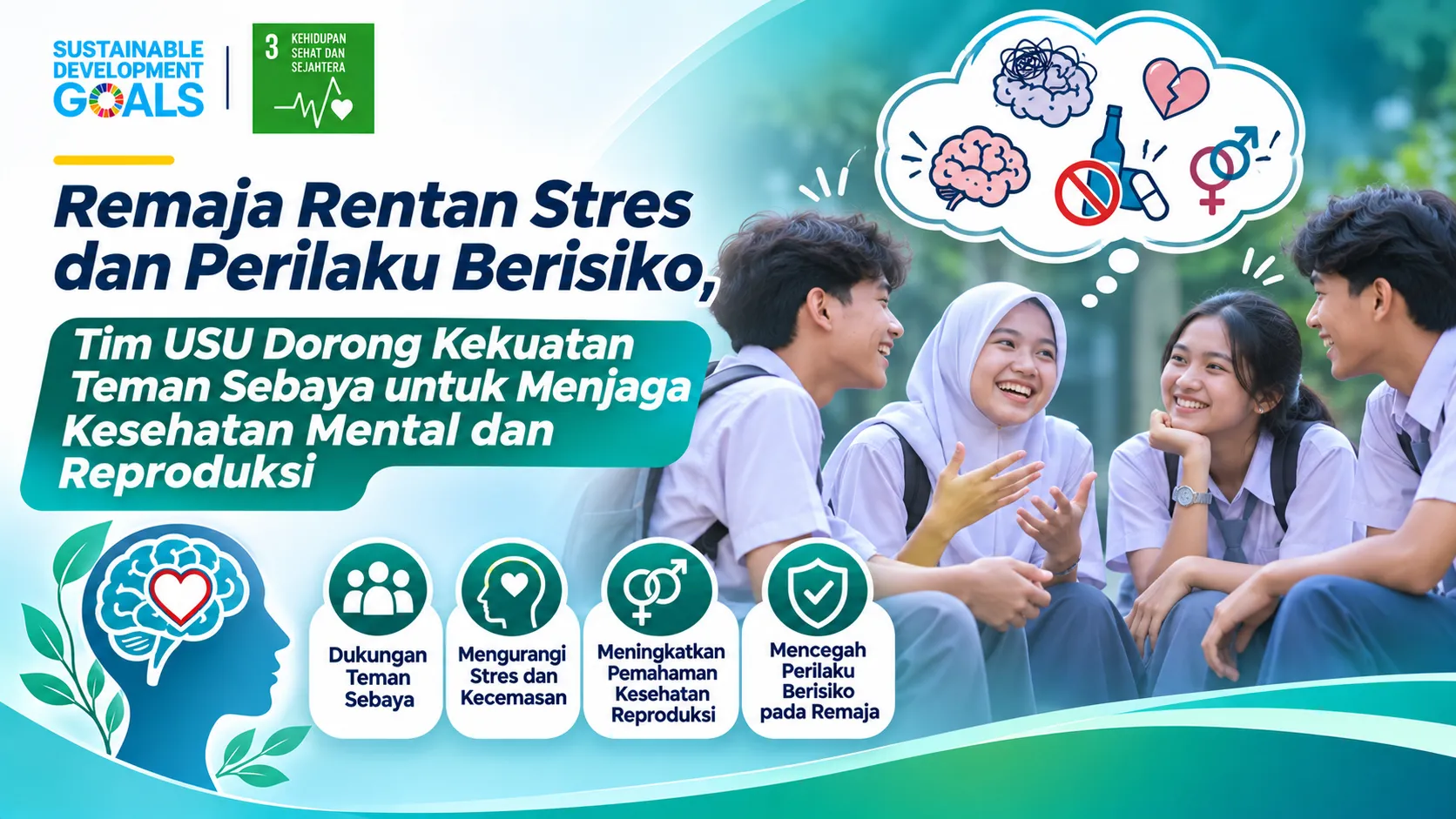
Adolescence is often described as a period filled with enthusiasm, friendship, and the search for identity. However, behind school activities and social interactions, many adolescents face emotional pressures that are difficult for them to express. Feelings of anxiety, stress, conflicts with friends, and a lack of knowledge about reproductive health can affect their well-being. In response to these issues, a community service activity involving academics from Universitas Sumatera Utara (USU) introduced an engaging approach: empowering adolescents to help their peers deal with emotional issues and risky behaviors.
The program was published in the Indonesian Journal for Social Responsibility in 2026 through an article entitled Pemberdayaan Teman Sebaya untuk Strategi Regulasi Emosi, Pencegahan Perilaku Berisiko, dan Pemahaman Kesehatan Reproduksi Remaja. The activity involved Vita Camellia, Khairunnisa, Muhammad Ichwan, Farah Dhiba, Zulfendri, and Dewi Gita, focusing on strengthening the capacity of adolescents in Tebing Tinggi City, North Sumatra.
Adolescent mental health is an important concern because the transition to adulthood brings various psychological, biological, and social changes. During this period, individuals begin to face academic demands, changes in family relationships, peer pressure, and the need to understand themselves.
The ability to manage emotions, or emotion regulation, is one of the important skills needed to deal with these situations. Emotion regulation is the process through which a person recognizes, understands, and manages emotional responses in order to cope with pressure more adaptively.
An inability to manage emotions can be associated with various problems, such as anxiety, aggressive behavior, social conflicts, and a tendency to engage in risky actions. Therefore, mental health education should not be limited to teaching the definition of stress but should also provide practical skills for dealing with it.
This empowerment program was carried out in collaboration with the Population Control and Family Planning Office (DPPKB) of Tebing Tinggi City through the Forum Generasi Berencana (GenRe) and the Adolescent Information and Counseling Center (PIK-R). Both organizations play a role in providing information, education, and support to adolescents.
The activity lasted for two days and involved 67 participants. On the first day, students underwent psychological distress assessments using the Kessler Psychological Distress Scale, or K10, along with assessments of their emotion regulation strategies using the Emotion Regulation Questionnaire (ERQ).
These assessments were conducted to obtain an initial overview of the participants' psychological conditions and their tendencies in managing emotions. The results served as a basis for determining educational approaches suited to the needs of the adolescent group.
Of the 67 participants, 48, or 71.64%, were female, while the remaining 19 were male. Most participants were between 16 and 17 years old and came from the student group and members of the GenRe Forum in Tebing Tinggi.
The K10 assessment results showed that 26 participants, or 38.81%, fell into the category of no psychological distress. Meanwhile, 23 participants, or 34.33%, showed mild distress, 13 participants, or 19.40%, fell into the moderate category, and five participants, or 7.46%, experienced severe distress.
These findings indicate that some participants were experiencing varying levels of psychological pressure. Although the K10 assessment is not a diagnostic tool for mental disorders, its results provide preliminary information about adolescents' mental health support needs.
The emotion regulation assessment also revealed interesting findings. A total of 25 participants, or 37.31%, predominantly used the cognitive reappraisal strategy, while 42 participants, or 62.69%, tended to use the expressive suppression strategy.
Cognitive reappraisal is a way of managing emotions by reinterpreting a situation so that the emotional response becomes more adaptive. In contrast, expressive suppression involves holding back or concealing the expression of emotions being experienced.
Both strategies can be used in everyday life. However, excessive use of expressive suppression may make it more difficult for someone to communicate their feelings or seek support when facing problems.
The assessment results became the basis for the community service team to provide training emphasizing emotional recognition, changing thought patterns about stressful situations, and developing skills to manage responses in a healthy way.
One of the methods introduced was mindfulness, an exercise that focuses attention on present experiences with awareness and without judgment. Participants were encouraged to recognize their thoughts and feelings without immediately reacting impulsively.
The training also included deep breathing techniques. Through these exercises, participants were introduced to ways of slowing their breathing and helping themselves calm down when facing pressure or anxiety-inducing situations.
In addition, participants received education about cognitive distortions, which are patterns of thinking that can cause someone to assess a situation disproportionately. Adolescents were encouraged to understand that the way they interpret events can influence the emotions and actions that arise.
In the reproductive health segment, the activity discussed the importance of understanding bodily changes, maintaining reproductive health, and recognizing the risks of unsafe sexual behavior. The education also highlighted the prevention of HIV/AIDS, drug abuse, and teenage pregnancy.
The approach used was not limited to lectures. The program involved counseling, group discussions, identification of cognitive distortions, and skills training that participants could practice independently.
What made this activity particularly interesting was the use of peers as part of the educational strategy. Adolescents are considered more likely to open up when interacting with friends who understand their experiences and social environment.
Through the GenRe Forum and PIK-R, participants were encouraged to become advocates for disseminating accurate health information. Thus, the knowledge gained during the training is expected to be shared with other students through peer communication and counseling.
The activity evaluation showed positive participant responses. A total of 38 participants stated that they were very satisfied, 19 participants were satisfied, eight participants were fairly satisfied, and two participants stated that they were dissatisfied with the educational activities provided.
These responses indicate good acceptance of the program, although participant satisfaction cannot yet be used as evidence that emotion regulation skills have improved sustainably.
The authors also acknowledged that the activity had not conducted an in-depth evaluation of its long-term impact on changes in psychological distress or the use of more adaptive emotion regulation strategies.
Therefore, further monitoring is needed to determine whether the skills taught are actually applied in everyday life. The involvement of schools, families, counselors, and health workers is important to ensure that adolescents receive continuous support.
Ultimately, this community service activity involving USU demonstrates that efforts to maintain adolescent mental and reproductive health can begin within their own immediate environments. By developing emotional management skills and strengthening the role of peers, adolescents have the opportunity to support one another in facing the challenges of growing up.
This program also supports the achievement of Sustainable Development Goals (SDGs) Goals 3 and 4, namely Good Health and Well-Being and Quality Education, by strengthening health literacy, psychosocial skills, and youth empowerment.
Key Research Points:
The community service activity involved 67 adolescent participants in Tebing Tinggi City, North Sumatra, over two days.
The program was carried out through collaboration among academics, the DPPKB of Tebing Tinggi City, the GenRe Forum, and PIK-R.
A total of 71.64% of participants were female, with the majority aged 16–17.
The K10 assessment results showed that 38.81% of participants had no psychological distress, 34.33% experienced mild distress, 19.40% moderate distress, and 7.46% severe distress.
A total of 62.69% of participants (42 people) predominantly used the expressive suppression strategy, while 37.31% used cognitive reappraisal.
The training covered mindfulness, deep breathing techniques, identification of cognitive distortions, and emotion regulation strategies.
Reproductive health education discussed the prevention of risky sexual behavior, HIV/AIDS, drug abuse, and teenage pregnancy.
The satisfaction evaluation recorded 38 participants as very satisfied, 19 as satisfied, eight as fairly satisfied, and two as dissatisfied.
The program encouraged peer empowerment to broaden the dissemination of mental and reproductive health information.
Long-term impact assessments have not yet been conducted, so further monitoring is needed to measure changes in adolescents' skills and behavior.
Author
Khairul Azmi
Source/Researcher