


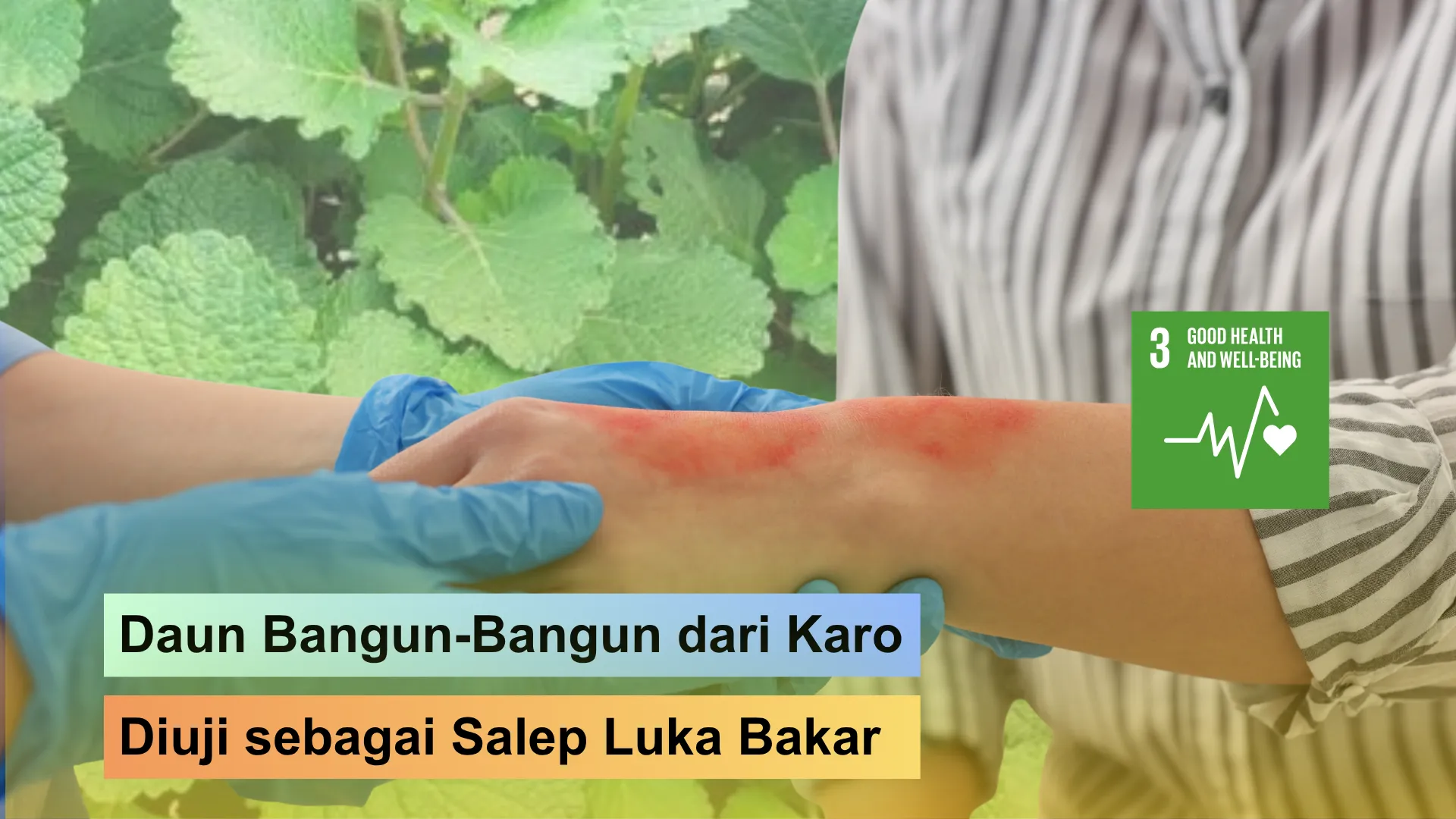
In the kitchens and gardens of Karo communities, bangun-bangun leaves have long been used to treat wounds. The leaves are known to contain compounds believed to relieve pain and inflammation. The question is: to what extent can these traditional claims be scientifically proven in a laboratory, particularly in the treatment of burns?
This question was addressed by a research team from the Departments of Pharmacology and Therapeutics and Anatomy, Faculty of Medicine, Universitas Sumatera Utara (USU), together with researchers from the University Institute of Diet and Nutritional Sciences, University of Lahore, Pakistan.
Why Burn Wounds Matter
Burns damage the skin layers and underlying tissues, triggering pain, swelling, and blisters. In second-degree burns, the damage is extensive enough that healing requires proper management of inflammation. White blood cells, particularly neutrophils and macrophages, play a role in clearing dead tissue and fighting germs. However, excessive inflammation can prolong pain and hinder regeneration.
How the Gel Was Made and Tested
Bangun-bangun leaves were obtained from Tanah Karo, Brastagi. Plant identification was conducted at the Herbarium Medanense (MEDAN), USU, and the extract was prepared at a local medicinal plant research laboratory. The gel was formulated using 3% sodium carboxymethylcellulose as the base, with a 10% extract concentration, and then sterilized by filtration. Phytochemical tests identified flavonoids, saponins, terpenoids, alkaloids, and tannins, but no glycosides. The study involved 54 male Wistar rats. Second-degree burns were induced using a 2 × 2 cm hot metal plate on the shaved skin of their backs. The rats were divided into three main groups: a negative control (base gel without extract), a positive control (Bioplacenton®, a placenta extract-based product), and a treatment group (10% bangun-bangun gel). Each group was further divided according to treatment duration of 3, 14, or 21 days, with six rats in each subgroup. The gel was applied twice daily.
What the Researchers Found
Pain: The pain score in the bangun-bangun group was lower than in the control groups at the end of the observation period (2.57 compared to 2.84 in the negative control and 2.75 in the Bioplacenton® group). However, this difference was not statistically significant (p = 0.107, according to the text). The authors described this as a trend that requires further investigation.
Inflammatory cells: At the end of the observation period (days 19 to 21), the number of leukocytes in the tissue of the bangun-bangun group decreased the most, averaging 208 compared to 1,393 in the negative control and 542 in the Bioplacenton® group. The differences compared with the negative and positive controls were reported as significant (p = 0.010 and p = 0.006).
Wound closure: On day 21, wounds in the bangun-bangun group showed the most advanced healing, with new tissue, minimal scabbing, and signs of remodeling. The negative control group still showed redness, swelling, and incomplete scab formation.
The authors acknowledged that the number of rats was small, results in rats may not necessarily apply to humans, and clinical trials are needed. The molecular mechanisms have not yet been investigated, and the optimal concentration and formulation have not been determined. They also suggested that bangun-bangun extract has the potential to become a more affordable alternative to synthetic medications, although this claim has not been demonstrated in this study.
Research Key Points
A 10% bangun-bangun leaf extract gel (Coleus amboinicus) was tested on 54 Wistar rats with second-degree burns.
The treatment group showed the lowest leukocyte count in tissue at the end of the observation period compared with the negative control (p = 0.010) and positive control (p = 0.006).
The bangun-bangun group demonstrated the fastest wound closure, based on macroscopic observations on day 21.
Pain reduction was not significantly different from the control groups (p = 0.107 according to the text, and p = 0.139 according to the abstract for the comparison with Bioplacenton®).
The extract contained flavonoids, saponins, terpenoids, alkaloids, and tannins; glycosides were not detected.
These are preliminary findings from an animal study. Clinical trials and further studies on concentration and safety are needed.
Author
Khairul Azmi
Resource Person/Researcher
Prof. Dr. dr. Yunita Sari Pane, M.Si.