


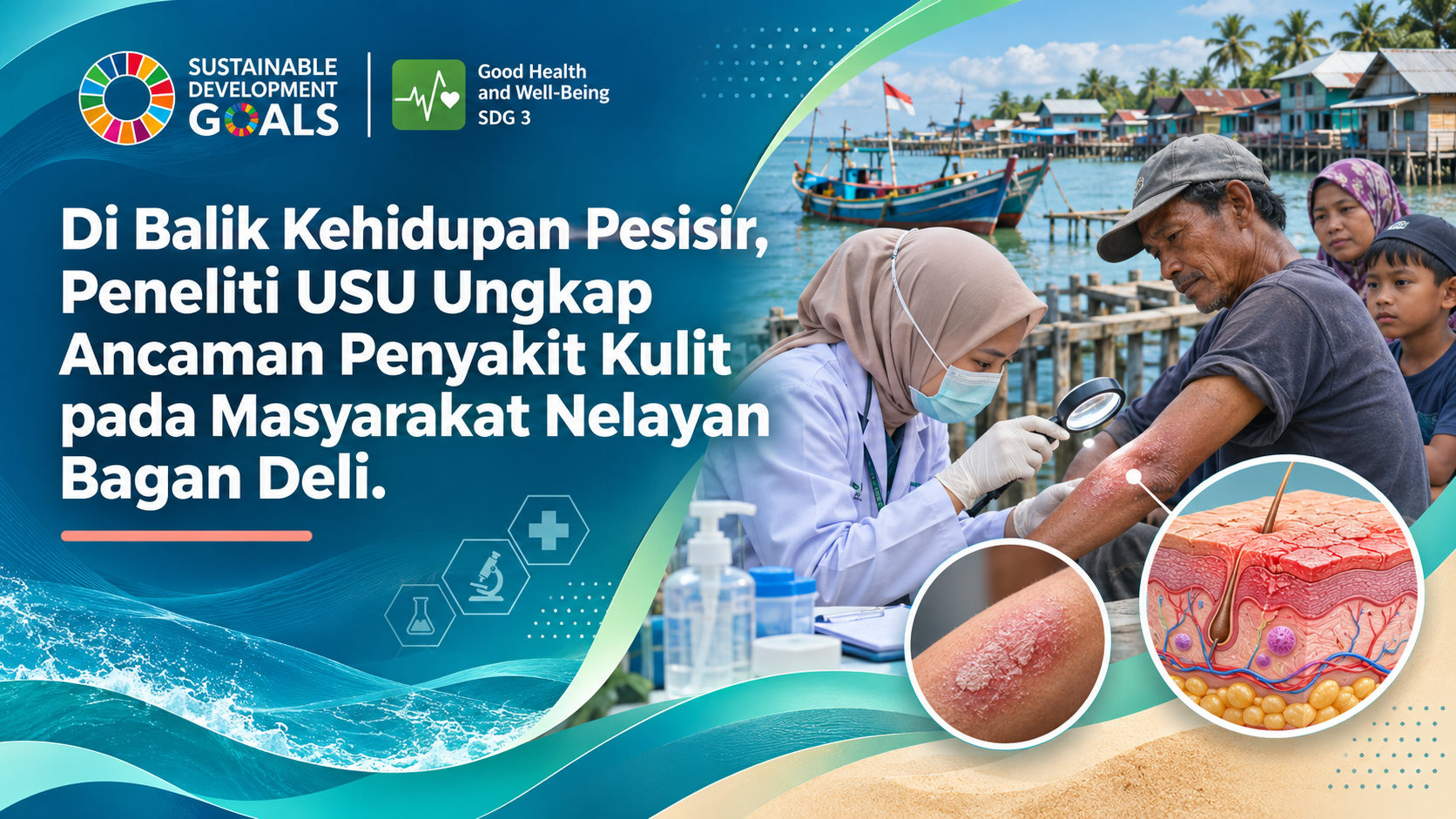
Coastal communities' lives are inseparable from environmental challenges. Intense sunlight, high humidity, exposure to seawater, and work activities that last for hours are part of the daily lives of fishing communities. However, behind their struggle to earn a living lies a health issue that often goes unnoticed: skin diseases that can potentially affect comfort, productivity, and even the community's quality of life.
This issue has become a concern for a team of lecturers from the Faculty of Medicine, Universitas Sumatera Utara (USU), through a community service activity entitled Community-Based Skin Health Services to Improve the Health of Fishing Communities in Bagan Deli. The activity was carried out in Bagan Deli Urban Village, Medan Belawan Subdistrict, Medan City, as an effort to improve access to skin examinations, treatment, and health education for coastal communities.
The activity was published in the Jurnal Pengabdian Masyarakat MEAMBO by Ariyati Yosi, Arlinda Sari Wahyuni, Muhammad Rusda, Dina Keumala Sari, Ramona Dumasari Lubis, and Mustafa Mahmud Amin from the Faculty of Medicine, USU. Through a community-based approach, the team sought to identify the skin diseases commonly experienced by residents while also understanding their effects on daily life.
Coastal Environments and Threats to Skin Health
For fishing communities, exposure to the coastal environment is difficult to avoid. Activities under sunlight, hot and humid air conditions, and contact with seawater can increase the risk of various skin disorders. These risks may also be aggravated by limited sanitation facilities, environmental cleanliness, and suboptimal use of personal protective equipment.
Skin diseases are often considered minor conditions that only cause itching or discomfort. In fact, persistent complaints can interfere with work, social activities, and even a person's psychological well-being.
In the study, the USU team emphasized that skin health is closely related to quality of life. For fishing communities whose livelihoods depend on physical activities, skin disorders have the potential to affect their ability to perform their work optimally.
This situation shows that skin healthcare services cannot focus solely on treatment. An approach that considers the environment, lifestyle habits, and public access to healthcare services is needed.
Examinations of 73 Residents Reveal the Prevalence of Heat Rash
To understand the community's health conditions firsthand, the Faculty of Medicine, USU, team organized skin health examinations on July 27, 2024, in Bagan Deli Urban Village. The activity, which lasted approximately four hours, involved 14 personnel consisting of lecturers and partners and was attended by 73 residents ranging in age from eight months to 72 years.
Of all the participants, 48 people, or 66%, were women. Adults aged 19–59 constituted the largest participant group, with 38 people, or 52%. The examination results showed that miliaria, or heat rash, was the most frequently identified diagnosis, accounting for 31 cases, or 42%. This condition is associated with blocked sweat ducts and can occur in hot and humid conditions.
In addition to miliaria, eight cases of scabies, or 11%, five cases of tinea corporis, and four cases each of folliculitis and urticaria were identified. The team also identified several other skin disorders, such as contact dermatitis, xerosis or dry skin, impetigo, cutaneous candidiasis, insect bites, and post-inflammatory hyperpigmentation.
The variety of diagnoses shows that skin health problems in coastal communities are not limited to one type of disease. Environmental conditions, personal hygiene, and the characteristics of daily activities are important aspects that need to be considered in prevention efforts.
Skin Diseases Affect Quality of Life
One of the important findings of this activity was the impact of skin diseases on people's quality of life. The team used the Dermatology Life Quality Index (DLQI) instrument to assess the extent to which skin disorders affected the lives of adult and elderly participants.
The results showed that 30 people, or 64% of the participants, stated that their skin diseases had a substantial impact on their quality of life. Ten people, or 21%, experienced a moderate impact, four people, or 9%, experienced a small impact, while three people, or 6%, experienced a very large impact.
These findings show that skin diseases are not merely a matter of appearance or temporary physical complaints. Itching, pain, and discomfort have the potential to interfere with work, sleep quality, social activities, and psychological well-being.
For people who work outdoors, skin health problems can become an additional challenge in maintaining daily productivity.
Nevertheless, this activity involved examinations and assessments conducted at a single point in time, so it cannot establish a causal relationship between specific environmental conditions and the skin diseases identified.
USU Provides Examinations, Treatment, and Education
In addition to identifying problems, this community service activity also provided direct healthcare services to residents. Participants underwent anamnesis, or medical history interviews, physical skin examinations, and received treatment according to their diagnoses and medical indications. Treatment was provided through both pharmacological and non-pharmacological approaches, accompanied by education on personal hygiene, skin care, infection prevention, and the use of personal protective equipment while working. Residents were also informed about the importance of having skin complaints examined early so that health problems would not persist for prolonged periods. This approach is important because some residents may not realize that skin complaints considered ordinary may require examination and treatment by healthcare professionals. The activity also involved the urban village government, healthcare workers, and implementation partners, enabling services to reach residents directly in their living environment.
Promoting Sustainable Services for Coastal Communities
The success of this activity demonstrates that community-based healthcare services can serve as an initial step toward expanding access to skin examinations and health education.
However, the team also noted several challenges, such as limited service time, supporting examination facilities, and residents who only sought medical attention after their complaints had persisted for quite some time.
Therefore, the researchers recommended regular skin health examinations, improved personal hygiene education, the use of personal protective equipment, and the strengthening of referral systems to healthcare facilities.
The activity's findings can also serve as a basis for developing public health programs that are better suited to the needs of coastal areas.
Through this contribution, USU demonstrates the role of higher education institutions in bringing scientific knowledge and healthcare services closer to the community.
This effort is in line with Sustainable Development Goal (SDG) 3, which emphasizes the importance of ensuring healthy lives and well-being for all.
Ultimately, improving the health of fishing communities is not only about the ability to treat diseases but also about ensuring that residents have access to knowledge, healthcare services, and continuous preventive support. From Bagan Deli, this activity conveys an important message: maintaining skin health also means protecting the comfort, productivity, and quality of life of coastal communities.
Key Research Points:
73 participants took part in skin health examinations in Bagan Deli Urban Village, Medan Belawan Subdistrict, on July 27, 2024.
42% of participants (31 cases) were diagnosed with miliaria, or heat rash, making it the most frequently identified skin disease.
11% of participants (8 cases) had scabies, followed by five cases of tinea corporis and four cases each of folliculitis and urticaria.
64% of adult and elderly participants who completed the DLQI stated that skin diseases had a substantial impact on their quality of life.
The services used a community screening and community service approach that integrated examinations, treatment, education, and quality-of-life assessments.
The activity's results support the development of regular examination programs, improved personal hygiene, the use of personal protective equipment, and sustainable skin healthcare services.
This community service activity contributes to the achievement of SDG 3: Good Health and Well-being, particularly by improving access to healthcare services for coastal communities.
Writer
Khairul Azmi
Source/Researcher
dr. Ariyati Yosi, M.Ked(KK), Sp.D.V.E, Subsp. D.T., FINSDV, FAADV