


Some babies are born with a hole in the wall separating the heart's two upper chambers. This condition is called an atrial septal defect (ASD) and is one of the most common congenital heart diseases, accounting for approximately 10 to 15% of all cases. If left untreated, excessive blood flow can strain the right side of the heart and trigger rhythm disturbances, high pressure in the pulmonary blood vessels, and even premature death. Therefore, closure of the defect is recommended for symptomatic patients and those with right ventricular enlargement.
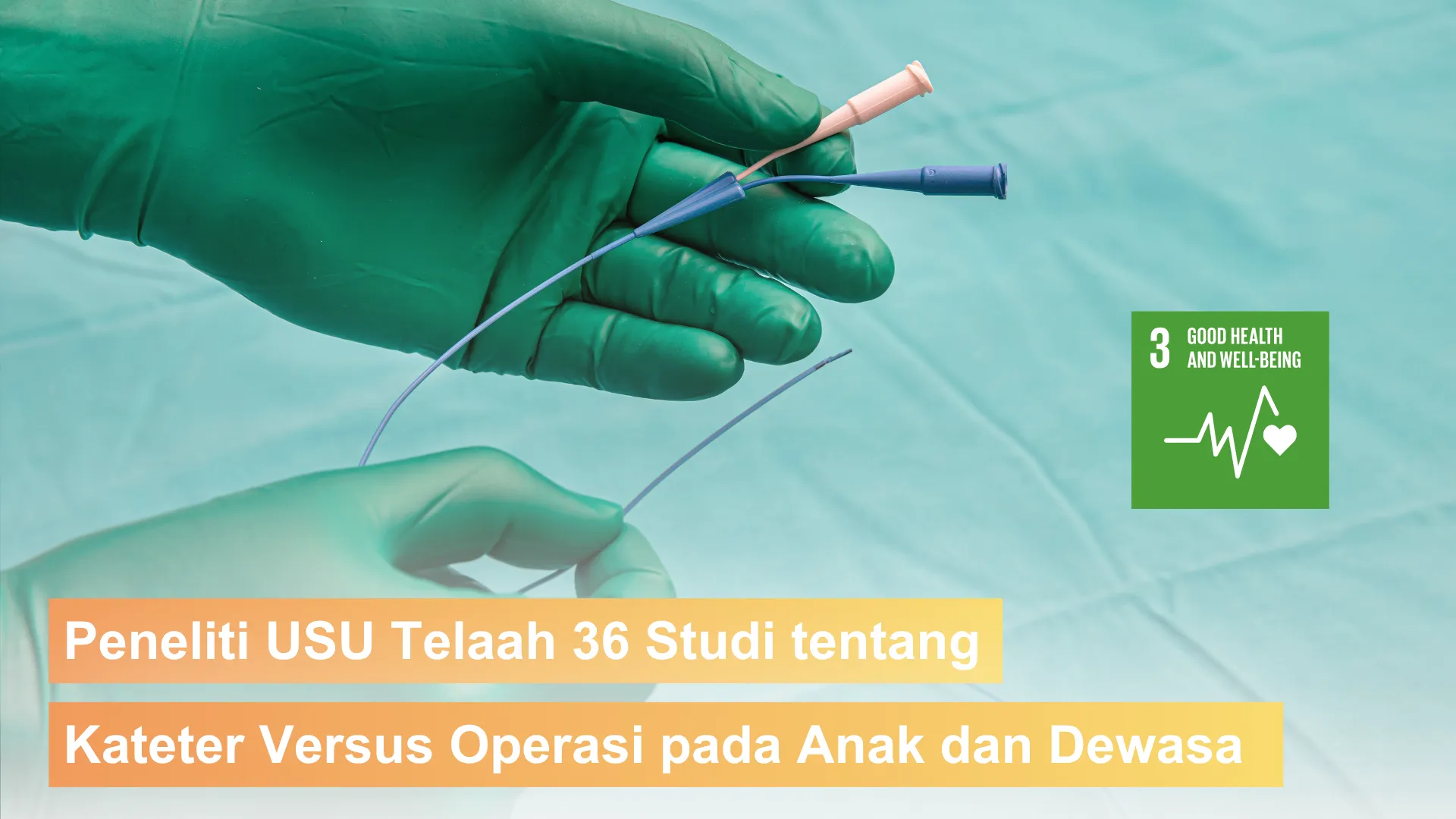
There are two treatment options. Open-heart surgery has long been the standard treatment. Since the 1990s, catheter-based closure devices have been used as a less invasive alternative for patients with suitable anatomy. However, evidence comparing the two methods in children and adults remains mixed and is derived mostly from observational studies rather than randomized trials. A research team from the Pediatric Cardiology Evidence-Based Medicine Center and the Department of Child Health, Faculty of Medicine, Universitas Sumatera Utara (USU), conducted a systematic review and meta-analysis to address this question.
How the Study Was Conducted
The team searched the literature through December 2024 and included 36 observational studies (cohort studies, case-control studies, and one national registry) from various countries. Study quality was assessed using the Newcastle-Ottawa Scale, and the protocol was registered with PROSPERO (CRD420251052612). The included studies were grouped by age (children or adults) and type of procedure (catheter-based or surgical).
What Was Found
Procedural success: Overall, the success rate was approximately 95% (confidence interval of 92 to 97%). Among adults, the success rates were 97% for catheter-based closure and 98% for surgery, with a very wide confidence interval for surgery (70 to 100%). Among children, the crude success rates were 87% (1,445 out of 1,656) for catheter-based closure and 99% (505 out of 510) for surgery, while the pooled model estimated rates of 93% and 97%, respectively.
Hospital stays and procedure duration: Catheter-based closure was associated with hospital stays that were approximately 3.9 days shorter and shorter procedure times (approximately 43 versus 90 minutes in adults and 71 versus 83 minutes in children).
Complications: According to the abstract, major complications were less frequent with catheter-based procedures (risk ratio 0.58; confidence interval 0.39 to 0.86). Events more frequently reported after surgery in children included pericardial effusion (2.1%), shock (3.9%), anemia (6.4%), and infection (2.9%).
The other side of catheter-based closure: Residual shunts were more frequently detected during follow-up, occurring in 4.6% of children and 7.2% of adults after catheter-based closure, compared with 1.7% of children who underwent surgery. Device embolization was reported in 1.0% of children and 1.3% of adults.
The authors concluded that catheter-based closure offers fewer complications and faster recovery, particularly in patients with suitable anatomy, while surgery remains necessary for large defects, inadequate septal rims, or complex anatomy. The choice of procedure should be individualized, taking into account age, anatomy, comorbidities, and the experience of the treatment center.
All studies were observational and therefore susceptible to confounding factors. Results varied considerably across studies (high heterogeneity), with a prediction interval for success rates of 55 to 100%. Definitions of success and follow-up durations differed between studies, and long-term data extending beyond 10 years remain limited.
Key Research Findings
A systematic review and meta-analysis of 36 observational studies (through December 2024) on catheter-based versus surgical ASD closure in children and adults.
The pooled procedural success rate was approximately 95% (92 to 97%), with very high heterogeneity (I² 90.2%) and a prediction interval of 55 to 100%.
Among children, the crude success rate was 87% for catheter-based closure compared with 99% for surgery; among adults, it was 97% for catheter-based closure compared with 98% for surgery.
Catheter-based closure was associated with shorter hospital stays (a difference of approximately 3.9 days) and fewer major complications (risk ratio 0.58), but more residual shunts during follow-up.
Surgery remains important for large defects, inadequate septal rims, or complex anatomy.
The evidence was entirely observational, and the authors recommend prospective studies and long-term data collection.
Author
Khairul Azmi
Resource Person/Researcher
Dr. dr. Putri Amelia, M.Ked(Ped), Sp.A(K)