


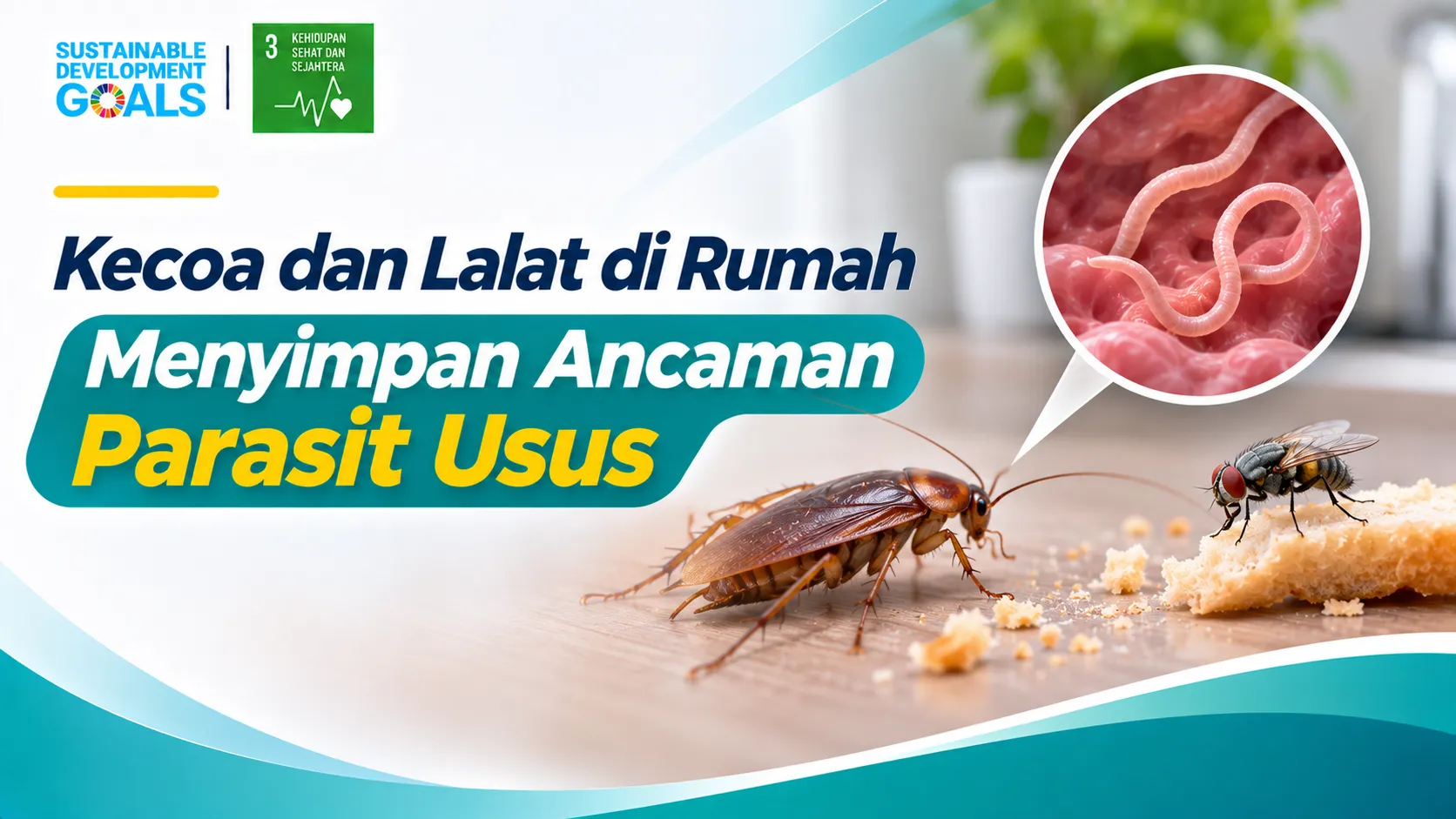
Cockroaches roaming around the kitchen and flies landing on food are often considered minor nuisances in everyday life. However, the presence of these two insects may indicate more serious environmental hygiene problems. Collaborative research by Universitas Sumatera Utara (USU) and Universitas HKBP Nommensen revealed the presence of various intestinal parasites in cockroaches and houseflies, while also identifying an association between parasite contamination in cockroaches and the stool examination results of household residents in Labuhan Deli, North Sumatra.
These findings were published in the Indonesian Journal of Environmental Health on October 26, 2026, through a study entitled “Intestinal Parasites in Cockroaches and Houseflies and Household Stool Positivity in Labuhan Deli Indonesia.” The study involved Yoan Carolina Panggabean, Lambok Siahaan, Adelina Haryani Sinambela, Nurfida Khairina Arrasyid, Dewi Saputri, Janry Sinaga, and M. Ary Irawan.
Intestinal parasite infections remain a public health concern, particularly in environments with inadequate sanitation. These diseases can be associated with digestive disorders and various health problems, depending on the type of parasite, infection intensity, and the condition of the exposed individual.
Cockroaches and houseflies are of particular concern because they frequently move between garbage areas, damp environments, organic materials, and food storage areas. Such movements allow both insects to come into contact with materials contaminated by microorganisms or parasites.
In environmental health, this condition is associated with the possibility of mechanical transmission of disease agents. This means that an organism can be carried on the surface of an insect's body without necessarily reproducing inside the insect.
To understand this issue, the research team conducted an observational study using a cross-sectional design involving 100 households in Labuhan Deli District, Deli Serdang Regency, throughout 2022.
The research site was a residential area with poor sanitation conditions. The participating households had lived there for at least one year and had a history of family members experiencing gastrointestinal or digestive disorders during the preceding year.
These characteristics are important to consider because the study sample does not represent the entire population of Labuhan Deli. The research specifically involved households with a history of digestive complaints.
Data collection was conducted through interviews, observations of the home environment, examination of residents' stool samples, and collection of cockroaches and flies around the participants' homes.
Stool samples were examined using direct microscopic examination and the formalin-ether sedimentation method. Meanwhile, the collected insects were examined to identify their species and the forms of parasites attached to their bodies.
Laboratory examinations were conducted at the Medical Parasitology Laboratory of Universitas Sumatera Utara. The insects were washed using a special solution, after which the resulting sediment was examined under a microscope.
The research results revealed conditions that warrant attention. Of the 100 households, 81 households, or 81%, had at least one resident whose stool examination tested positive for intestinal worms or helminths.
Meanwhile, 71 households, or 71%, had at least one resident whose stool examination tested positive for protozoa. Both categories could be found in the same household.
These figures represent the proportion of households with positive examination results, not the percentage of the entire population infected. Because participants were selected based on a history of family digestive disorders, the results also cannot be generalized to all households in the area.
In addition to examining humans, the researchers identified two insect species, namely the American cockroach (Periplaneta americana) and the housefly (Musca domestica).
Four groups of intestinal worms and five groups of protozoa were found in the cockroach samples. Meanwhile, the fly samples showed three groups of worms and three groups of protozoa.
The identified worm species included Ascaris lumbricoides, Trichuris trichiura, hookworms, and Enterobius vermicularis. Some of these are parasites that can cause health problems in humans.
The study also identified several protozoa, including Cryptosporidium sp., Giardia lamblia, Blastocystis sp., Entamoeba coli, and Iodamoeba buetschlii.
However, not all of these organisms are pathogenic. Some species, such as Entamoeba coli and Iodamoeba buetschlii, are generally considered non-disease-causing, but their presence may indicate possible fecal contamination in the environment.
Among the findings identified in cockroaches, Ascaris lumbricoides was the most frequently detected worm, accounting for 26 of the 46 recorded worm findings, or 56.5%. Meanwhile, Cryptosporidium sp. accounted for ten of the 40 recorded protozoan findings, or 25%.
These percentages describe the composition of the recorded parasite findings, not the percentage of infected cockroaches. The study also did not determine whether the detected parasite forms were still alive or capable of causing infection.
The most interesting findings emerged when researchers compared cockroach contamination with the stool examination results of household residents.
Among the 54 households with cockroach samples testing positive for parasites, 46 households, or 85.2%, had residents with positive stool examination results for protozoa. In contrast, among the 46 households with parasite-negative cockroach samples, the proportion was 54.3%.
Statistical analysis showed that households with parasite-contaminated cockroaches had a prevalence of positive stool results for protozoa 1.57 times higher than that of households with negative cockroach samples.
A similar association was found in examinations for intestinal worms. A total of 96.3% of households with parasite-positive cockroach samples had positive stool examination results for intestinal worms, compared with 63% in the cockroach-negative group.
The resulting prevalence ratio reached 1.53, with a statistically significant association. These findings indicate that cockroach contamination and the presence of parasites in residents' stool samples were more frequently found together.
Nevertheless, these results do not prove that cockroaches are a direct cause of infection. Poor sanitation, contaminated water sources, waste management, and other environmental factors may influence both findings simultaneously.
Meanwhile, the analysis of flies did not provide strong conclusions because only two households had fly samples that tested positive for parasites. This number was too small to estimate the association accurately.
The study also did not establish the direction of parasite transmission. Contamination may originate from the same environment and be found in both insects and residents without direct transmission from insects to humans necessarily occurring.
Another limitation was the use of a cross-sectional design, which only describes conditions during a single observation period. The study did not assess the effectiveness of cockroach control programs, fly eradication, or sanitation improvements in reducing infection rates.
Nevertheless, the research results provide important information for strengthening environmental health efforts. Keeping food storage areas clean, managing household waste, using clean water, and controlling insect breeding sites are relevant preventive measures.
The researchers also emphasized the need for further studies that consider sanitation conditions, water sources, household size, and socioeconomic factors to obtain a more comprehensive picture of these relationships.
Ultimately, this research involving USU serves as a reminder that family health cannot be separated from the cleanliness of the surrounding living environment. The presence of parasites in insects can serve as an important indicator of possible environmental contamination.
These findings also support the achievement of Sustainable Development Goals (SDGs) 3 and 6, namely Good Health and Well-Being and Clean Water and Sanitation, through strengthening environmental health research and community-based disease prevention efforts.
Research Key Points:
The study used a cross-sectional design involving 100 households in Labuhan Deli District, Deli Serdang Regency, North Sumatra, in 2022.
Participants came from households that had lived in the area for at least one year and had a history of digestive disorders among family members during the preceding year.
A total of 81% of households had at least one resident with a positive stool examination result for intestinal worms.
A total of 71% of households had at least one resident with a positive stool examination result for protozoa.
The insects examined were the American cockroach (Periplaneta americana) and the housefly (Musca domestica).
Four worm taxa and five protozoan taxa were found in cockroaches, while three taxa of each group were found in flies.
Ascaris lumbricoides was the most frequently detected worm in cockroaches, accounting for 26 of the 46 recorded worm findings (56.5%).
Households with parasite-positive cockroach samples had a prevalence of positive stool results for protozoa 1.57 times higher than the cockroach-negative group (PR=1.57; 95% CI 1.18–2.09; p=0.001).
Writer: Khairul Azmi
Source/Researcher: dr. Yoan Carolina Panggabean, MKT