


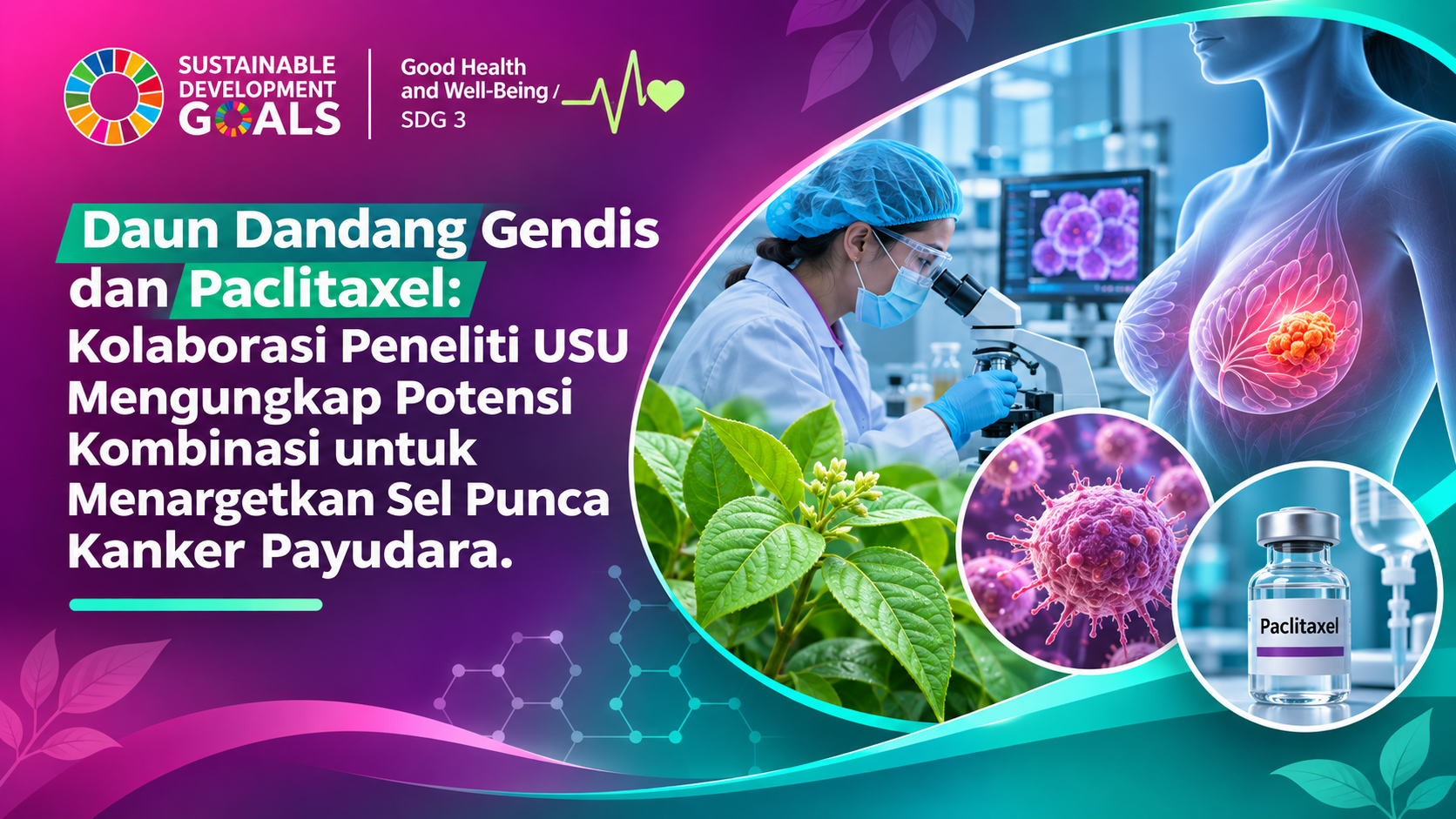
Breast cancer remains a major challenge in the healthcare field, not only because of the number of cases but also because some cancer cells are able to survive after treatment and trigger recurrence. One group of cells receiving particular attention is breast cancer stem cells (BCSCs). These cells have the ability to self-renew, form new cancer cell populations, and contribute to metastasis and resistance to therapy. Therefore, strategies capable of targeting BCSCs are an important direction in the development of breast cancer treatment.
This potential was investigated by a research team from Universitas Sumatera Utara (USU), together with collaborators from the International Islamic University Malaysia, through a study entitled “Synergistic Effects of Clinacanthus nutans Leaf Aqueous Extract and Paclitaxel on The Cell Cycle and Apoptosis of Breast Cancer Stem Cells Expressing CD44+/CD24−”. The article was published in Trends in Sciences, volume 23, issue 11, in 2026, with article number 13206. The study examined whether an aqueous extract of Clinacanthus nutans leaves could enhance the effect of paclitaxel on BCSCs, particularly in inhibiting the cell cycle and promoting programmed cell death.
Paclitaxel is a chemotherapy drug used in the treatment of breast cancer. This drug works by disrupting microtubule dynamics, thereby inhibiting the process of cell division. Nevertheless, cancer therapy may face challenges in the form of resistance and side effects. On the other hand, Clinacanthus nutans, a plant known in several Asian countries, including Indonesia, has been studied for its bioactive compounds and potential anticancer activity. The researchers explored the possibility that its aqueous leaf extract could serve as a complementary agent to paclitaxel, rather than as a replacement for chemotherapy drugs already used in clinical practice.
The study was conducted in vitro using MDA-MB-231 cells, a breast cancer cell line used to obtain BCSCs with the CD44+/CD24− marker characteristics. These cells were separated using the magnetic-activated cell sorting method and subsequently confirmed through flow cytometry. Following the isolation process, the proportion of cells with the CD44+/CD24− markers increased from 79.2 percent before separation to 92.4 percent. This result indicates that the isolation process successfully enriched the cell population targeted by the study.
The researchers then tested combinations of aqueous C. nutans leaf extract and paclitaxel at several dose levels. Cell viability was examined using the MTT assay, while the potential interaction between the two substances was evaluated through the combination index. A combination index value below one indicates a synergistic effect, a value of one indicates an additive effect, and a value above one indicates possible antagonism. From the various combinations tested, the researchers then selected doses for cell cycle and apoptosis observations. The examinations were conducted using flow cytometry, allowing changes in cell distribution across the cell cycle phases and stages of cell death to be observed.
One of the most notable results was observed in the G2/M phase, the stage when cells prepare for and undergo division. The combination of 16 micrograms per milliliter of extract and 16 nanomolar of paclitaxel increased the proportion of BCSCs in the G2/M phase to 40.43 percent. This figure was higher than that of the paclitaxel-only group, at 37.93 percent, and the control group, at 20 percent. The difference between the high-dose combination and paclitaxel alone was reported to be statistically significant. This finding indicates that the combination may strengthen cell arrest in the G2/M phase, further disrupting the division of cancer cells.
The combination's effects were also observed in the examination of apoptosis, or programmed cell death. In the group receiving 16 micrograms per milliliter of extract combined with 16 nanomolar of paclitaxel, the proportion of cells undergoing early apoptosis reached 16.13 percent. Meanwhile, late apoptosis reached 48.10 percent. In the paclitaxel-only group, late apoptosis was recorded at 39.63 percent. The difference between the high-dose combination group and the paclitaxel-only group was reported to be significant. These results indicate that the addition of the extract has the potential to increase the programmed cell death response in BCSCs under experimental conditions.
The researchers also identified compounds in the extract using liquid chromatography-mass spectrometry (LC-MS/QTOF) technology. The six compounds detected and considered to have potential anticancer activity were 3β,6β-dihydroxynortropane, isoorientin 2''-O-arabinoside, 2-hydroxyhexadecanoic acid, 2-aminohexadecanoic acid, enigmol, and spisulosine. Several of these compounds have previously been associated with processes related to the inhibition of proliferation or the activation of apoptosis. However, this study has not yet demonstrated the individual contribution of each compound to the overall effects of the combination.
The study abstract also reported increased P53 expression and decreased MDM2 expression in the C. nutans extract group. P53 is a tumor suppressor protein that plays a role in the response to cell damage, including cell cycle arrest and the regulation of apoptosis. MDM2 is known as a regulator that can inhibit P53 activity. Changes in these two markers provide clues about possible molecular pathways involved. Nevertheless, these results need to be interpreted within the scope of the tests conducted and cannot immediately be considered proof of the complete mechanism in the human body.
The research findings open opportunities for developing studies on combinations of natural substances and chemotherapy drugs to target cancer cells that may play a role in recurrence. However, there are important limitations: the study was conducted on cell cultures in a laboratory, with three independent replicates, rather than on animals or patients. Cell responses in culture dishes are not always the same as tumor responses in the body, which are influenced by metabolism, the immune system, drug distribution, dosage, and other biological factors. Therefore, these results cannot yet serve as a basis for patients to replace, discontinue, or add herbal products to their cancer treatment without consulting a doctor.
Overall, the study by the USU research team and its collaborators shows that an aqueous extract of C. nutans leaves has the potential to act synergistically with paclitaxel in inhibiting the cell cycle, particularly in the G2/M phase, as well as increasing BCSC apoptosis. The six identified bioactive compounds provide direction for further research to determine which components play the most significant roles. The next stages need to include testing the mechanisms of each compound, safety, dosage, effectiveness in animal models, and ultimately appropriate clinical evaluation. Through this gradual approach, the potential of local plants can be scientifically investigated without overlooking safety standards and the need for therapeutic evidence. This study also demonstrates the contribution of university research to exploring Indonesia's biological resources through a biomedical approach that is measurable, collaborative, and based on strong scientific evidence.
Key Research Points
The research was conducted by Aldy Safruddin Rambe, Siti Syarifah, Adi Muradi Muhar, Yunita Sari Pane, and Alfi Khatib.
The research involved collaboration between Universitas Sumatera Utara and the International Islamic University Malaysia.
The research subject was breast cancer stem cells (BCSCs) with CD44+/CD24− markers obtained from the MDA-MB-231 cell line.
The substances tested were an aqueous extract of Clinacanthus nutans leaves and the chemotherapy drug paclitaxel.
The proportion of cells with CD44+/CD24− markers increased from 79.2 percent before isolation to 92.4 percent after isolation.
The combination of 16 µg/mL extract and 16 nM paclitaxel increased the proportion of cells in the G2/M phase to 40.43 percent.
Late apoptosis in the high-dose combination group reached 48.10 percent, compared with 39.63 percent in the paclitaxel-only group.
The study identified six potential compounds: 3β,6β-dihydroxynortropane, isoorientin 2''-O-arabinoside, 2-hydroxyhexadecanoic acid, 2-aminohexadecanoic acid, enigmol, and spisulosine.
The study demonstrated the potential synergistic effects of C. nutans leaf extract and paclitaxel in laboratory cell testing.
The research results do not yet constitute evidence of clinical effectiveness in humans and require further research on safety and effectiveness.
Author
Khairul Azmi
Source/Researcher
Prof. Dr. dr. Aldy Safruddin Rambe, Sp.S(K)