


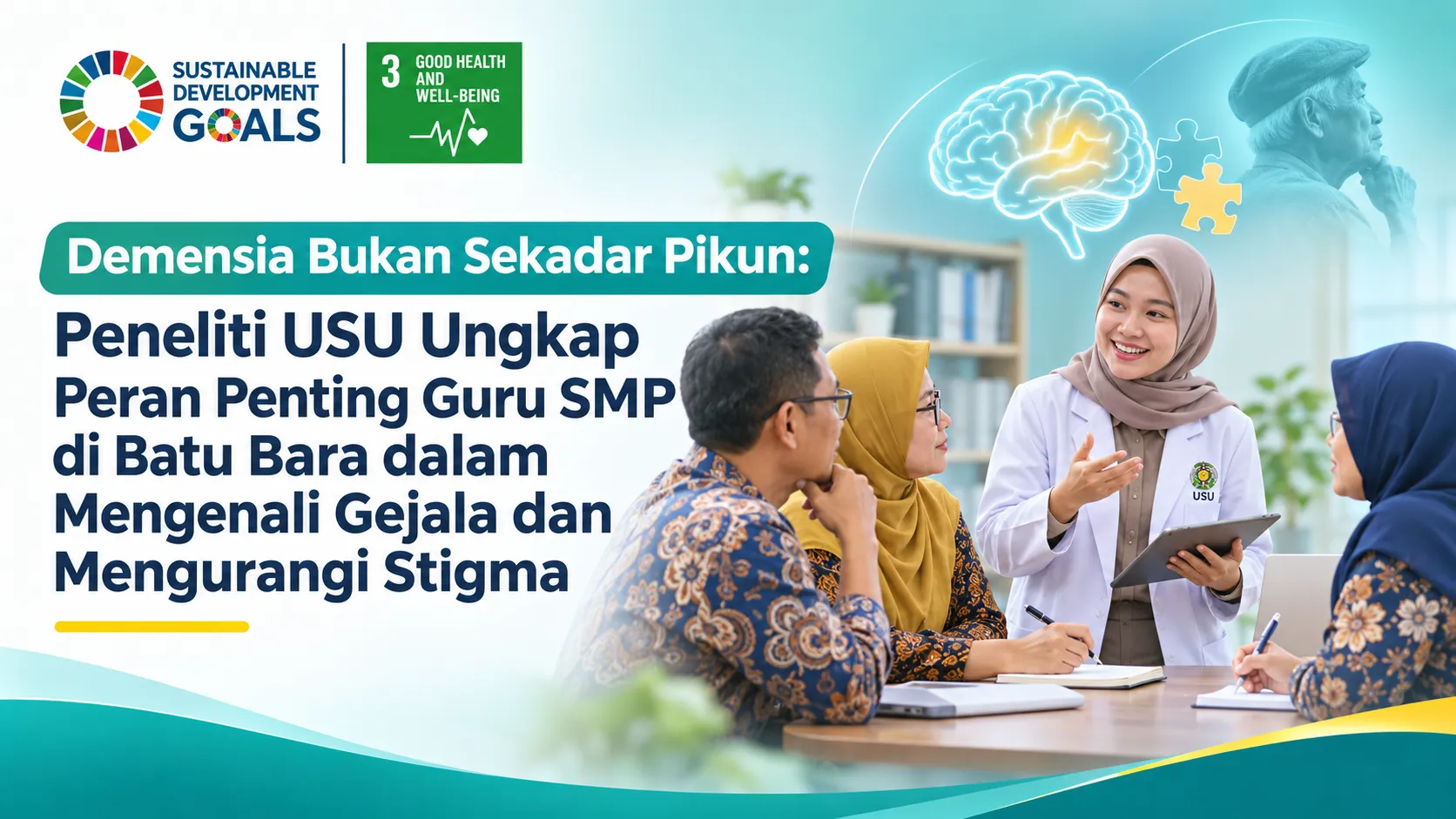
Dementia is often considered a normal part of the aging process. Someone who begins to forget things frequently, experiences behavioral changes, or has difficulty carrying out daily activities is sometimes simply considered to be experiencing age-related forgetfulness. In fact, these conditions may indicate cognitive impairment that requires medical attention. In response to this issue, research by Universitas Sumatera Utara (USU) shows that improving understanding of dementia can begin in an environment that is rarely associated with healthcare services for older adults: schools.
These findings were published in the Journal of Endocrinology, Tropical Medicine, and Infectious Disease in 2026 through a study entitled Pilot Study on Dementia Awareness and Knowledge Improvement Through Teacher Education: Experience from North Sumatra, Indonesia. The research was conducted by Fasihah Irfani Fitri, Aldy Safruddin Rambe, Elmeida Effendy, Muhammad Rusda, and Mustafa Mahmud Amin from the Faculty of Medicine, USU.
Dementia is a condition involving a decline in cognitive abilities that can interfere with daily life. These impairments can affect a person's memory, thinking abilities, language, decision-making, and behavior. Unlike mild memory changes that may occur with age, dementia causes significant impairment in an individual's independence.
This disease also has a wide-ranging impact on families. When someone develops dementia, family members often face caregiving responsibilities, emotional stress, and the need to adjust their daily activities to the patient's condition.
Unfortunately, public understanding of dementia still faces various obstacles. Misconceptions, stigma, and limited information can prevent early symptoms from being recognized, resulting in delays in obtaining medical evaluation.
In this study, the USU team saw that teachers are strategically positioned to help address this issue. Teachers not only carry out educational responsibilities but also interact with students, parents, and the community in their daily lives.
Some students may live with grandparents or other family members who experience cognitive impairment. This condition can affect their emotional well-being, family relationships, and even their learning activities at school.
Teachers who understand dementia have the potential to be more sensitive to the difficulties faced by students. They can also provide support, reduce misunderstandings, and guide families toward seeking appropriate health information.
To examine this potential, the research team conducted a preliminary study at SMP Negeri 1 Tanjung Tiram, Batu Bara Regency, North Sumatra. A total of 35 teachers participated in an educational activity designed to improve their knowledge and awareness of dementia.
The study used a quasi-experimental design with measurements taken before and after the intervention. Through this approach, the researchers could compare participants' knowledge levels before receiving the materials with their results after completing the training.
The program was designed through collaboration between neurology and education experts. The materials were developed to be easily understood by teachers without a medical education background.
The activities combined interactive lectures, multimedia presentations, group discussions, case studies, and question-and-answer sessions. This approach aimed to ensure that participants did not merely receive information but also understood how to apply it in real-life situations.
The materials covered the definition of dementia, risk factors, clinical symptoms, disease stages, the importance of early recognition, and ways to provide support to affected individuals and families.
Participants were also introduced to more empathetic communication strategies. These skills are important because people with dementia may have difficulty understanding conversations or expressing their needs clearly.
In addition to communication strategies, the educational program discussed caregiving approaches, family support, and prevention through the management of modifiable risk factors and the adoption of a healthy lifestyle.
Before the activity began, all participants completed an initial assessment using a dementia knowledge questionnaire. The instrument consisted of 20 multiple-choice questions covering disease recognition, management, daily caregiving strategies, and communication with people with dementia.
The measurement results showed that the participants' average knowledge score before the training was 12.2 out of a maximum of 20 points. This score indicated room for improvement in teachers' understanding of dementia.
After participating in the activity, the participants completed the same questionnaire again. The results showed that the average score increased to 16.6 points.
Thus, the average score increased by 4.4 points. Statistical analysis showed that this difference was significant, with a p-value of 0.029.
These findings indicate that the structured educational program was associated with an improvement in participants' knowledge in the short term.
The changes were particularly evident in their understanding of the early signs of dementia, strategies for supporting families or caregivers, and communication techniques for interacting with individuals experiencing cognitive impairment.
The study also collected qualitative feedback from the teachers. Through open-ended questions and group discussions, participants were asked to share their experiences, understanding, and perspectives after completing the training.
The results revealed an interesting change in perspective. Several teachers admitted that they better understood that memory impairment and certain behavioral changes should not automatically be considered normal parts of aging.
Participants also reported greater confidence in recognizing signs that require medical attention. This understanding can help teachers provide initial information to families without assuming the authority of healthcare professionals to make a diagnosis.
In addition, the teachers stated that they felt better prepared to use patient and nonjudgmental communication approaches when interacting with families affected by dementia.
These findings are important because stigma can cause patients and their families to feel ashamed, isolated, or reluctant to seek help.
With better understanding, teachers have the potential to help build a social environment that is more accepting of individuals with dementia.
However, the researchers also identified challenges in applying the knowledge gained after the training. Some participants expressed concerns about limited time, resources, and opportunities to apply the materials continuously.
The teachers proposed follow-up training and the provision of practical educational materials, such as posters, brochures, and simple guides that could be used at school.
These proposals indicate that educational activities are not sufficient if conducted only once. Institutional support is needed to ensure that the knowledge acquired can be maintained and applied consistently.
This study also has limitations because it involved only 35 teachers from one school. In addition, there was no control group to compare the results with those of participants who did not attend the training.
The evaluation was conducted immediately after the intervention, so it remains unknown whether the improvement in knowledge can be sustained over the long term. The study also did not measure actual behavioral changes in supporting families affected by dementia.
Nevertheless, the study results provide an overview of the potential of school-based education as a means of expanding public health literacy.
The USU team recommends developing the program through regular training, providing easily accessible educational materials, and integrating dementia education into teachers' professional development.
Cooperation between schools, healthcare professionals, universities, and local governments is also necessary to expand the program's benefits.
Ultimately, this study shows that efforts to raise awareness of dementia do not have to be limited to hospitals or healthcare facilities. Schools can serve as important spaces for introducing accurate understanding, reducing stigma, and fostering concern for families dealing with cognitive impairment.
Through teacher empowerment, Universitas Sumatera Utara also supports the achievement of Sustainable Development Goals (SDGs) Goals 3 and 4, namely Good Health and Well-Being and Quality Education, by connecting education, health, and social concern in community life.
Research Key Points:
The study was a pilot study using a quasi-experimental pretest-posttest design involving 35 teachers from SMP Negeri 1 Tanjung Tiram, Batu Bara Regency, North Sumatra.
The educational program covered the definition of dementia, risk factors, early symptoms, communication strategies, caregiving, family support, and prevention.
The training used interactive lectures, multimedia presentations, group discussions, case studies, and question-and-answer sessions.
Participants' knowledge was measured using a questionnaire containing 20 multiple-choice questions before and after the training.
The average knowledge score increased from 12.2 to 16.6 points out of a maximum score of 20.
The average increase reached 4.4 points, with a statistically significant difference (p=0.029).
Participants demonstrated improved understanding of the early symptoms of dementia, support for families, and empathetic communication techniques.
Teachers reported increased confidence in recognizing signs of dementia and providing support to students and affected families.
The program demonstrated the potential of teachers to promote health literacy, reduce stigma, and raise public awareness.
The study did not establish long-term behavioral changes because the evaluation was conducted immediately after the training.
Study limitations included the small number of participants, the involvement of only one school, and the absence of a control group.
The researchers recommend follow-up training, the provision of practical educational materials, and the integration of dementia literacy into teachers' professional development programs.
Author
Khairul Azmi
Source/Researcher
Dr. dr. Fasihah Irfani Fitri, M.Ked(Neu), Sp.S(K)