


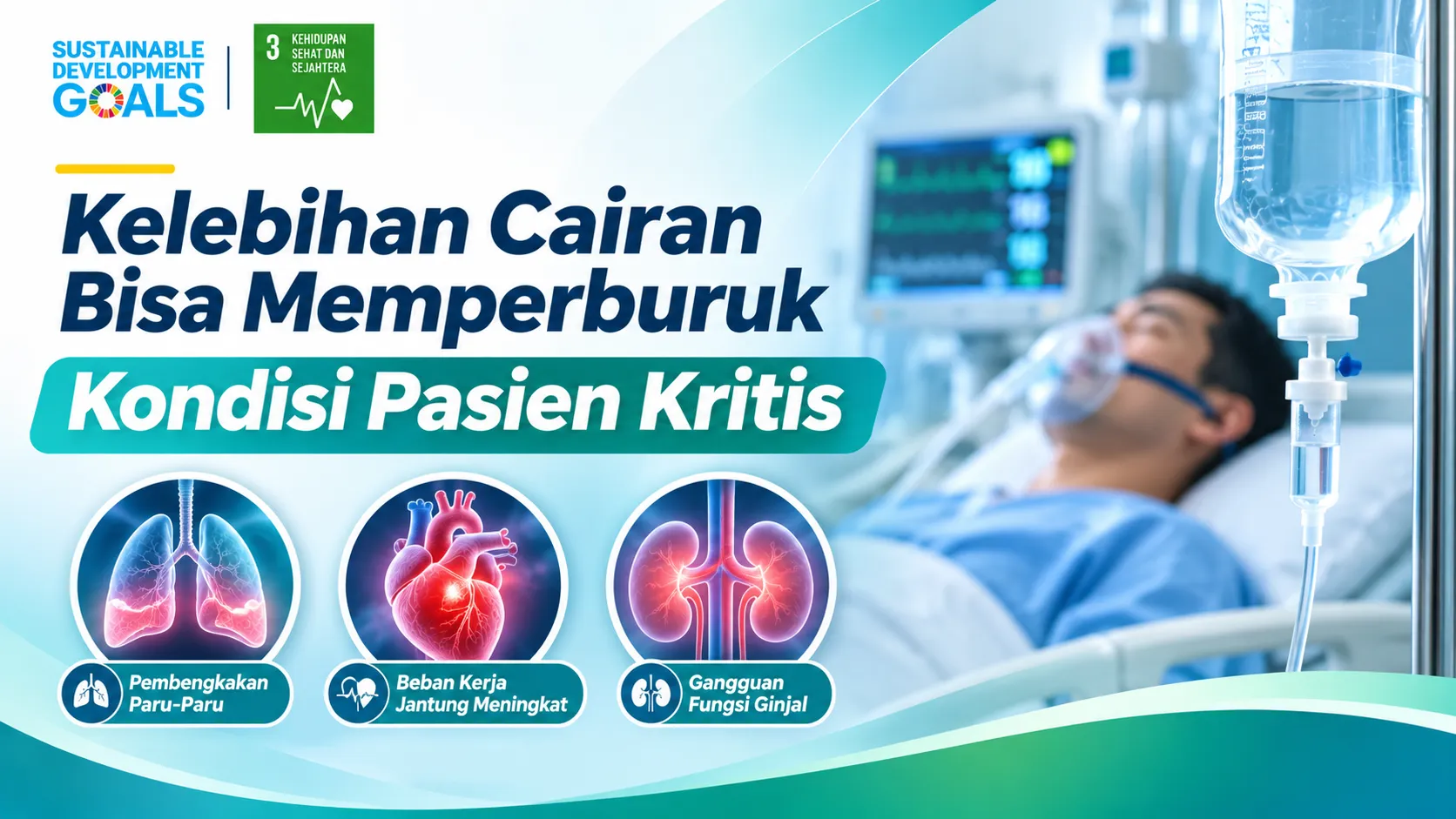
In the treatment of critically ill patients, intravenous fluids are often an important part of medical interventions to maintain blood pressure, support circulation, and sustain vital organ function. However, fluid administration is not simply a matter of ensuring that the body receives an adequate amount. An imbalance between fluid intake and output can be associated with a patient's health condition and may even be related to the risk of death. This issue became the focus of research by Universitas Sumatera Utara (USU) in the intensive care unit of Haji Adam Malik Central General Hospital, Medan.
The study entitled Fluid Balance Profile in Patients Admitted to the Intensive Care Unit (ICU) of Haji Adam Malik Central General Hospital, Medan, January–June 2025, published in the Journal of Society Medicine in 2026, revealed an important association between fluid balance, length of stay, and outcomes among critically ill patients. The study was conducted by Muhammad Shiddiq and Ahmad Yafiz Hasby from the Faculty of Medicine USU and the anesthesiology and intensive care services at Haji Adam Malik Central General Hospital.
The Intensive Care Unit, or ICU, is a specialized hospital facility that treats patients with severe and life-threatening conditions. Patients admitted to this unit often experience organ dysfunction, circulatory instability, and metabolic problems that require continuous monitoring. In these circumstances, fluid management is an important component of maintaining the body's balance.
Physiologically, fluid balance describes the relationship between the amount of fluid entering and leaving the body. Fluid intake may come from intravenous infusions, medications, and other sources, while fluid output includes urine and other fluid losses recorded during treatment. When the amount of fluid entering the body exceeds the amount leaving it, this is called a positive fluid balance. Conversely, a negative fluid balance occurs when fluid output exceeds fluid intake.
Neither condition automatically indicates a health problem. For certain patients, large amounts of fluid are necessary to address circulatory disturbances or low blood pressure. However, excessive fluid accumulation can increase the risk of tissue swelling, respiratory problems, and organ complications. Therefore, decisions about fluid administration must be adjusted to each patient's clinical needs.
To better understand this condition, the USU research team conducted an observational study using a cross-sectional approach based on medical record data from ICU patients at Haji Adam Malik Central General Hospital between January and June 2025. The study aimed to describe cumulative fluid balance profiles and analyze their associations with length of stay and patient outcomes.
Of the 222 patients recorded as having received ICU care during the study period, 64 adult patients met all the analysis criteria. The participants were patients aged at least 18 years who received treatment for at least 24 hours and had sufficient medical record data for evaluation.
The results showed that 38 patients, or 59.4%, had a negative cumulative fluid balance. Meanwhile, the remaining 26 patients, or 40.6%, had a positive fluid balance. These findings provide an overview of variations in fluid management and body fluid status among patients receiving intensive care.
Based on patient characteristics, the 25–65-year-old age group accounted for the largest proportion of the study population, at 64.1%. A total of 60.9% of patients were male, while 65.6% were admitted to the ICU for medical rather than surgical reasons. In addition, obesity was the most common body mass index category, accounting for 42.2%.
Differences in fluid balance were also found across age groups. Among patients aged 25–65, negative fluid balance was more common. In contrast, patients over 65 tended to have a positive fluid balance. This condition warrants attention because older adults may face greater challenges in maintaining fluid balance due to physiological changes and underlying health conditions.
The most important findings emerged when researchers compared fluid balance with treatment outcomes. Of the 26 patients with a positive fluid balance, 20 died. Meanwhile, of the 38 patients with a negative fluid balance, 23 survived.
In proportional terms, 57.1% of patients who died belonged to the positive fluid balance group. Conversely, 79.3% of patients who survived had a negative fluid balance. Statistical testing showed a significant association between fluid balance and patient outcomes, with a p-value of 0.003.
The study also found a significant association between fluid balance and length of ICU stay, with a p-value of 0.001. A total of 80.5% of patients who received treatment for more than seven days had a negative fluid balance, while patients with stays of one to three days more frequently showed a positive fluid balance.
These results indicate that fluid balance patterns differ according to the length of a patient's hospital stay. However, these findings do not mean that deliberately maintaining a negative fluid balance will always prolong survival or improve a patient's condition. Length of stay is influenced by many factors, including disease severity, treatment response, and changes in organ function.
The study also recorded the use of various types of fluid therapy during intensive care. A 0.9% sodium chloride solution was the most frequently used fluid, administered to 98.4% of patients. Ringer's lactate was used in 79.7% of patients, while other types of fluids were administered according to each individual's medical needs.
In addition to fluid management, the presence of comorbidities was also an important factor in assessing patient conditions. A total of 50% of patients had no recorded comorbidities, while others had hypertension, diabetes mellitus, kidney failure, or combinations of these conditions.
The researchers emphasized that fluid balance must be monitored carefully because inappropriate management may worsen the condition of critically ill patients. Nevertheless, this was an observational study with a limited sample size using data from a single hospital. Therefore, the identified association cannot establish that positive fluid balance directly causes death.
These findings provide an important basis for strengthening fluid monitoring, developing appropriate treatment guidelines, and conducting regular evaluations of intensive care practices. Fluid management needs to take into account circulatory status, kidney function, resuscitation requirements, and each patient's individual clinical changes.
Ultimately, USU's research shows that successful treatment of critically ill patients depends not only on sophisticated medical equipment but also on the accuracy of clinical decisions in maintaining the body's balance. Systematic fluid monitoring is an important step toward supporting safer, more effective, and evidence-based ICU care. This effort also aligns with Sustainable Development Goal (SDG) 3, which aims to ensure healthy lives and promote well-being through improvements in healthcare service quality.
Key Research Findings:
The study used an analytical observational design with a cross-sectional approach based on medical records of ICU patients at Haji Adam Malik Central General Hospital, Medan, from January to June 2025.
A total of 64 adult patients met the analysis criteria out of 222 patients recorded as having received ICU care.
A total of 59.4% of patients (38 people) had a negative cumulative fluid balance, while 40.6% (26 people) had a positive fluid balance.
Most patients were aged 25–65 (64.1%), male (60.9%), and admitted for medical reasons (65.6%).
A total of 35 patients (54.7%) died, while 29 patients (45.3%) survived during the observation period.
Among patients who died, 57.1% belonged to the positive fluid balance group, while 79.3% of patients who survived had a negative fluid balance.
Significant associations were found between fluid balance and patient outcomes (p=0.003), as well as between fluid balance and length of ICU stay (p=0.001).
A total of 80.5% of patients with stays exceeding seven days had a negative fluid balance.
A 0.9% NaCl solution was the most frequently used type of fluid (98.4%), followed by Ringer's lactate (79.7%).
The study emphasizes the need for close fluid balance monitoring, the implementation of guidelines, and fluid management tailored to each patient's condition.
Writer
Khairul Azmi
Source/Researcher
dr. Ahmad Yapiz Hasby, M.Ked (An), SpAn-TI