


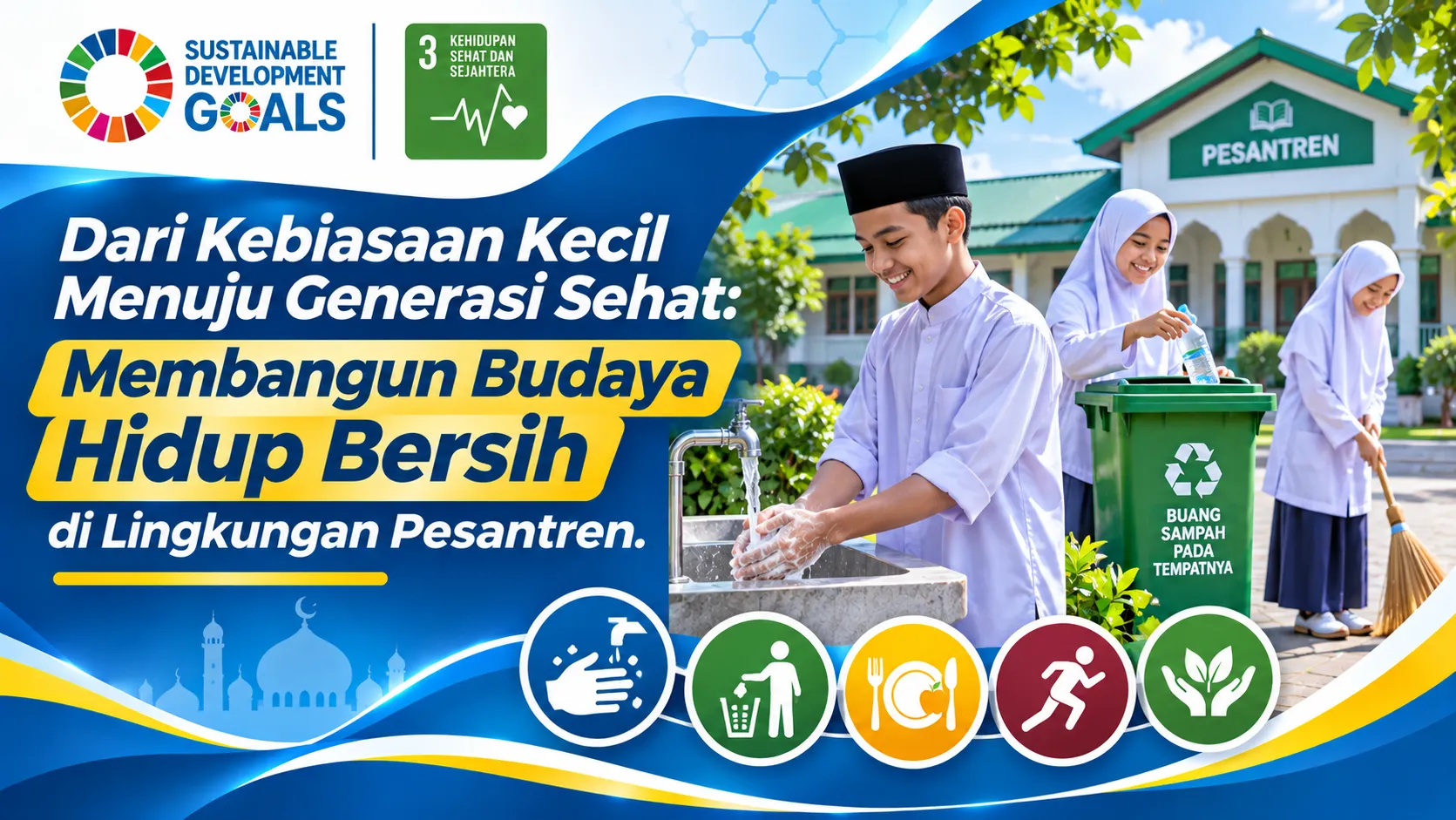
Simple habits such as washing hands, keeping clothes clean, and maintaining the cleanliness of one's living environment are often considered ordinary routines. In fact, these behaviors play an important role in maintaining health, especially in boarding school environments where many students share daily activities. This awareness formed the basis of a Universitas Sumatera Utara (USU) community service activity aimed at strengthening a culture of clean and healthy living at Al Mukhlisin Modern Islamic Boarding School, Tanjung Morawa, North Sumatra.
The program was published in an article entitled Efforts to Raise Awareness About Clean And Healthy Lifestyle In Students As Well As Efforts to Implement New Habits With Various Training On School Health Business Activities In Modern Pesantren Al Mukhlisin Tanjung Morawa in the Journal of Saintech Transfer, Volume 9, Number 1, 2026. The activity was carried out by Rusdiana, Sry Suryani Widjaja, Rusmalawaty, and Rina Amelia from Universitas Sumatera Utara as an effort to improve students' understanding of Clean and Healthy Living Behavior (PHBS) while strengthening the implementation of School Health Units (UKS).
The boarding school environment has different characteristics compared with ordinary schools. In addition to attending academic and religious classes, some students live together in dormitories, use shared facilities, and participate in various group activities. These conditions make personal hygiene and environmental sanitation important aspects of preventing the spread of disease.
Interactions that take place throughout almost the entire day can increase the likelihood of disease transmission if proper hygiene habits have not been established. Sharing personal belongings, improper handwashing habits, and poorly maintained environmental cleanliness are issues that require attention in health education.
The community service team emphasized that health is not merely the absence of disease, but also an important factor supporting a person's ability to learn, engage in activities, and lead a productive life. Therefore, the development of healthy behaviors needs to begin during school age through a continuous educational process.
One approach used was strengthening the School Health Unit program. UKS is considered an important means of improving students' health through health education, basic healthcare services, and the development of a healthy school environment.
However, the presence of a UKS does not always guarantee that health education is implemented optimally. Limited facilities, insufficient use of health equipment, and the absence of established healthy living habits can become obstacles to creating an educational environment that supports student well-being.
To understand these needs, the USU team first conducted an initial survey of the boarding school's conditions. The assessment was carried out to identify the availability of health facilities, the need for UKS equipment, and aspects of hygiene behavior that required further attention.
The assessment results indicated the need to improve health education while providing supporting facilities so that UKS activities could be implemented in a more structured manner. These findings became the basis for developing a program that focused not only on delivering information but also on encouraging students to practice healthy habits directly.
The educational materials covered various simple actions that could be practiced every day. Students learned about proper handwashing techniques, the importance of bathing regularly, changing clothes and underwear after bathing, and keeping personal belongings clean.
Special attention was given to the habit of sharing towels. In a boarding school environment, sharing personal items can increase the risk of transmitting certain microorganisms. Therefore, students were encouraged to understand the importance of using personal belongings separately and keeping them clean.
In addition to personal hygiene, the activity also emphasized shared responsibility for maintaining cleanliness throughout the boarding school environment. Keeping rooms, public facilities, and daily activity areas clean was part of developing healthy habits that required the involvement of the entire school community.
Interestingly, the education was not delivered solely through lectures. The team used a participatory approach combining interactive presentations, discussions, question-and-answer sessions, demonstrations, and learning activities through songs and group activities.
These methods were designed to ensure that students did not simply listen to information, but also understood the reasons behind each health practice and had opportunities to put them into practice. Through direct interaction, participants were encouraged to connect the materials with their experiences of living at the boarding school.
The activity documentation in the journal shows students' involvement during the presentations and group activities. This approach was an important part of creating a more engaging learning atmosphere, especially for students who need practical methods to understand health behaviors.
The team emphasized that knowledge alone does not necessarily lead to behavioral change. A person may understand the importance of washing hands or maintaining cleanliness but may not necessarily practice these habits consistently. Therefore, demonstrations and habit formation are important components of health education.
In addition to providing education, the program also supported the strengthening of UKS facilities at the boarding school. The equipment provided included an examination or resting bed, body weighing scales, a medicine storage cabinet, a thermometer, and a first-aid kit containing basic supplies.
The provision of these facilities was intended to help the school deliver basic healthcare services and provide resources for initial treatment when students experience health complaints or minor injuries.
The availability of adequate health facilities is also expected to strengthen the role of UKS as a center for education and the development of healthy behaviors. Thus, the health program does not end when the educational sessions are completed, but has facility support that allows the boarding school to continue the activities.
In their discussion, the community service team highlighted the importance of building an environment where healthy behaviors can be practiced repeatedly. Cleanliness habits are easier to maintain when supported by facilities, guidance, and the active involvement of boarding school administrators and students.
Although the activity demonstrated the implementation of education and participant involvement, the article did not present quantitative measurements before and after the program to determine the extent of improvements in students' knowledge or behavioral changes. Therefore, the long-term impact on participants' health still requires further evaluation.
Program sustainability is an important aspect because developing healthy habits requires repetition, role modeling, and monitoring. Boarding school administrators are expected to make use of the available materials and facilities to support regular health activities.
Through this activity, Universitas Sumatera Utara demonstrated the contribution of higher education institutions in connecting academic knowledge with the real needs of the community. The program not only strengthened health education but also provided practical support for the boarding school environment.
Ultimately, the activity at Al Mukhlisin Modern Islamic Boarding School shows that building a healthy generation can begin with simple changes in habits. When knowledge, skills, and health facilities work together, boarding schools have greater opportunities to foster a sustainable culture of clean living that becomes part of students' everyday character.
Key Research Points:
The community service activity was carried out at Al Mukhlisin Modern Islamic Boarding School, Tanjung Morawa, North Sumatra, focusing on Clean and Healthy Living Behavior (PHBS) education and the strengthening of School Health Units (UKS).
The program was implemented by a multidisciplinary team from Universitas Sumatera Utara, involving the fields of biochemistry, community medicine, public health, and preventive medicine.
The initial survey identified the need to improve personal hygiene education and strengthen UKS facilities and infrastructure within the boarding school environment.
The educational materials covered proper handwashing techniques, regular bathing, changing clothes and underwear, avoiding the sharing of towels, and maintaining personal and environmental hygiene.
The education used participatory methods through interactive lectures, demonstrations, discussions, question-and-answer sessions, songs, and group activities to increase student engagement.
The strengthening of UKS facilities included the provision of an examination or resting bed, body weighing scales, a thermometer, a medicine storage cabinet, and first-aid supplies.
The program emphasized that improving health knowledge needs to be supported by repeated practice and an environment that facilitates the development of healthy habits.
Activity documentation showed students' participation in educational sessions, demonstrations, and group learning activities.
The article did not report quantitative measurements of changes in knowledge or behavior before and after the activity, so the program's long-term effectiveness cannot yet be determined.
The sustainability of UKS implementation and the involvement of boarding school administrators are important factors in supporting the development of a culture of clean and healthy living.
Writer
Khairul Azmi
Source/Researcher