


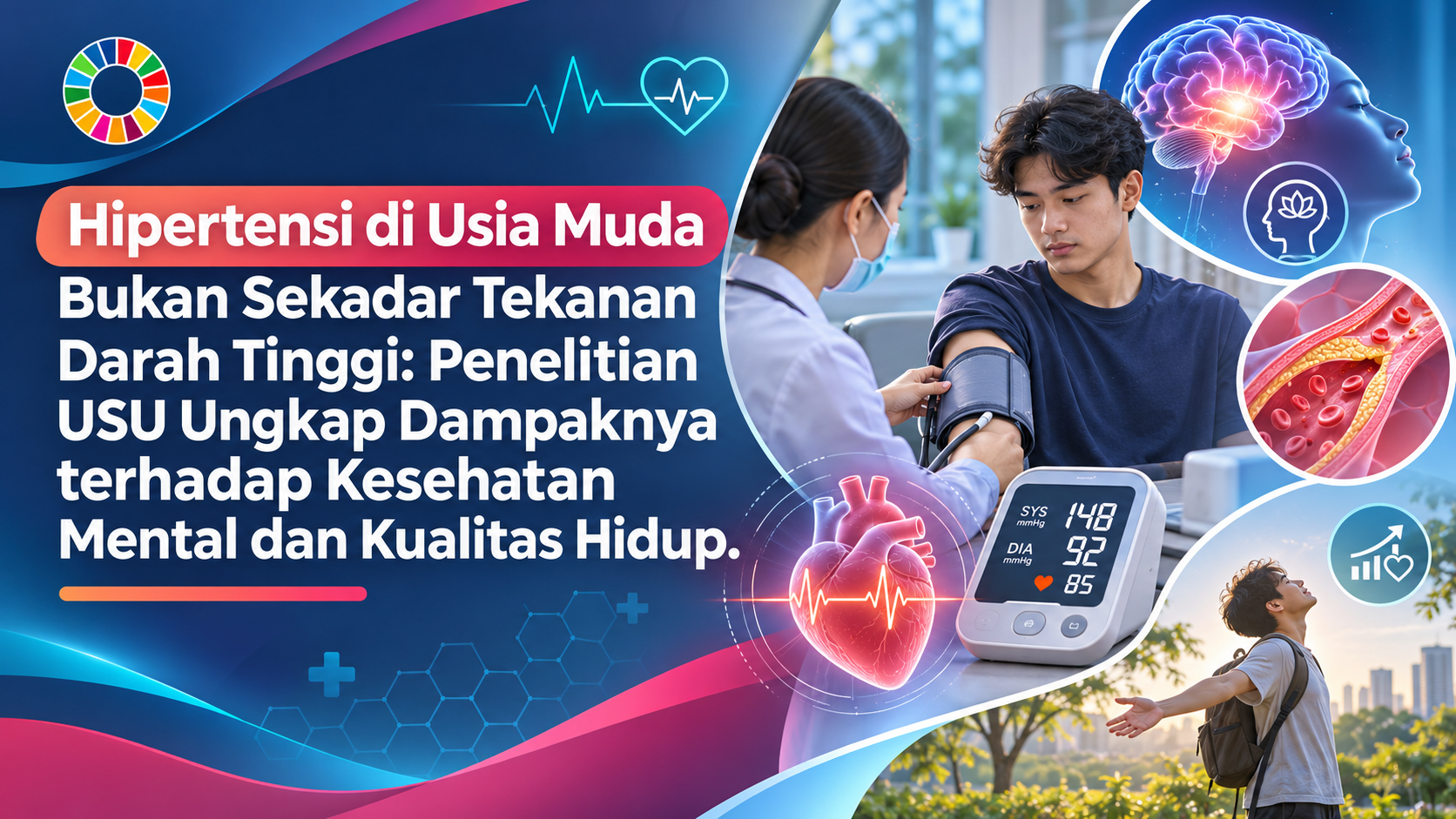
Hypertension has often been considered a disease that primarily affects older adults. However, this assumption needs to be reconsidered. High blood pressure can also affect young adults, even when they are still of productive age. The issue is that hypertension at a young age not only carries the risk of cardiovascular disorders but can also potentially affect psychological well-being and quality of life in the long term. Amid the demands of work, education, family, and economic circumstances, a hypertension diagnosis can become an additional burden that is not always immediately apparent.
This issue became the focus of researchers in a study entitled Identification of Mental Health Disorder Symptoms, Predisposing Factors and their Impact on Quality of Life in Young Hypertensive Patients: A Multicenter Longitudinal Study. Published in the Clinical Practice & Epidemiology in Mental Health journal in 2026, the study involved Elmeida Effendy, Mustafa Mahmud Amin, Vita Camellia, Rika Sarfika, Christantie Effendy, Tiasarah Aretha Sitepu, and Dewi Gita Maharani. The research team came from Universitas Sumatera Utara, Andalas University, and Gadjah Mada University. Through this study, the authors sought to identify symptoms of mental health disorders, factors associated with vulnerability to these conditions, and their impact on the quality of life of young patients with hypertension.
The study involved 791 respondents aged 18–45 who had been diagnosed with hypertension for at least six months. Data collection was conducted through outpatient clinics in several cities in Indonesia, including Yogyakarta, Padang, and Medan. The respondents' average age was 33 years, with a standard deviation of 10.14 years. Based on respondent characteristics, there were 457 men, or 57.8 percent, and 334 women, or 42.2 percent. In terms of employment, the unemployed group accounted for the largest proportion at 21.4 percent, followed by professionals at 18.1 percent and students at 15.2 percent.
To assess the respondents' psychological conditions, the researchers used the Depression Anxiety Stress Scale-21 (DASS-21). This instrument was used to identify symptoms of depression, anxiety, and stress. Meanwhile, quality of life was assessed using the World Health Organization Quality of Life-BREF (WHOQOL-BREF), which covers four aspects: physical health, psychological well-being, social relationships, and environment. The researchers also conducted semi-structured interviews to explore psychosocial factors associated with the respondents' mental health conditions, including family history, socioeconomic circumstances, and strategies for coping with life's pressures.
One of the important findings of this study was the negative relationship between the length of time a person had experienced hypertension and their quality of life. The analysis showed a correlation of r = -0.45 for overall quality of life, with a p-value of p < 0.001. This means that the longer a person lives with hypertension, the lower their reported quality of life. This relationship was also observed across various aspects of life. Psychological health showed a correlation of -0.40, physical health -0.35, environment -0.30, and social relationships -0.25. These findings illustrate that the effects of hypertension do not stop at physical health but can extend to social relationships and a person's perception of their living environment.
The mental health aspect also revealed equally important findings. The study found that the duration of hypertension was associated with increased symptoms of anxiety, depression, and stress. Anxiety showed a correlation of -0.42, depression -0.38, and stress -0.30, all with p-values of p < 0.001. In the researchers' interpretation, the negative direction of these correlations indicates that the longer a person experiences hypertension, the higher the level of psychological distress symptoms they report. Anxiety was the symptom with the strongest association compared with depression and stress.
Anxiety among young patients with hypertension may be associated with various concerns in their daily lives. Some patients may worry about possible complications, the need to take medication over the long term, or uncertainty about their future health conditions. On the other hand, economic pressures, work demands, family conflicts, and limited social support can intensify psychological distress. This study identifies socioeconomic and psychosocial factors as important aspects that need to be considered when understanding the mental health vulnerabilities of patients with hypertension.
The study's discussion also highlights the possible influence of childhood experiences on cardiovascular health as individuals enter adulthood. Difficult family economic conditions, family conflicts, and stressful life experiences can leave long-term psychological effects. Early exposure to stress may affect behavioral patterns, problem-solving abilities, and the body's physiological responses to pressure. Nevertheless, these factors should be understood as contextual elements and possible risk pathways, rather than cause-and-effect relationships directly established by this study.
These findings carry an important message for healthcare services. So far, hypertension management has generally focused on blood pressure measurement, medication, dietary regulation, and lifestyle changes. However, this study shows that such an approach needs to be complemented by attention to patients' mental health. Regular screening for symptoms of anxiety, depression, and stress can help healthcare professionals identify psychological issues that patients may not spontaneously disclose. Counseling, health education, strengthening family support, and multidisciplinary approaches can also become part of more comprehensive hypertension management.
Although it provides important insights, this study has several limitations. Its observational and correlational design means that the findings cannot establish a cause-and-effect relationship between hypertension duration, psychological symptoms, and declining quality of life. Respondents were also recruited from outpatient clinics in several cities, meaning that the results may not represent all population groups, particularly residents of rural areas or those who do not regularly access healthcare services. In addition, mental health was measured using self-administered questionnaires rather than structured psychiatric diagnostic interviews, meaning that the results indicate psychological symptoms and do not automatically establish a diagnosis of a mental disorder.
Ultimately, this study reminds us that hypertension at a young age is a health issue that requires more comprehensive management. Treatment success should not be measured solely by controlled blood pressure readings but also by patients' ability to live with better physical and psychological health. Integrating mental health assessments into hypertension services is an important step toward improving patients' quality of life. Thus, attention to mental health is not merely an addition to treatment but an essential part of efforts to build healthier and more prosperous lives.
Key Research Points
The study involved 791 hypertensive patients aged 18–45 from several healthcare centers in Indonesia.
The respondents' average age was 33 ± 10.14 years, with 57.8 percent men and 42.2 percent women.
The study used DASS-21 to measure symptoms of depression, anxiety, and stress, and WHOQOL-BREF to assess quality of life.
The duration of hypertension was negatively correlated with overall quality of life (r = -0.45; p < 0.001).
Negative correlations were also found in psychological health (r = -0.40), physical health (r = -0.35), environment (r = -0.30), and social relationships (r = -0.25).
The duration of hypertension was associated with increased symptoms of anxiety (r = -0.42), depression (r = -0.38), and stress (r = -0.30), all with p < 0.001.
Anxiety showed the strongest association with hypertension duration compared with depression and stress.
Socioeconomic and psychosocial factors are important aspects in understanding patients' mental health conditions.
The study recommends integrating mental health screening and psychosocial interventions into routine hypertension services.
The study's correlational design cannot establish cause-and-effect relationships, and its findings need to be further developed through subsequent research.
Author
Khairul Azmi
Source/Researcher
Prof. Dr. dr. Elmeida Effendy, M.Ked(KJ), Sp.KJ(K)