


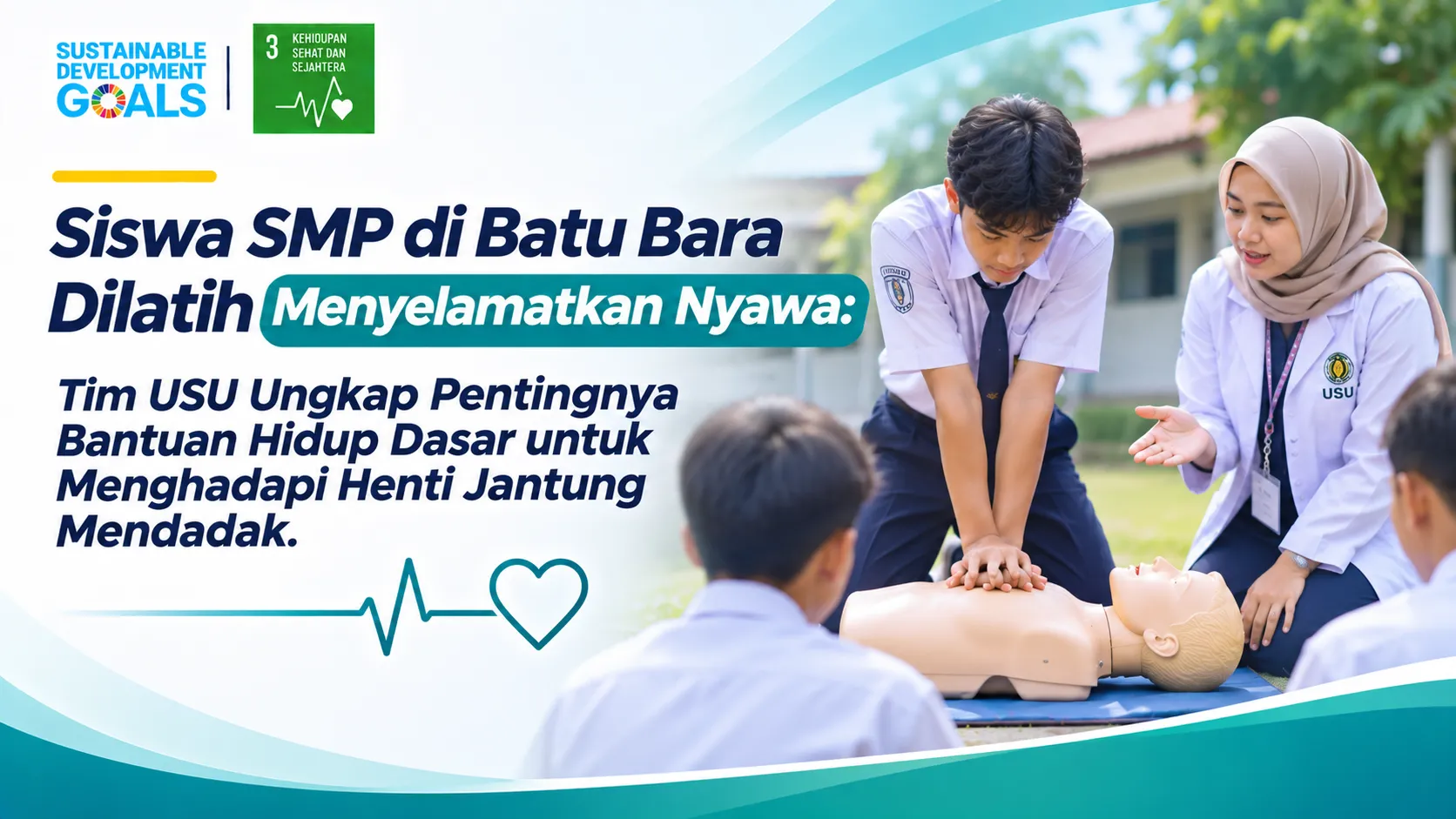
When someone suddenly loses consciousness due to cardiac arrest, every second is extremely valuable. Assistance provided before medical personnel arrive can affect a person's chances of survival. However, limited public knowledge of life-saving procedures often causes this opportunity to be missed. In response to this challenge, a team from the Faculty of Medicine, Universitas Sumatera Utara (USU), conducted Basic Life Support training for students of SMP Negeri 1 Tanjung Tiram, Batu Bara Regency, North Sumatra.
The activity was published in Jurnal Medika: Medika in 2026 through an article entitled “Basic Life Support Training Improves the Knowledge and Skills of Junior High School Students in Batubara.” The program involved Ester Lantika Ronauli Silaen, Noni Novisari Soeroso, Dharma Lindarto, Delfitri Munir, and Oke Rina Ramayani from Universitas Sumatera Utara, with a focus on introducing first aid skills to junior high school students.
Sudden cardiac arrest is an emergency condition in which the heart stops pumping blood effectively. As a result, the flow of oxygen to the brain and vital organs is disrupted. Without prompt assistance, this condition can cause permanent organ damage and even death.
In their publication, the authors explained that Out-of-Hospital Cardiac Arrest (OHCA) remains a global health problem with a low survival rate.
In Indonesia, the journal estimates that OHCA occurs at approximately 30 cases per 10,000 people, with a survival rate of around eight percent. This situation illustrates the significant need to improve community preparedness in responding to emergencies.
One factor that can influence a victim's survival is the presence of people near the incident who understand first aid procedures. They are often referred to as lay rescuers, namely members of the public who are not professional healthcare workers but possess basic knowledge to provide initial assistance.
In cardiac arrest situations, such assistance may include recognizing the victim's condition, activating emergency services, and performing cardiopulmonary resuscitation according to their abilities and training.
Cardiopulmonary resuscitation (CPR) is a procedure intended to help maintain blood flow when the heart is unable to function effectively. Chest compressions are an important component because they help circulate blood to the brain and vital organs while awaiting further medical treatment.
Although these skills are very important, not everyone has the opportunity to receive training. As a result, some people feel afraid, panic, or hesitate to take action when witnessing someone experiencing an emergency.
This issue prompted the USU team to introduce Basic Life Support to school students. According to the authors, students are a potential target group for education because they are capable of learning new skills while also sharing information with their families and peers.
The activity was centered at SMP Negeri 1 Tanjung Tiram, Sukamaju Village, Tanjung Tiram District, Batu Bara Regency. The area was selected as a community empowerment site to expand the dissemination of medical knowledge within the community.
The program used a single-group pre-post intervention approach conducted over one day. The activities were designed to combine theoretical explanations, demonstrations, and hands-on practice so that students would not only understand the concepts but also gain initial experience in performing life-saving procedures.
The first stage involved coordination with the school and participant recruitment. The team then identified students' initial understanding of heart disease, the signs of cardiac arrest, and how to provide assistance.
Initial observations indicated that students' knowledge of Basic Life Support was still limited. Some participants did not yet understand the causes of cardiac arrest, the signs to recognize, or the initial steps that could be taken before medical assistance arrived.
Based on these conditions, the team prepared educational materials covering the definition of Basic Life Support, the causes and signs of cardiac arrest, the importance of a rapid response, and the basic steps of cardiopulmonary resuscitation.
The materials were delivered through lectures by the Faculty of Medicine, USU team. To facilitate understanding, students were also provided with educational pamphlets explaining the concepts and stages of first aid.
Through this approach, participants were introduced to the principle that initial assistance must be provided promptly, safely, and appropriately. Recognizing the victim's condition is an important step before determining the next course of action.
The activity then continued with a practical session using mannequins, which are human-shaped training devices designed for medical practice.
The use of mannequins allowed students to learn hand positioning and chest compression techniques without endangering others. Participants had the opportunity to observe demonstrations and practice the skills explained by the instructors.
The training also covered the recognition of compression and ventilation cycles in the context of the exercise. Through this simulation, students could understand that resuscitation requires coordination, proper technique, and awareness of the victim's condition.
One interesting finding emerged during the discussion session. Before the training, students' knowledge of Basic Life Support was considered very limited. After receiving the educational materials, students began asking more critical questions about the mechanisms and benefits of life-saving procedures.
The questions raised included those concerning the benefits of Basic Life Support and the possibility of the heart resuming its function after resuscitation is performed.
According to the discussion in the journal, the change in the quality of the questions indicated that participants were beginning to understand the concepts more deeply rather than merely memorizing the information presented.
Students were also introduced to the understanding that chest compressions aim to maintain blood circulation, particularly to the brain, when the heart's pumping function is impaired. This procedure does not guarantee that the heart will immediately resume beating normally.
In addition to improving understanding, the practical activities provided students with new experiences in responding to emergency simulations. Participants were able to practice applying the skills under supervision, with the expectation that they would be better prepared to face similar situations.
The authors considered hands-on practice to play an important role in building confidence. Fear and a lack of confidence often become barriers that prevent people from providing first aid.
Through safe training experiences, students gained an understanding of the actions required when someone needs emergency assistance. However, these skills still require repeated practice to be maintained.
The program also introduced the concept of the Chain of Survival, a series of interconnected responses that improve the chances of survival for cardiac arrest victims.
This chain emphasizes the importance of early recognition, activation of emergency services, high-quality CPR, early defibrillation when available and indicated, and advanced medical care.
In the context of community education, this knowledge can equip students to recognize emergencies and promptly seek appropriate assistance.
Although it demonstrated positive developments, this study has limitations. The evaluation of its success was primarily based on qualitative observations of students' participation, questions, and engagement throughout the activities.
The publication did not present quantitative data on knowledge scores before and after the training or skill measurements using standardized assessment instruments. Therefore, the extent of improvement in students' abilities cannot yet be determined numerically.
Furthermore, the activity lasted only one day and did not involve long-term evaluation. The study could not establish how well students retained their skills or applied them in actual emergency situations.
Nevertheless, the training provides an overview of the potential of schools as community-based first aid education centers.
The USU team recommends that the Basic Life Support program be developed sustainably through regular training activities and integration into school education.
Collaboration among universities, educational institutions, healthcare workers, and youth organizations is also considered important for expanding the reach of training to the wider community.
Ultimately, the activity at SMP Negeri 1 Tanjung Tiram demonstrates that life-saving skills can begin to be introduced at school age. With proper education and repeated practice, the younger generation has the potential to become part of a first aid system that is more responsive to emergencies.
This effort also supports the achievement of the third Sustainable Development Goal (SDG 3), namely ensuring healthy lives and promoting well-being for all, through strengthening health education, community preparedness, and the ability to respond to medical emergencies.
Research Key Points:
Basic Life Support training was conducted by a team from the Faculty of Medicine, USU, at SMP Negeri 1 Tanjung Tiram, Batu Bara Regency, North Sumatra.
The program aimed to improve students' knowledge, engagement, and basic skills in responding to out-of-hospital cardiac arrest.
The journal states that the estimated incidence of OHCA in Indonesia is approximately 30 cases per 10,000 people, with a survival rate of around 8%.
The activity was conducted using a single-group pre-post intervention approach over one day.
The materials covered cardiac arrest recognition, emergency signs, the concept of Basic Life Support, and the principles of cardiopulmonary resuscitation.
Participants received education through lectures, pamphlets, demonstrations, discussions, and mannequin-based practice.
After the training, students demonstrated improved understanding qualitatively through more critical questions and engagement during practical sessions.
Hands-on practice provided initial experience in learning chest compression techniques and basic first aid procedures.
The study did not present quantitative data on improved scores, so the extent of changes in knowledge and skills could not be measured numerically.
The authors recommend regular training, the integration of BLS into school education, and collaboration between universities and communities to expand emergency preparedness.
Author
Khairul Azmi
Source/Researcher
dr. Ester Lantika Ronauli Silaen, M.Ked(An), SpAn-TI, Subsp.TI (K)