


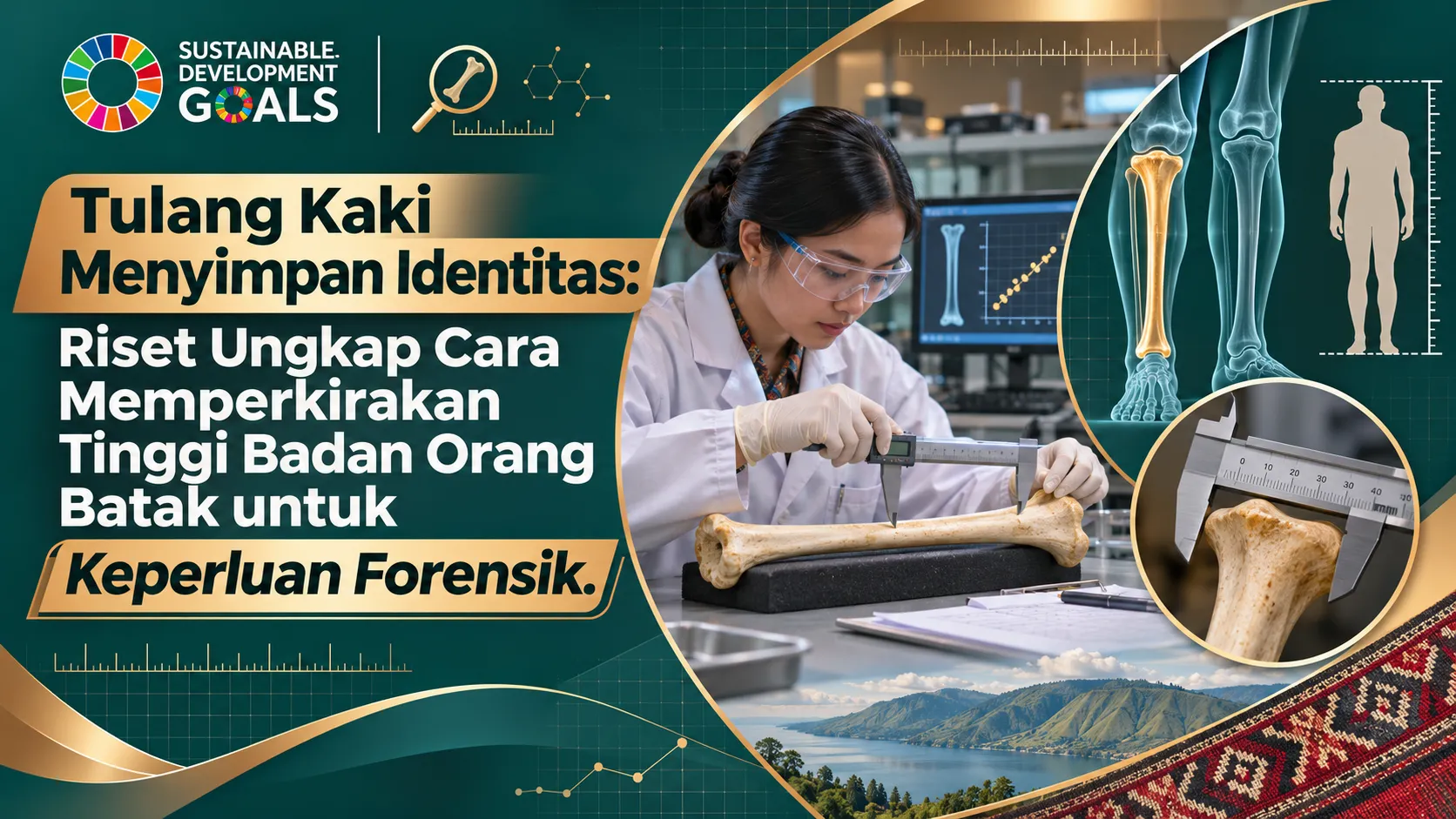
How can someone be identified when their identity is unknown and their body is no longer intact? In forensic medicine, the answer to this question is often preserved in seemingly simple parts of the body, including the leg bones. By measuring the length of the shinbone, or tibia, a person's height can apparently be estimated using a scientific approach. This potential is revealed in research on the anthropometric characteristics of Batak adults in North Sumatra.
The study, entitled Anthropometric Estimation of Height from Tibial Length in Batak Adults: A Cross-Sectional Study, was published in the journal Public Health of Indonesia, Volume 12, Number 3, in 2026. The study, conducted by Asan Petrus, Mega Sari Sitorus, and Jessy Chrestella from the Faculty of Medicine, Universitas Sumatera Utara (USU), developed a mathematical model to estimate height based on tibia length among young adults of Batak ethnicity.
In human identification, height is one of the important components used to establish a person's biological profile. This information can help narrow down possible identities when complete data are unavailable. Along with estimated age, sex, and other characteristics, height is part of forensic anthropology examinations used in medical and legal investigations.
However, direct height measurement is not always possible. In cases involving severe accidents, natural disasters, fires, or bodies that have suffered damage, the condition of the body may prevent complete measurement. In such situations, long bones such as the tibia can provide information for estimating a person's height.
Indonesia is vulnerable to various disasters, including earthquakes, tsunamis, landslides, and transportation accidents. This makes the development of victim identification methods an important need in forensic medical services. Accurate identification is not only related to scientific processes but also has humanitarian implications for victims' families.
Tibia length has long been known to have a relationship with height. Biologically, the size of long bones contributes to human body proportions. Nevertheless, this relationship is not always the same across population groups because it is influenced by genetic variation, environmental factors, growth, and anthropometric characteristics.
Problems arise when height estimation formulas developed for a particular population are applied to another group without considering differences in body characteristics. This approach has the potential to produce estimation errors that may reduce the accuracy of forensic analysis.
For this reason, the study focused on the Batak ethnic group, one of the communities with a large population in North Sumatra. The researchers sought to develop regression equations better suited to the group's anthropometric characteristics while comparing predictive performance by sex.
The study used an analytical cross-sectional design involving 52 Batak respondents aged 21–25. All participants had Batak ancestry from both parents and met the requirements for anthropometric examination. The research was conducted at Haji Adam Malik Central General Hospital, Medan, with measurements reported to have taken place in 2024.
Of all the participants, 18 were men and 34 were women. The researchers measured height and right and left tibia lengths using standardized anthropometric instruments. Measurements were repeated to reduce the possibility of errors and improve consistency of the results.
Descriptive analysis showed that the average height of male respondents was 167.2 cm, while that of female respondents was 158.3 cm. The average right tibia length in men was 36.5 cm and the left tibia length was 36.7 cm. Among women, the average right tibia length was 34.6 cm and the left tibia length was 34.7 cm.
These differences indicate variations in body size between male and female respondents. This characteristic is one important reason for developing estimation equations that account for sex rather than using a single formula for the entire population.
Statistical analysis found a significant positive relationship between tibia length and height. This means that individuals with longer tibias tend to have greater height within the study group. However, the strength of the relationship varied according to sex and the combination of measurements used.
Among women, combining right and left tibia lengths produced a very strong correlation, with a value of r=0.949. Meanwhile, the combined correlation among men was r=0.961. Both results indicate that shinbone length has a strong relationship with height among the respondents studied.
Nevertheless, a strong correlation does not automatically mean that height predictions will always be accurate. To evaluate estimation performance, the researchers developed several linear regression equations and calculated their estimation error rates.
An interesting finding emerged in the female group. The model combining right and left tibia lengths produced an adjusted R² value of 78.9% and a Standard Error of Estimate (SEE) of 2.65 cm. This value indicates that the model was able to explain most of the variation in height in the study data, with a relatively smaller estimation error compared with the other models.
Among men, the combined model produced an adjusted R² of 58.4% and an SEE of 3.65 cm. The difference in predictive performance indicates that the relationship between shinbone length and height is not entirely identical between the two sex groups.
These findings reinforce the importance of using anthropometric models suited to population characteristics. In a forensic context, a difference of several centimeters can affect the match between an estimated biological profile and information about a person's identity.
The researchers also cautioned that combining right and left tibia measurements requires careful interpretation. Both measurements come from anatomically related body structures, so a very strong relationship may create statistical issues if not analyzed appropriately.
In addition, the study had limitations, including a relatively small number of respondents and an age range restricted to 21–25 years. Selecting participants from a particular location also limits the ability of the findings to represent all Batak communities across different regions.
Therefore, the equations developed cannot yet be considered universal standards for all age groups or all Batak subgroups. Further testing involving a larger number of participants, a more balanced sex distribution, and greater regional variation is needed to strengthen the model's accuracy.
Nevertheless, this research contributes to the development of an Indonesian anthropometric database that takes population diversity into account. The information has the potential to support disaster victim identification, forensic medical examinations, and the development of anatomical and ergonomic research.
Through accurate scientific measurements and analysis, bones can preserve important clues about a person's characteristics. By examining shinbone length, forensic science gains an opportunity to help uncover human identities, even when other information is difficult to find.
Key Research Points:
The study used an analytical cross-sectional design involving 52 young adult Batak respondents aged 21–25 in North Sumatra.
Participants consisted of 18 men and 34 women, with measurements of height and right and left tibia lengths.
The average height of male respondents was 167.2 ± 5.65 cm, while that of female respondents was 158.3 ± 5.76 cm.
The average right and left tibia lengths in men were 36.5 cm and 36.7 cm, respectively, while those in women were 34.6 cm and 34.7 cm.
The analysis found a significant positive relationship between tibia length and height across all measurement groups (p≤0.002).
The combined correlation of right and left tibia lengths among women reached r=0.949, while that among men was r=0.961, indicating a very strong relationship.
The combined right and left tibia regression model for women showed the highest predictive ability, with an adjusted R² of 78.9% and an SEE of 2.65 cm.
The combined regression model for men produced an adjusted R² of 58.4% and an SEE of 3.65 cm.
Differences in results between sexes demonstrate the importance of developing height estimation equations that account for the biological and anthropometric characteristics of populations.
The combined use of right and left tibia measurements requires caution because of the potential for multicollinearity, which may affect regression model stability.
Study limitations include a small sample size, a restricted age range, and the absence of validation in a broader Batak population.
The research supports the development of an Indonesian forensic anthropometric database and has the potential to assist in disaster victim identification and medicolegal investigations.
The research contributes to SDG 3 through the development of forensic medical science and SDG 16 by supporting human identification processes and legal certainty.
Writer
Khairul Azmi
Source/Researcher
Dr. dr. Asan Petrus, M.Ked(For), Sp.F