


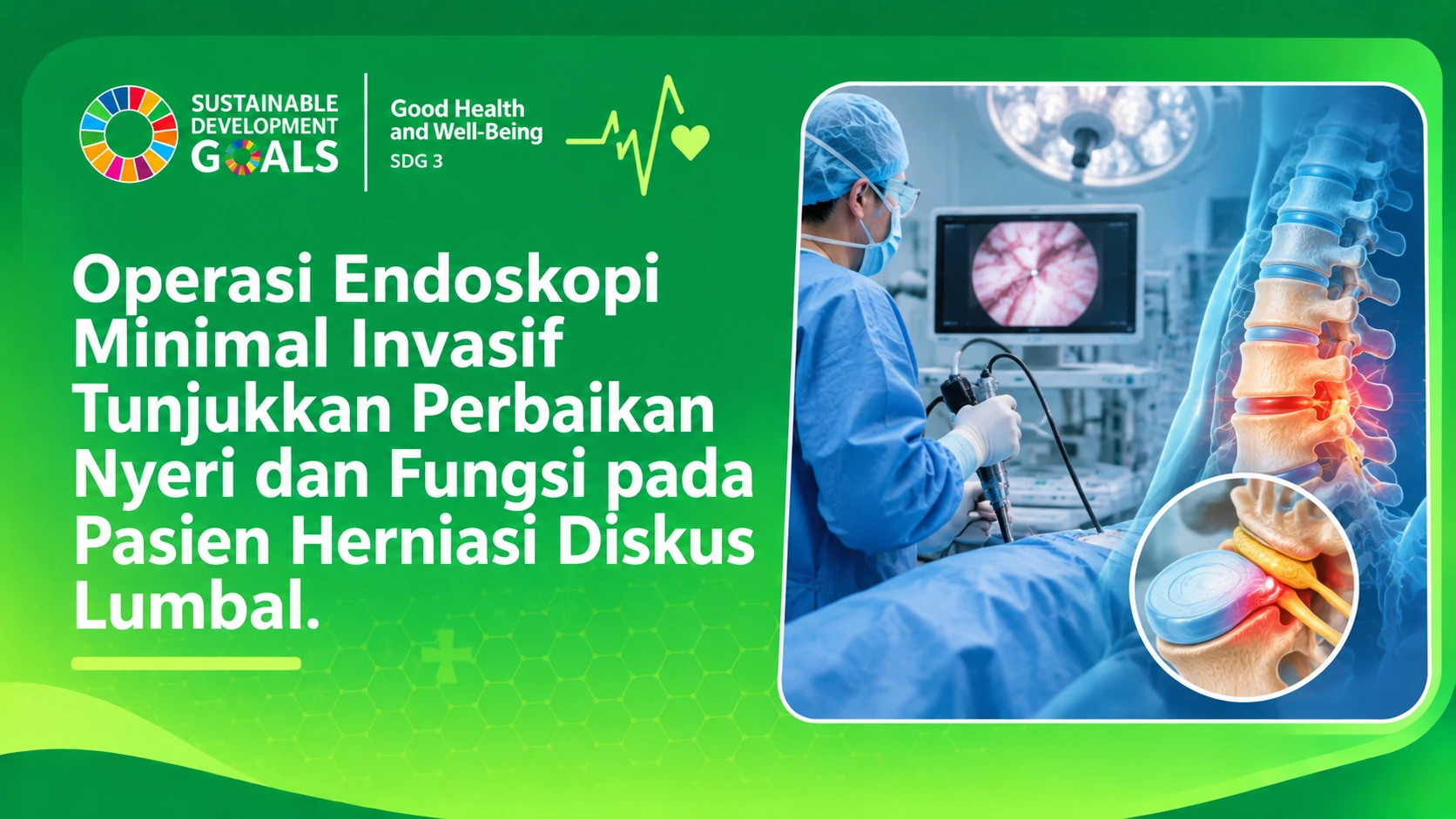
Lower back pain that radiates to the legs can be a sign of lumbar disc herniation, a condition in which the cushion between the vertebrae protrudes and presses against the nerve roots. Treatment usually begins with conservative therapy. However, in patients with persistent pain or neurological disorders, surgery may be considered to relieve pressure on the nerves.
One of the available surgical options is Percutaneous Endoscopic Interlaminar Discectomy (PEID), a minimally invasive spinal surgery technique that uses an endoscope through the interlaminar space. This technique allows doctors to visualize the disc area and remove fragments pressing on the nerves through a small incision. With targeted access, the procedure is intended to minimize disruption to the muscles and normal structures surrounding the spine.
The experience of implementing PEID at Haji Adam Malik General Hospital, Medan, was reported in a study entitled “Percutaneous Endoscopic Interlaminar Discectomy for Lumbar Disc: Early Experience, Outcome and Complication: A Retrospective Observational Study With a Pre–Post Design”. The study was authored by Sabri Ibrahim, Muhammad Deni Nasution, and Muhammad Fahmi Rasyid from University of North Sumatera. The article was posted on Research Square on July 13, 2026, with DOI 10.21203/rs.3.rs-10317745/v1. This study evaluated changes in patients' pain intensity and physical function before and after undergoing PEID.
The researchers used a retrospective observational design with measurements taken before and after the procedure. The data came from 41 adult patients who underwent PEID for single-level lumbar herniated nucleus pulposus at Haji Adam Malik General Hospital between January 1, 2020, and December 31, 2024. Patients diagnosed with discitis, a history of spinal fractures, or radiologically confirmed spinal instability were excluded. All patients underwent surgery at a single spinal level. The procedures were performed by the same surgeon and monitored by the same spinal surgery team.
Clinical success was assessed using two instruments. The Visual Analog Scale (VAS) was used to measure pain intensity, while the Oswestry Disability Index (ODI) assessed functional limitations caused by spinal problems. Preoperative scores were compared with scores obtained three months after surgery. Complication records were reviewed from medical records. During the procedure, patients received general anesthesia and prophylactic antibiotics. The doctor made an incision of approximately 10 millimeters, inserted an endoscopic working sheath through the interlaminar space, and then removed the herniated disc fragment. The remaining disc tissue was treated using radiofrequency coagulation. The entire process was performed under endoscopic visualization to examine the space around the nerve roots.
Of the 41 patients, 21 (51.2 percent) were male and 20 (48.8 percent) were female. The average patient age was 40.37 years, with a standard deviation of 13.48 years. The most common location of herniation was at the L4/L5 level, involving 15 patients (36.6 percent). Herniation at the L3/L4 and L5/S1 levels was each found in 13 patients (31.7 percent). The average operating time was 56.34 minutes, with a standard deviation of 10.49 minutes.
The measurements showed a reduction in pain scores after surgery. The average preoperative VAS score was 7.68, while the postoperative score decreased to 5.34. This difference was statistically significant, with a p-value of 0.001. These findings indicate that patients in the study group experienced reduced pain intensity after undergoing PEID. Nevertheless, the average postoperative score still indicates that some patients experienced pain. Therefore, these results are more appropriately interpreted as an improvement compared with the initial condition, rather than meaning that all patients became completely pain-free.
Improvements were also observed in ODI scores. The average preoperative score was 57.07, which then decreased to 21.95 during the postoperative evaluation. This difference was also statistically significant, with a p-value of 0.001. The decrease in ODI scores indicates reduced activity limitations associated with spinal conditions. In other words, the observed changes were not only related to pain but also involved aspects of patients' physical function. These two findings formed the basis for the researchers' conclusion that PEID has the potential to help reduce pain and improve functional ability in patients with lumbar disc herniation.
In terms of safety, 39 patients (95.1 percent) experienced no recorded complications. Two patients (4.9 percent) experienced durotomy, a tear in the membrane surrounding the nerves. The article describes the management of these complications, which involved using a smaller-diameter endoscope, suctioning fluid and blood, and applying an autologous muscle graft combined with fibrin glue. The occurrence of these two cases confirms that minimally invasive techniques still carry risks and require surgeons to be prepared to recognize and manage complications.
In their discussion, the researchers presented PEID as one of the minimally invasive alternatives for treating lumbar disc herniation. This approach provides direct access through the interlaminar window and can reduce the need for extensive paravertebral muscle dissection, as performed in conventional open surgery. The literature discussed in the article also indicates that interlaminar and transforaminal approaches can produce comparable clinical outcomes under certain conditions. The choice of technique must still take into account the location, type, and direction of disc fragment migration, as well as the patient's anatomy. Thus, PEID is not a procedure that is automatically suitable for every case of disc herniation.
The study was conducted retrospectively at a single hospital and involved 41 participants. There was no comparison group undergoing open surgery or another endoscopic technique, so the results cannot be used to claim that PEID is superior to other procedures. The follow-up period was also relatively short, at three months, meaning that the study did not evaluate recurrence or the sustainability of functional improvements over the long term. The retrospective design also allows for the possibility of selection bias and confounding factors that cannot be fully controlled.
The researchers recommend further studies with prospective designs, larger sample sizes, participation from multiple healthcare centers, and longer follow-up periods. Subsequent studies are also needed to assess recurrence, long-term outcomes, and comparisons between PEID and other surgical options. Overall, the initial experience at Haji Adam Malik General Hospital demonstrated significant reductions in VAS and ODI scores following the procedure, with two recorded cases of durotomy complications. These results support PEID as one of the treatment options for lumbar disc herniation, while emphasizing the need for patient selection, surgical expertise, and further evidence before broader conclusions can be drawn.
Key Research Points:
The study involved 41 adult patients with single-level lumbar disc herniation who underwent PEID at Haji Adam Malik General Hospital, Medan, during the 2020–2024 period.
The most common level of herniation was L4/L5, involving 15 patients (36.6 percent).
The average operating time was 56.34 ± 10.49 minutes.
The average VAS pain score decreased from 7.68 to 5.34 after surgery (p=0.001).
The average ODI score decreased from 57.07 to 21.95 (p=0.001), indicating improved physical function.
A total of 39 patients (95.1 percent) experienced no recorded complications; two patients (4.9 percent) experienced durotomy.
The study concluded that PEID can be one of the treatment options for lumbar disc herniation.
Study limitations included a retrospective design, limited sample size, a single research center, the absence of a comparison group, and a three-month follow-up period.
Author
Khairul Azmi
Resource Person/Researcher
Dr. dr. Sabri, M.Ked(Neurosurg), Sp.BS(K)