


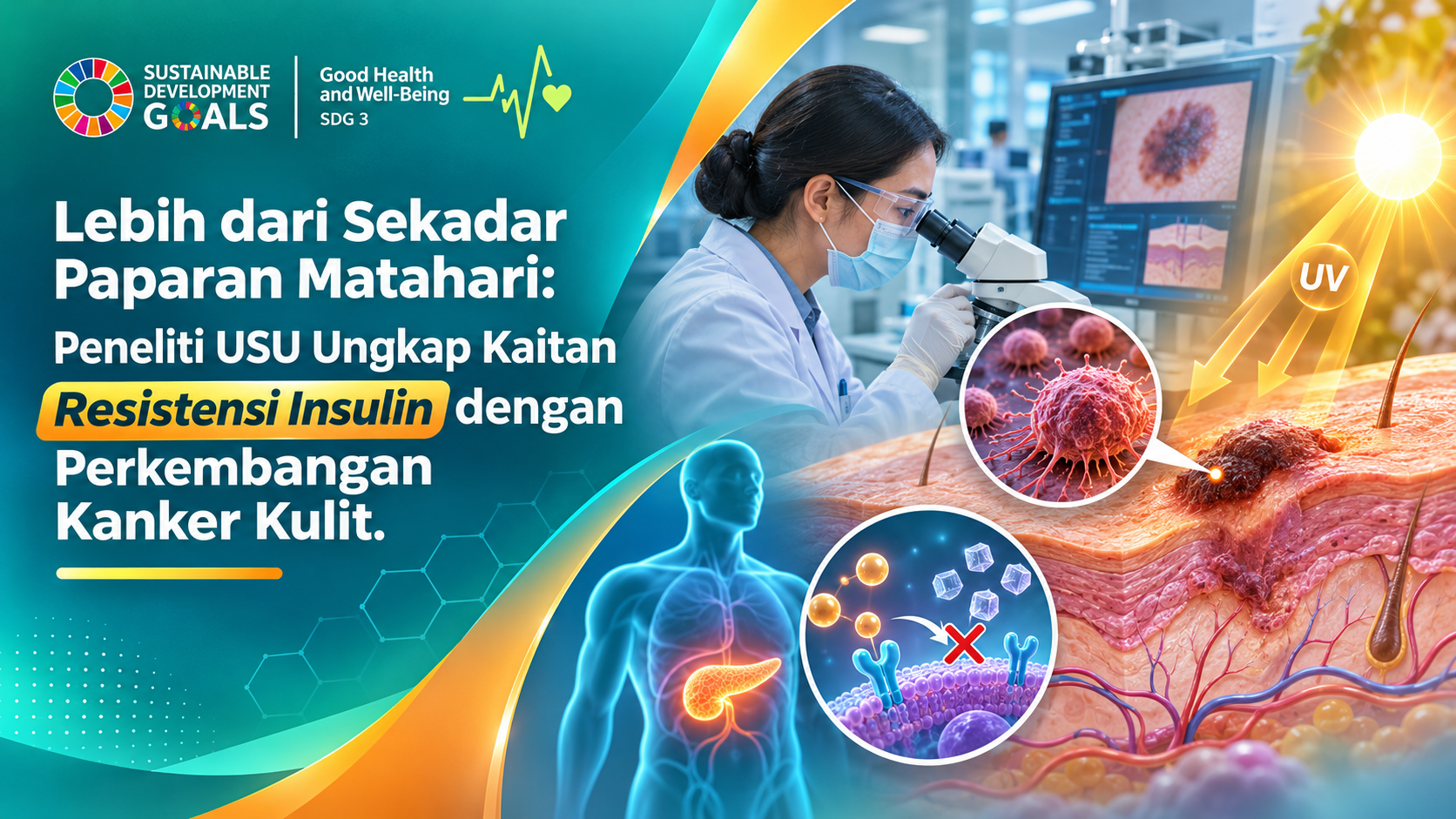
Skin cancer is often associated with exposure to ultraviolet (UV) radiation, particularly due to prolonged exposure to sunlight. However, a scientific review by researchers from Universitas Sumatera Utara (USU) invites readers to consider another factor that may also influence the course of this disease: insulin resistance. Through an article entitled Insulin Resistance and Cutaneous Squamous Cell Carcinoma: A Narrative Review of Molecular Mechanisms, the researchers explain how metabolic disorders can create biological conditions that support the emergence and development of cutaneous squamous cell carcinoma (cSCC).
cSCC is a type of skin cancer that originates from keratinocytes, the main cells that make up the outermost layer of the skin. cSCC accounts for approximately 20 percent of all keratinocyte carcinomas, with global incidence estimated to have increased by 345 percent since 1990. Although it is often considered less aggressive than melanoma, cSCC can still cause serious morbidity and accounts for most deaths among keratinocyte cancers. When detected early, the five-year survival rate can reach 99 percent. However, once the cancer has spread, this rate drops to less than 50 percent.
So far, UV radiation has been recognized as the main environmental factor triggering cSCC. However, the relationship between diabetes and skin cancer has also long been observed. The authors highlight insulin resistance (IR) as a possible independent driver, even in individuals who have not yet been diagnosed with diabetes. Insulin resistance occurs when the body's cells respond less effectively to insulin. As a result, blood sugar regulation is disrupted, and the body may produce more insulin as compensation. This elevated insulin level is one of the key factors in the mechanisms discussed.
According to the review, excess insulin, or hyperinsulinemia, can activate the insulin-like growth factor-1 receptor (IGF-1R). This receptor activation then triggers two signaling pathways within cells, namely MAPK/ERK and PI3K/Akt. When the activity of both pathways increases excessively, keratinocytes are driven to continue proliferating, while apoptosis is suppressed.
The MAPK/ERK pathway promotes the activity of transcription factors that increase the expression of cyclin D1 and the cell cycle regulatory proteins CDK4/6. This sequence accelerates cell division. The PI3K/Akt pathway can also inhibit proteins that promote apoptosis, including FOXO factors, which activate pro-apoptotic genes such as BIM and PUMA.
The problem does not stop at growth signals. Insulin resistance is also frequently accompanied by hyperglycemia, a condition in which blood glucose levels are high. Glucose can form advanced glycation end products (AGEs), which bind to the RAGE receptor and trigger the production of reactive oxygen species (ROS). ROS accumulation causes oxidative stress and DNA damage, thereby increasing genomic instability.
The review also highlights the p53 protein, which functions as one of the guardians of a cell's genetic integrity. Under normal conditions, p53 helps stop the cell cycle or trigger apoptosis when DNA is damaged. However, oxidative stress and changes in signaling pathways can disrupt the function of this tumor suppressor. The article summarizes findings from previous studies reporting TP53 alterations in various cases of cSCC. Changes in other genes, including HRAS and CDKN2A, can also support uncontrolled cell growth.
The next mechanism is related to chronic inflammation. ROS and AGEs can activate NF-κB, a major regulator of the inflammatory response. Prolonged activation promotes the production of cytokines such as interleukin-6 (IL-6) and tumor necrosis factor-alpha (TNF-α). These two molecules can strengthen signals that support the growth and survival of cancer cells. IL-6 is also associated with increased matrix metalloproteinases (MMPs), enzymes that break down the extracellular matrix. When the supporting tissue is degraded, cancer cells can more easily penetrate surrounding tissues.
TNF-α, on the other hand, can increase the expression of vascular endothelial growth factor (VEGF), which plays a role in the formation of new blood vessels. These blood vessels supply oxygen and nutrients to tumor tissue. Changes in the environment surrounding the tumor, or the tumor microenvironment, also involve immune cells and fibroblasts. Some of the evidence summarized by the authors indicates that factors such as TGF-β can promote changes in supporting tissue, invasion, and resistance to certain therapies.
The disease process may begin with actinic keratosis (AK), a precancerous skin lesion associated with UV exposure, which can then develop into invasive cSCC. The article mentions a ten-year follow-up study that found a cumulative cSCC incidence of 17.1 percent among people with AK, compared with 5.7 percent in the control group. This finding underscores the importance of monitoring precancerous lesions. UV radiation remains the main risk factor, while IR is discussed as an additional pathway that may contribute.
From a clinical perspective, the authors consider that understanding these mechanisms could open opportunities for research into therapies targeting more than one pathway. Metformin, for example, is discussed because of its potential to influence IGF-1R signaling and the NF-κB inflammatory response. Other strategies mentioned include approaches to reduce oxidative stress, inhibit inflammatory mediators, or target molecules involved in tumor invasion. However, these are research implications, not recommendations for using medication to prevent or treat skin cancer.
The authors also emphasize that knowledge gaps remain. The chronological relationship between hyperinsulinemia and inflammation is not yet fully clear. The roles of changes in the gut microbiome, microbial metabolites, and the effects of diet and physical activity on cSCC molecular pathways in individuals with insulin resistance still need to be investigated. Longitudinal research, multi-omics approaches, and organoid models are needed to examine these relationships.
Ultimately, this review broadens the perspective on skin cancer by placing metabolic health within the scientific discussion. Its main message is not that insulin resistance definitely causes cSCC, but that hyperinsulinemia, hyperglycemia, oxidative stress, and inflammation may be interconnected within an environment that supports tumor development. A better understanding of these relationships could help researchers identify new biomarkers and therapeutic targets. While evidence continues to develop, early detection of skin lesions, awareness of UV exposure, and management of metabolic health remain important parts of a comprehensive approach to health. For the public, this review also serves as a reminder that skin cancer needs to be understood through multiple factors, rather than a single cause. Monitoring skin changes and consulting healthcare professionals remain important, especially when non-healing wounds or changing lesions appear.
Key Research Points:
The article is a narrative review discussing the molecular mechanisms linking insulin resistance and cutaneous squamous cell carcinoma (cSCC).
Hyperinsulinemia can activate IGF-1R and the MAPK/ERK and PI3K/Akt pathways, which promote cell proliferation and suppress apoptosis.
Hyperglycemia promotes the formation of AGEs and RAGE activation, which are associated with ROS production and DNA damage.
NF-κB activation can increase inflammatory cytokines, including IL-6 and TNF-α, and support changes in the tumor microenvironment.
MMPs play a role in the degradation of the extracellular matrix, which can facilitate cancer cell invasion.
Metformin and several molecular targets are discussed as research opportunities, not clinical treatment recommendations.
Further research is needed to clarify causal relationships, the role of the microbiome, and the effects of lifestyle interventions.
Author
Khairul Azmi
Source/Researcher
Dr. dr. Dedi Ardinata, M.Kes, AIFM