


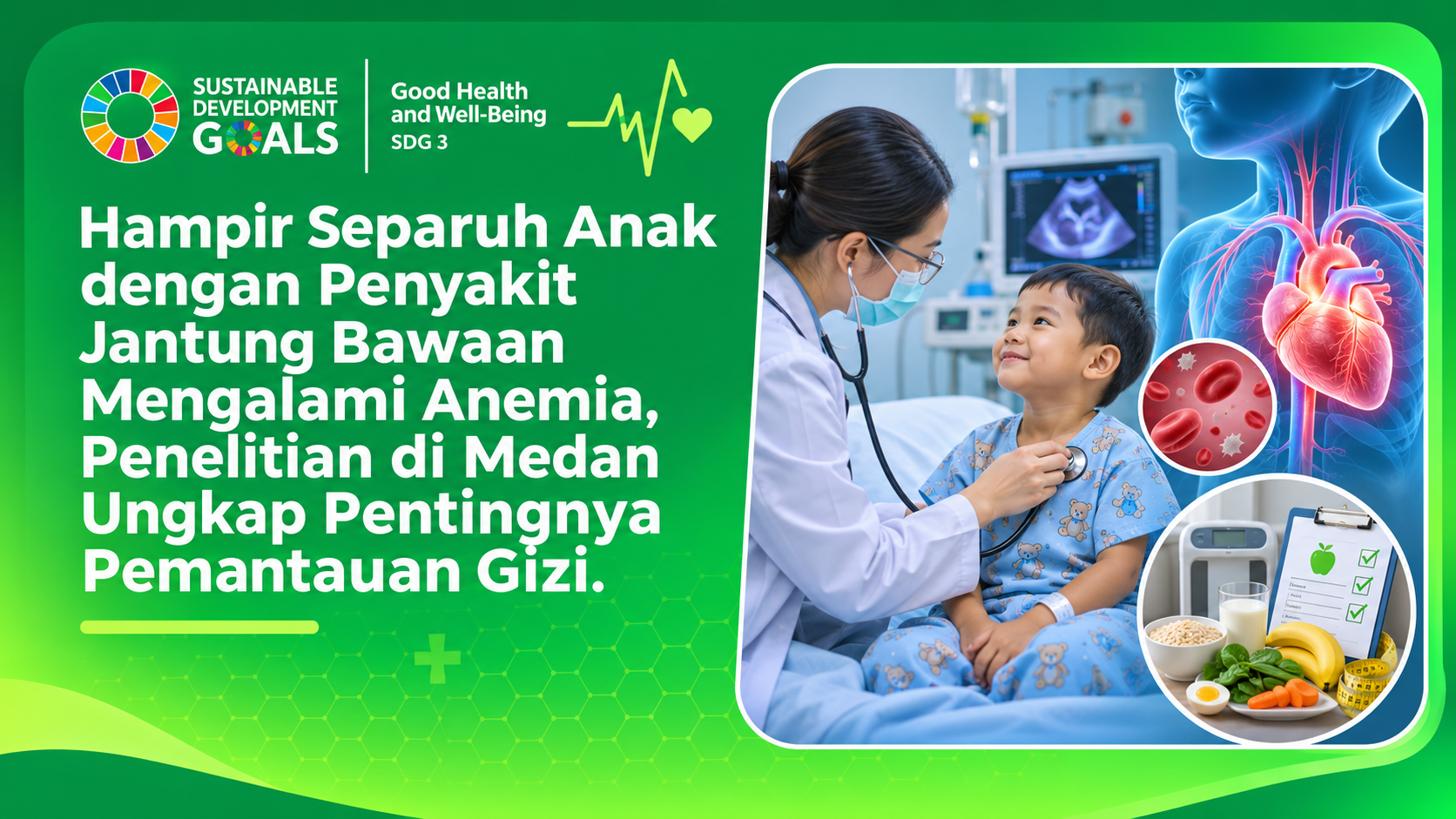
Congenital heart disease (CHD) is not merely a matter of heart structure. In children, this condition can also affect growth, nutritional status, and the body's ability to carry oxygen. One issue that requires attention is anemia, a condition in which hemoglobin levels are lower than the body's needs. In children with uncorrected CHD, anemia and malnutrition can exacerbate one another and worsen health conditions. A study at a teaching hospital in Medan sought to examine this relationship more closely.
The study, entitled “Anemia incidence and nutritional status in children with uncorrected congenital heart disease at a teaching hospital in a developing country,” was published in Heart Science Journal, volume 7, issue 3, pages 62–68, in 2026. The article was written by Putri Amelia, Johnson Kannady, Nydia Akrami Lubis, Elmeida Effendy, and Rina Amelia. The authors are affiliated with several units at Universitas Sumatera Utara and Haji Adam Malik General Hospital, Medan. The study examined the prevalence of anemia, nutritional status profiles, and factors associated with anemia in children with uncorrected CHD.
The study used a retrospective design by reviewing the medical records of pediatric patients at Haji Adam Malik General Hospital, Medan. The analyzed data covered the period from January 2023 to July 2024, while the study was conducted from July to October 2024. Of the 965 CHD patients recorded during the review period, 223 initially met the inclusion criteria. After 53 patients were excluded due to incomplete medical records or repeat visits, 170 patients were included in the analysis. The group was divided equally, comprising 85 children with cyanotic CHD and 85 children with acyanotic CHD.
The researchers collected information on age, sex, weight, height, hemoglobin levels, and CHD type. Nutritional status was assessed using several anthropometric indicators: weight-for-age, height-for-age, weight-for-height, and body mass index-for-age. The assessment used WHO growth standards for the relevant age groups and the Centers for Disease Control and Prevention growth charts for children aged 5–18 years. Anemia was determined based on age-specific hemoglobin thresholds according to WHO criteria. Statistical analyses included group comparison tests and logistic regression to assess factors associated with anemia.
The study results showed that 73 of the 170 children (42.9 percent) had anemia, while 97 children (57.1 percent) had hemoglobin levels within the normal range. Thus, nearly one in two patients in the study group had anemia. In terms of cardiac diagnoses, Tetralogy of Fallot was the most common type of cyanotic CHD, accounting for 35.9 percent of all participants. In the acyanotic group, ventricular septal defect was the most common diagnosis, at 20 percent.
The nutritional status profile revealed considerable challenges. Based on the weight-for-age indicator, 38.8 percent of the children were classified as severely underweight, while 34.7 percent were classified as underweight. Based on height-for-age, 27.6 percent were severely stunted and 25.9 percent were stunted. Meanwhile, the weight-for-height indicator showed that 25.9 percent were severely wasted and 30 percent were wasted. These findings illustrate that nutritional problems in children with CHD are not reflected by just one anthropometric measure.
When nutritional status was compared between the cyanotic and acyanotic CHD groups, the researchers found no significant differences in weight-for-age, height-for-age, weight-for-height, or body mass index-for-age. The p-values for all comparisons were above 0.05. This means that, in this study sample, the overall patterns of nutritional problems appeared relatively similar in both groups. These findings serve as a reminder that nutritional problems can affect children with CHD regardless of whether their condition is classified as cyanotic or acyanotic.
The analysis of the relationship between nutritional status and anemia produced more specific findings. No significant associations were found between anemia and weight-for-age, height-for-age, or body mass index-for-age. However, the weight-for-height indicator showed a statistically significant association, with a p-value of 0.049. Further analysis also revealed that severe wasting was more frequently found among children with anemia. This suggests that acute malnutrition or low body weight relative to height may be more closely associated with anemia than several other growth indicators.
In the multivariate regression analysis, cyanotic CHD was associated with lower odds of anemia compared with the acyanotic group, with an OR of 0.13 and a p-value of less than 0.001. Conversely, severe wasting remained associated with increased odds of anemia, with an OR of 2.97, a 95 percent confidence interval of 1.02–9.07, and a p-value of 0.049. Age and sex did not show significant associations after other factors were taken into account. These results should be interpreted cautiously: the odds values describe statistical associations within the sample, not evidence that one type of CHD directly protects children against anemia.
From a clinical perspective, this study emphasizes the importance of assessing nutritional status and hemoglobin levels together in children with uncorrected CHD. Monitoring should not focus solely on anatomical heart defects. Regular anthropometric assessments, anemia detection, dietary intake evaluation, and management of nutritional disorders can be important components of multidisciplinary care. Early identification of severe wasting can also help healthcare professionals determine which children require more intensive evaluation and nutritional support.
Although the study provides important insights, it has limitations. Its retrospective design meant that the researchers depended on the completeness of medical records and could not establish cause-and-effect relationships. Information on socioeconomic factors and iron intake was not consistently available. Analysis of NYHA functional class could also only be performed for some patients. In addition, the study was conducted at a single referral hospital, so its findings may not represent all children with CHD in Indonesia.
Overall, this study shows that anemia was found in 42.9 percent of children with uncorrected CHD, while nutritional deficiencies were also prominent. Severe wasting remained a factor associated with anemia after statistical adjustment. The main message is that the care of children with CHD needs to consider heart health, hemoglobin levels, and growth as interconnected aspects. Early detection and a multidisciplinary approach may help improve children's clinical condition and quality of life.
These conditions make routine monitoring an important part of healthcare services for children with heart defects from an early age.
Key Research Points:
The study involved 170 children with uncorrected CHD at Haji Adam Malik General Hospital, Medan.
A total of 73 children (42.9 percent) had anemia.
A total of 38.8 percent of the children were severely underweight based on the weight-for-age indicator.
Tetralogy of Fallot was the most common cyanotic CHD diagnosis, accounting for 35.9 percent.
No significant differences in nutritional status were found between the cyanotic and acyanotic CHD groups.
Severe wasting was associated with increased odds of anemia (OR 2.97; p=0.049).
Cyanotic CHD was associated with lower odds of anemia compared with the acyanotic group (OR 0,13; p<0,001)
Penelitian menekankan pentingnya deteksi anemia dan pemantauan gizi secara berkala dalam perawatan anak dengan PJB.
Writer
Khairul Azmi
Resource Person/Researcher
Dr. dr. Putri Amelia, M.Ked(Ped), Sp.A(K)