


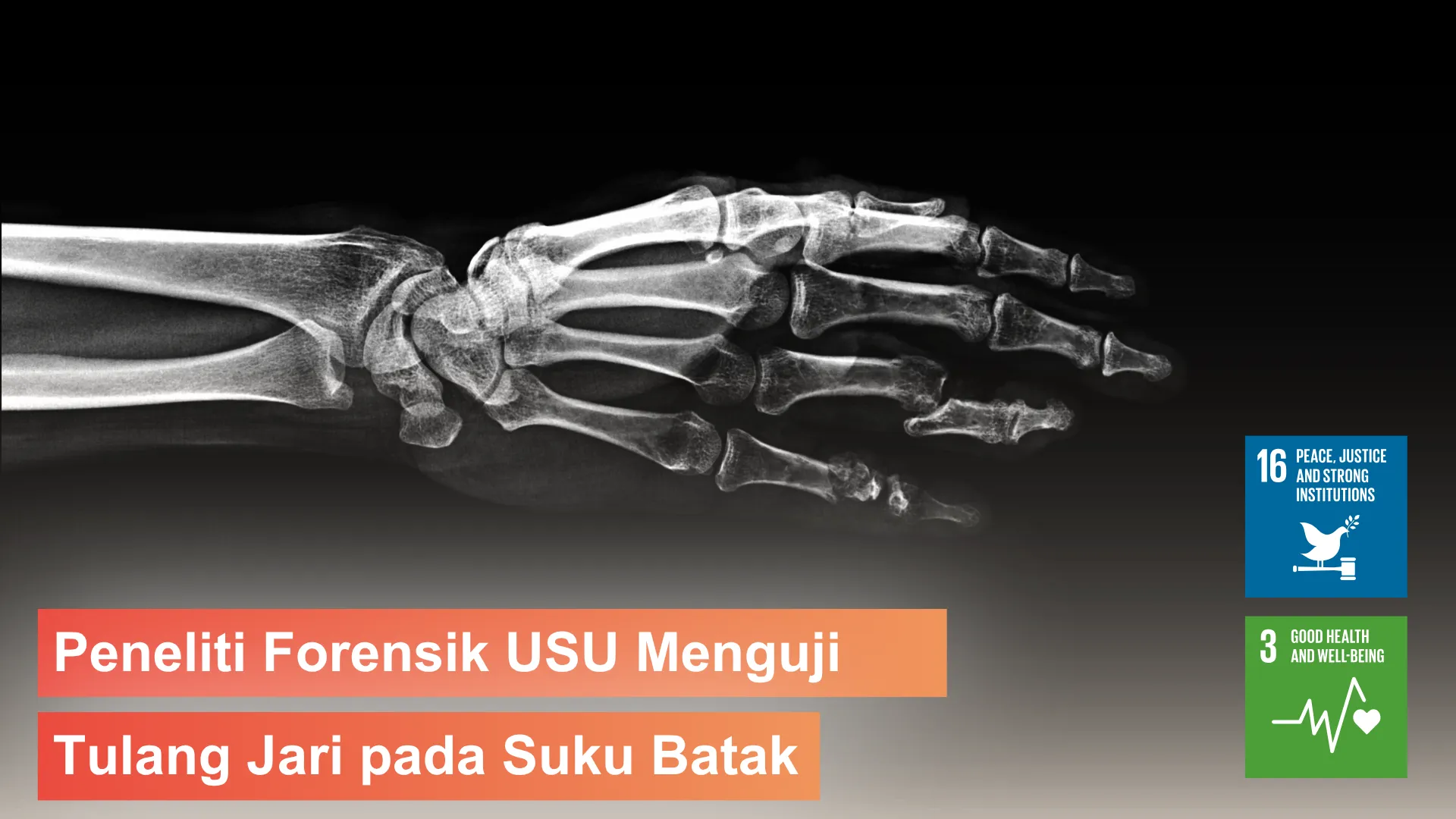
Earthquakes, flash floods, landslides, fires, and major accidents often leave behind incomplete human remains. When faces can no longer be recognized and long bones such as the thigh or arm bones cannot be found, identification officers still need to estimate the victims' biological characteristics, one of which is height. What if only parts of the hands remain?
Why Local Data Are Needed
Indonesia is among the countries most vulnerable to disasters. The authors cite that approximately 97% of Indonesia's population lives in areas exposed to hazards, and floods and landslides repeatedly occur in Sumatra, including an incident in West Sumatra in 2024 that killed 67 people, with others reported missing. Because body proportions differ among population groups, height estimation formulas generally need to be developed specifically for the target population. According to the authors, data on the correlation between P2 and height in the Batak ethnic group are not yet available.
How the Study Was Conducted
This cross-sectional study was conducted at the Radiology Department of Materna Hospital, Medan, from June to July 2024. Participants included 56 Batak individuals aged 21 to 25 years (19 men and 37 women), selected consecutively. Individuals with a history of fractures, congenital abnormalities, hand or finger surgery, spinal abnormalities, or dwarfism were excluded. Height was measured while standing barefoot using a digital measuring device with an accuracy of 0.1 cm. Both hands underwent digital X-rays (posteroanterior position), and the lengths of the right and left P2 segments were measured using the built-in measuring tool of the radiology equipment. The relationship between P2 length and height was analyzed using Pearson correlation and linear regression.
What Was Found
In the combined male and female group, the model using P2 was able to explain approximately half of the variation in height. According to the abstract, the adjusted R² values were 47.4% for the right P2, 45.7% for the left P2, and 48.4% when both sides were combined. In other words, approximately half of the differences in height among participants could not be explained by P2 length.
When analyzed separately by sex, the predictive power was lower than that of the combined model. The detailed figures for each sex in the manuscript are inconsistent between the abstract and discussion section, so they are not reported here.
The authors concluded that P2 can serve as a supporting indicator for forensic identification when only partial human remains are available. They also mentioned other studies involving Korean and Indian populations, which used several finger segments and achieved higher predictive power than using only one segment.
Key Research Points
A cross-sectional study involving 56 Batak adults aged 21 to 25 years (19 men and 37 women) at Materna Hospital, Medan, from June to July 2024.
Proximal phalanx II length was measured from digital X-rays of both hands and correlated with height.
In the combined sample, the adjusted R² was approximately 46 to 48% (47.4% for the right side, 45.7% for the left side, and 48.4% for both sides combined, according to the abstract).
Predictive power in the separate analyses by sex was lower, with figures that were inconsistent in the manuscript.
The authors consider P2 a supporting indicator when only part of a hand is found.
The preprint has not undergone peer review and does not yet provide a ready-to-use formula or an estimation error.
Author
Khairul Azmi
Resource Person/Researcher
Dr. dr. Asan Petrus, M.Ked(For), Sp.F