


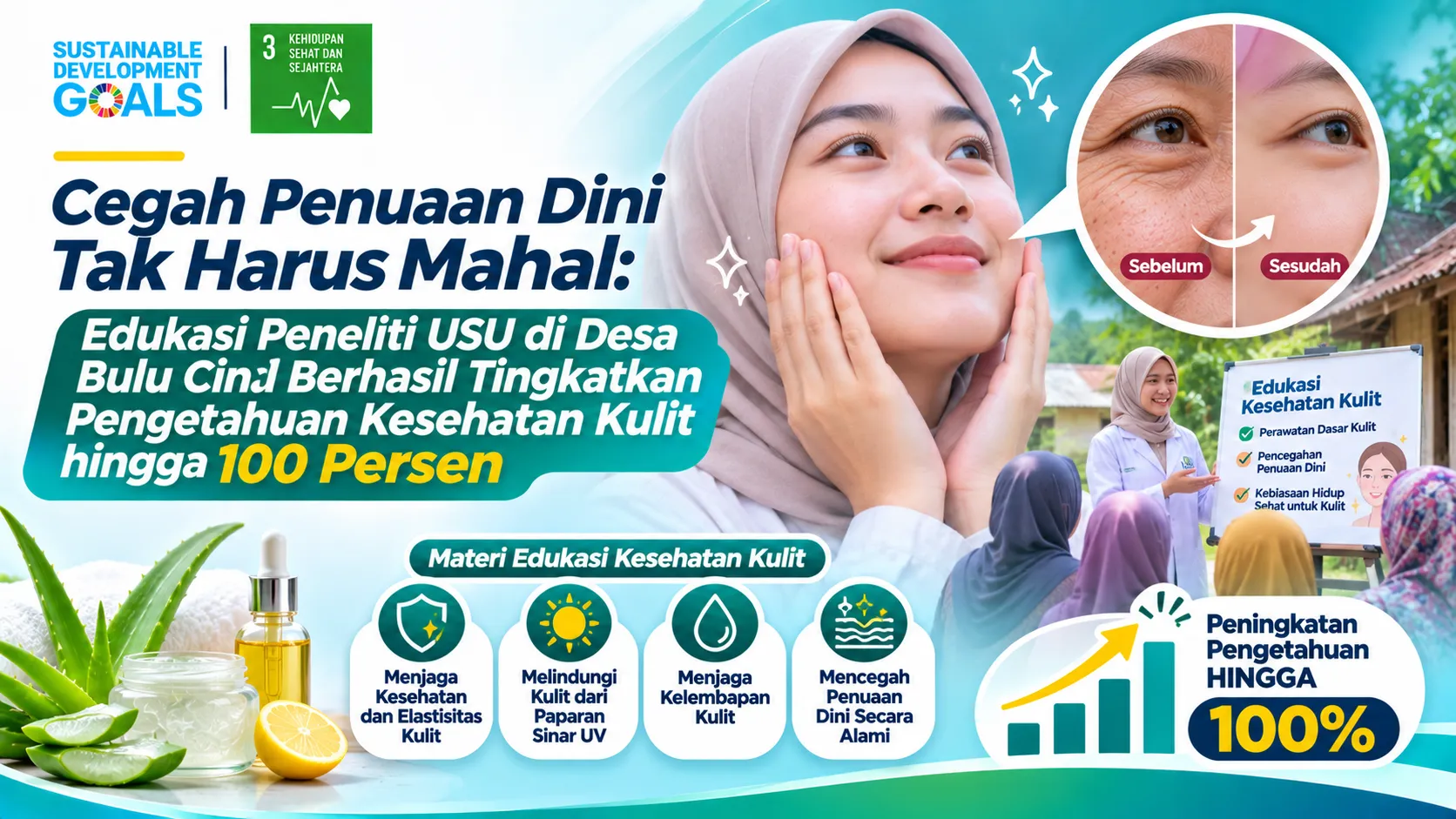
Healthy facial skin is often associated with the use of expensive skincare products and various modern beauty procedures. In fact, maintaining skin health can begin with simple habits, such as protecting the face from sun exposure, maintaining cleanliness, managing one's diet, and adopting a healthy lifestyle. This was the message brought by the team from the Faculty of Medicine, Universitas Sumatera Utara (USU), through an educational activity on preventing premature facial skin aging in Bulu Cina Village, Deli Serdang Regency, North Sumatra.
The program was published in Jurnal Pengabdian Mandiri, Volume 5, Number 8, August 2026, through an article entitled Penyuluhan Kesehatan dan Pencegahan Penuaan Dini Kulit Wajah di Desa Bulu Cina. The activity involved Khairina Nasution, Nelva Karmila Jusuf, Muhammad Rusda, Dina Keumala Sari, Fauzi Budi Satria, Dina Arwina Dalimunthe, Deryne Anggia Paramita, Cut Putri Hazlianda, and Raphaella from the Faculty of Medicine, USU.
Skin aging is a natural biological process that occurs with increasing age. This condition is characterized by the appearance of wrinkles, reduced elasticity, changes in pigmentation, and a decreased ability of the skin to retain moisture. However, the aging process can occur more rapidly due to environmental exposure and unhealthy lifestyle habits.
In their publication, the USU team explained that skin aging is influenced by intrinsic and extrinsic factors. Intrinsic factors are related to biological processes, genetics, and hormonal changes, while extrinsic factors include exposure to ultraviolet radiation, pollution, smoking habits, diet, and other environmental factors.
Ultraviolet radiation is one of the key factors contributing to photoaging, or skin aging caused by sun exposure. This condition can cause collagen damage, changes in elasticity, and the appearance of pigmented spots that make the skin look older more quickly.
In addition to affecting appearance, skin changes can also have an impact on a person's psychological condition. The researchers explained that premature aging may be associated with decreased self-confidence and increased anxiety, particularly when changes in appearance affect how individuals perceive themselves.
In response to this issue, the Faculty of Medicine, USU, team initiated a skin health education program with members of the Family Welfare Empowerment (PKK) in Bulu Cina Village, Hamparan Perak District, Deli Serdang Regency.
The area was selected because of the need to improve public understanding of skin health. Based on an initial assessment, the team found that some PKK members did not yet fully understand the causes of premature aging or the preventive measures that could be applied in everyday life.
To address this need, the program was designed using a direct community education approach. The activity did not only involve delivering material but also included consultations, discussions, question-and-answer sessions, quizzes, and assessments of knowledge before and after the educational session.
A total of 45 PKK members participated in this activity. All participants were women who worked as homemakers. Through the involvement of PKK members, the health information provided was expected to be shared with their families and surrounding communities.
Before the educational session began, participants took a pretest to measure their level of knowledge about facial skin health. The questions covered facial cleansing habits, skincare product use, the influence of diet, the benefits of sunscreen, sleep patterns, stress, and skin hygiene.
The initial assessment results showed that most participants had not yet achieved the highest knowledge category. A total of 31 participants, or 68.9%, had a moderate level of knowledge, while 14 participants, or 31.1%, had a good level of knowledge.
These findings indicate that there is still room to improve public understanding of proper skin care. Misinformation can cause individuals to adopt inappropriate habits, such as washing their faces too frequently or neglecting sunscreen use.
During the educational session, the team explained that maintaining facial hygiene does not mean washing the face as often as possible. Participants were introduced to the recommendation of washing their faces approximately twice a day as part of their skin hygiene routine.
The next topic highlighted the importance of sunscreen use. This product helps protect the skin from ultraviolet radiation, which contributes to skin tissue damage and the appearance of signs of sun-induced aging.
The team also emphasized that sunscreen should be used consistently, not only when someone happens to remember it. In the educational materials, participants were advised to apply sunscreen every morning and reapply it when spending extended periods outdoors.
In addition to sun protection, the educational session discussed the influence of diet on skin health. Adequate nutritional intake is necessary to support various biological processes in the body, including the maintenance and repair of skin tissue.
Sleep quality and stress management were also important parts of the discussion. Lack of sleep and prolonged psychological stress can affect overall health, including various processes related to skin health.
Interestingly, the material was not delivered solely through verbal explanations. The USU team used multimedia equipment, brochures, banners, and educational videos to make the information easier for participants to understand and remember.
The use of these visual media was one of the strategies to make learning more engaging. Through images and simple examples, participants could understand the relationship between ultraviolet exposure, daily habits, and changes occurring in facial skin.
After the entire educational program was completed, participants took another knowledge assessment through a posttest. The evaluation results showed a striking improvement compared with their knowledge levels before the activity.
Whereas only 14 participants were in the good knowledge category during the initial assessment, after the educational session all 45 participants, or 100%, successfully achieved this category. No participants remained in the moderate or poor knowledge categories.
These results serve as an indicator that the educational session successfully improved participants' understanding in the immediate post-activity evaluation. This improvement demonstrates the benefits of a health education approach that uses simple explanations, direct interaction, and accessible learning media.
Nevertheless, the research team acknowledged that these results cannot yet describe long-term behavioral changes. The study did not use a control group, and the evaluation was conducted only over a short period. Therefore, it remains unknown whether participants will maintain better skincare habits after the activity ends.
The limited number of participants from a single area is also an important consideration. Consequently, the results of this activity cannot yet be directly generalized to the entire population of Deli Serdang or North Sumatra.
Despite these limitations, the program demonstrates the significant potential of PKK members as community-based health education advocates. After gaining a better understanding, they can help share information about skin protection, facial hygiene, and healthy lifestyles with people in their immediate communities.
The USU team recommended that educational sessions be conducted continuously through further training and mentoring for PKK members. This step is necessary to strengthen understanding while encouraging the application of healthy habits in everyday life.
Ultimately, the activity in Bulu Cina Village demonstrates that improving public health can begin with simple educational initiatives that address the actual needs of the community. Skin protection is not solely related to beauty but is also part of efforts to maintain health and well-being.
Through the empowerment of PKK members, Universitas Sumatera Utara also contributes to achieving Sustainable Development Goals (SDGs) Goal 3, namely ensuring healthy lives and promoting well-being for all through strengthening health literacy and community-based education.
Key Research Points:
The community service activity was conducted by the Faculty of Medicine, USU, team in collaboration with PKK members in Bulu Cina Village, Hamparan Perak District, Deli Serdang Regency.
A total of 45 participants attended the educational session, all of whom were women and worked as homemakers.
The program aimed to improve understanding of facial skin health and the prevention of premature aging.
The material covered the identification of skin aging signs, environmental factors, ultraviolet exposure, sunscreen, diet, facial hygiene, sleep, and stress.
The educational methods included seminars, consultations, discussions, quizzes, brochures, banners, and educational videos.
Before the educational session, 68.9% of participants (31 people) had a moderate level of knowledge, while 31.1% (14 people) had a good level of knowledge.
After the educational session, all participants (100%) achieved the good knowledge category based on the posttest results.
The proportion of participants with a good level of knowledge increased by 68.9 percentage points.
The activity demonstrated successful short-term knowledge improvement but did not yet establish long-term changes in skincare behavior.
The authors recommended continuous education and mentoring for PKK members so that skin health knowledge can be disseminated throughout the community.
Author
Khairul Azmi
Source/Researcher
dr. Khairina, Sp.D.V.E, Subsp. D.K.E, M.Ked (DV), FINSDV, FAADV