


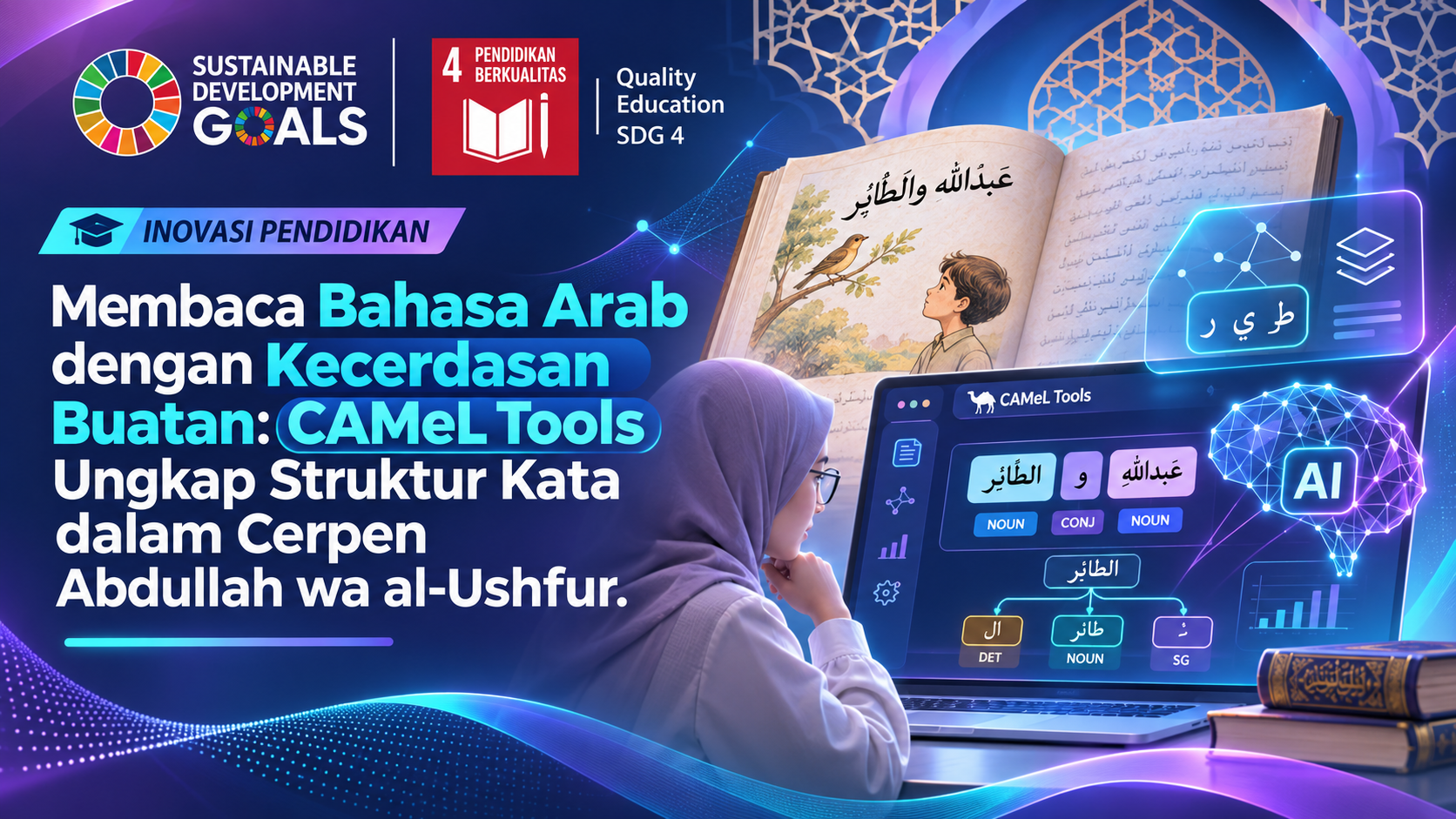
The development of artificial intelligence technology is bringing increasingly new dimensions to the fields of education and language research. Whereas language analysis was previously conducted largely through manual examination of individual words and sentence structures, various digital tools now make it possible to carry out these processes more quickly and systematically. One innovation attracting attention in linguistics is Natural Language Processing (NLP), a technology that enables computers to process, recognize, and analyze human language. This opportunity was utilized by a research team from Universitas Sumatera Utara (USU) through a study on the use of CAMeL Tools to analyze Arabic word categories in the short story Abdullah wa al-Ushfur.
The study, written by Khairina Nasution, Rima Mella, and Rozanna Mulyani from the Arabic Literature Study Program, Faculty of Cultural Sciences, Universitas Sumatera Utara, was published in the Journal of Linguistics, Culture and Communication, Volume 4, Number 1, 2026, pages 278–296. This study explores the use of Arabic language processing technology to identify word categories in a literary work. Through this research, the authors aim to demonstrate that technology can be used not only for language translation but also to help reveal the linguistic structures that shape a story.
Arabic itself has relatively complex characteristics. Its morphological system involves roots, word formation patterns, prefixes, suffixes, and infixes, which can produce various forms from a single root. Another challenge is that many Arabic texts are written without harakat or vowel marks. This condition can create ambiguity because a single written form may have more than one possible meaning or grammatical function. Consequently, the process of identifying word classes requires an understanding of sentence structure and context.
In Arabic grammar, there are three main categories that form the foundation of sentence construction, namely ism, fi'il, and harf. Ism is a category that includes nouns, proper nouns, adjectives, and other nominal forms. Fi'il refers to verbs that indicate actions, activities, or events associated with time. Meanwhile, harf refers to particles that function to connect words and parts of sentences. All three play important roles in constructing meaning and coherence within a text.
To identify these three categories, the researchers used CAMeL Tools, an open-source toolkit specifically designed for Arabic language processing. This tool provides various NLP features, such as tokenization, morphological analysis, disambiguation, named entity recognition, sentiment analysis, and Part-of-Speech (POS) Tagging. The latter feature served as the main instrument in this study because it can assign grammatical labels to each word based on its linguistic function.
The research object was the short story Abdullah wa al-Ushfur, sourced from the muthala'ah materials of grade 2 at Kulliyatul Mu'allimin al-Islamiyah (KMI). The short story was selected because it uses Standard Arabic or Modern Standard Arabic and contains various linguistic elements that can be analyzed. The study employed a qualitative descriptive approach with a documentation method. The story text was first collected, selected, and adjusted in format before being processed using CAMeL Tools.
The analysis process was carried out in several stages, beginning with text preparation, identification of word categories using the POS Tagging feature, grouping of the identified results, and interpretation based on Arabic grammatical rules. Interestingly, the text used was first stripped of its harakat. Nevertheless, CAMeL Tools could still help identify word categories by utilizing context-based statistical models. The researchers also conducted manual checks to anticipate classification errors, particularly for words with more than one possible meaning.
The research results show that CAMeL Tools successfully identified various word classes in the short story. The categories found included noun, proper noun, adjective, number noun, verb, preposition, conjunction, subordinating conjunction, relative pronoun, demonstrative pronoun, interrogative pronoun, interrogative adverb, negative particle, and pseudo verb. These various labels were then grouped into the three main Arabic language categories, namely ism, fi'il, and harf.
One interesting finding was the prominent use of the ism category in constructing the descriptive elements of the story. This category includes words referring to characters, objects, places, and situations found in the narrative. The presence of ism helps readers identify elements of the story and understand the situations being depicted. Thus, nominal elements play an important role in creating a complete narrative picture.
In addition to ism, the fi'il category also plays an important role in developing the storyline. Verbs describe the various actions and activities performed by the characters. Through the use of fi'il, the sequence of events in the story can unfold, enabling readers to follow the dynamics of the characters' actions from beginning to end. Meanwhile, the harf category functions as a connecting element that maintains syntactic relationships between words and clauses. Although it is not always the most prominent element, the presence of harf is essential to ensure that sentence structures remain complete and easy to understand.
These findings demonstrate that the short story Abdullah wa al-Ushfur combines descriptive elements and actions in conveying its narrative. The use of ism helps construct descriptions of characters and settings, fi'il drives the sequence of events, while harf maintains connections between linguistic elements. In other words, word category analysis not only provides information about grammatical structures but can also help explain how language choices contribute to the formation of a literary work.
In terms of scientific development, this study contributes to the use of NLP technology in Arabic linguistic research. To date, various studies on Arabic language processing technology have focused more on tool development, system evaluation, and large-scale corpus analysis, such as social media and news. This study presents a different application by using literary texts as the object of analysis. This opens up opportunities for students and researchers to combine linguistics, literature, and technology within a single research approach.
Nevertheless, the researchers also acknowledged certain limitations. This study remains qualitative and descriptive in nature and has not used statistical measurements such as F1-score or inter-rater agreement to evaluate the system's level of accuracy. Furthermore, the research object covers only one short story, meaning that the findings cannot yet be generalized to various Arabic literary genres. Future research is recommended to involve nahwu experts as human annotators, conduct quantitative accuracy measurements, and expand the research objects to collections of short stories, novels, and other Arabic language learning texts.
Ultimately, this study emphasizes that technological advances can serve as important partners in the development of language studies. CAMeL Tools is not merely a tool for assigning labels to words but also a means of helping researchers understand the linguistic characteristics of a text in a more structured manner. The integration of artificial intelligence technology with Arabic linguistic studies is expected to encourage the development of more innovative learning and research methods. Through this approach, the richness of Arabic language and literature can continue to be explored using methods relevant to the developments of the times.
Key Research Points
The research was conducted by Khairina Nasution, Rima Mella, and Rozanna Mulyani from the Arabic Literature Study Program, Faculty of Cultural Sciences, Universitas Sumatera Utara.
The research object was the Arabic-language short story Abdullah wa al-Ushfur from the grade 2 muthala'ah materials at KMI.
The study employed a qualitative descriptive approach with the assistance of Natural Language Processing (NLP) technology.
CAMeL Tools was utilized through its Part-of-Speech (POS) Tagging feature to automatically identify Arabic word classes.
The identification results included various word classes, such as noun, proper noun, adjective, verb, preposition, conjunction, and several other categories.
These various word classes were grouped into the three main Arabic language categories: ism, fi'il, and harf.
Ism plays a role in describing characters, objects, places, and situations; fi'il develops the storyline through the characters' actions; while harf connects sentence elements.
The study demonstrates the potential of CAMeL Tools as a tool for more systematic and efficient Arabic linguistic analysis.
Further research is recommended to use a broader corpus and involve Arabic language experts in validation to quantitatively measure accuracy.
Author
Khairul Azmi
Source/Researcher
dr. Khairina, Sp.D.V.E, Subsp. D.K.E, M.Ked (DV), FINSDV, FAADV