


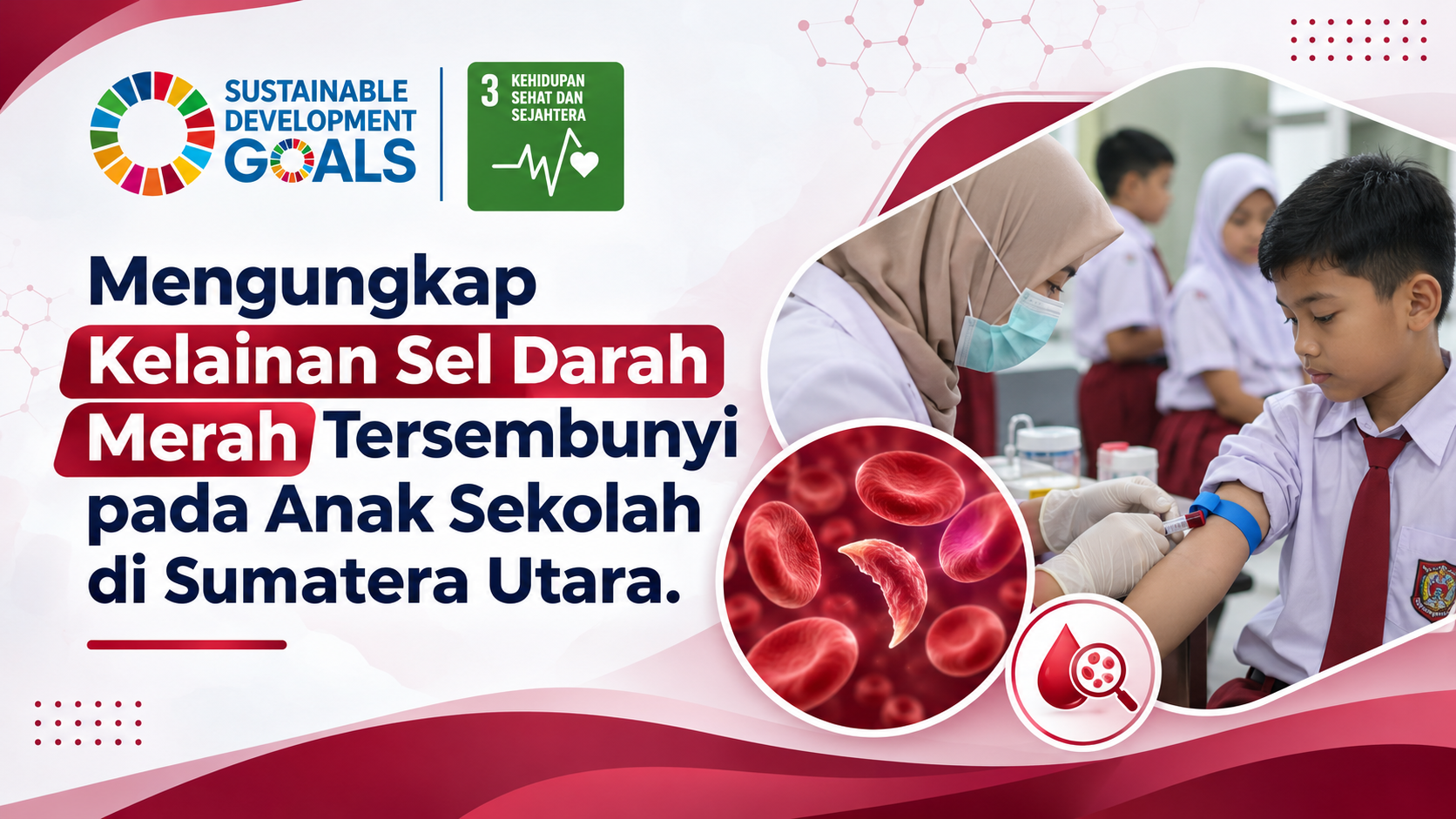
In a coastal area of North Sumatra that still has malaria endemicity, red blood cell disorders have been found in children who appear healthy. This finding conveys an important message from a study entitled “Profile of red blood cell disorders among healthy schoolchildren in the low malaria-endemic region in Indonesia”. The study mapped several red blood cell disorders as well as anemia among students in Tanjung Leidong, North Labuhanbatu Regency. These disorders can occur without symptoms, but are important to identify because they are associated with anemia and the safety of malaria treatment.
This study was conducted by a cross-institutional team involving researchers from Universitas Sumatera Utara, the Tridarma Community Health Strengthening Foundation, Exeins Health Initiative, and the National Research and Innovation Agency. Tanjung Leidong was selected because it is an area with moderate malaria endemicity. Local data recorded an Annual Parasite Incidence (API) of 1.13 in 2024. Previous local information was still limited, particularly regarding disorders other than G6PD deficiency.
This cross-sectional study involved 334 healthy students from the D. I. Panjaitan Educational Foundation, ranging from elementary to senior high school levels. Data were collected from August 12 to September 4, 2024, through malaria testing using microscopy, hemoglobin measurements, glucose-6-phosphate dehydrogenase (G6PD) enzyme activity testing, and genetic testing for Southeast Asian Ovalocytosis (SAO), hemoglobin E (HbE), and alpha-thalassemia.
One of the main findings of the study was the identification of several types of red blood cell disorders at varying proportions. G6PD deficiency was found in 0.90 percent of participants, SAO in 0.90 percent, and HbE in 2.40 percent. For alpha-thalassemia, a one-gene deletion was found in 6.26 percent of participants, while a two-gene deletion was found in 0.30 percent. Thus, single-gene alpha-thalassemia was the most frequently identified disorder among the children studied. These figures provide an initial overview and do not yet represent all children in the area.
The researchers also found that approximately 14 percent of participants had anemia. The proportion differed between girls and boys. Among those with moderate anemia, 12 girls, or 7.02 percent of all female participants, and seven boys, or 4.29 percent of all male participants, were recorded. One boy was found to have severe anemia. Anemia remains a condition that requires attention even among students who appear healthy, taking age and sex differences into account.
Malaria testing using microscopy showed no detected malaria infections among all participants. However, the researchers cautioned that negative microscopy results do not completely rule out the possibility of asymptomatic infection. This study did not use PCR testing to detect low levels of malaria parasites. This means that parasites were not detected using the method employed, but asymptomatic infection could not be ruled out.
Red blood cell disorders have an interesting biological relationship with malaria. Certain genetic variations can inhibit parasites from entering or developing inside red blood cells. SAO, HbE, and certain forms of thalassemia have been associated with protection against severe malaria. However, this potential benefit does not mean that these disorders are always without risks. G6PD deficiency, for example, can increase the susceptibility of red blood cells to oxidative stress. In individuals with this deficiency, certain oxidative drugs, including 8-aminoquinoline antimalarial drugs such as primaquine and tafenoquine, can trigger hemolysis. Therefore, identifying G6PD status is important before administering certain treatments.
The study also examined the relationship between nutritional status, anemia, and red blood cell disorders. Children who were underweight showed a tendency toward higher proportions of anemia and red blood cell disorders compared with groups with normal nutritional status, overweight, or obesity. Nevertheless, the relationship between body mass index and anemia was not statistically significant. The researchers found a weak negative correlation between body mass index and red blood cell disorders. Nutritional and genetic factors may be interrelated, but a causal relationship has not yet been established.
There was also an important note regarding the method used to measure hemoglobin. The researchers compared the STANDARD G6PD Analyzer with HemoCue. The analysis showed that the results from the two devices did not have sufficient agreement to be used interchangeably. The mean measurement difference was 0.709 g/dL, with a wide range of agreement. Therefore, the researchers concluded that the STANDARD G6PD Analyzer should not yet replace HemoCue for hemoglobin measurements. Hemoglobin accuracy is important for assessing anemia and G6PD activity.
The authors acknowledged several limitations. The samples came from a single school complex and were relatively limited in number, so the results do not automatically represent the broader child population. PCR testing for asymptomatic malaria was not performed, red blood cell morphology examination through blood smear microscopy was unavailable, and iron deficiency status was not specifically analyzed. The study also did not use a hematology analyzer as a reference standard for hemoglobin measurements. Consequently, the respective contributions of nutritional and genetic factors to anemia could not yet be distinguished in detail.
Nevertheless, this study provides an initial basis for mapping red blood cell disorders in Tanjung Leidong. Its main message is the importance of an integrated approach: screening for blood disorders, anemia testing, nutritional assessment, and education about medication risks need to complement one another. Screening can identify asymptomatic carriers of disorders, educate families, and support genetic counseling. Further research involving larger samples and more comprehensive laboratory testing is needed to strengthen this overview.
These findings also emphasize the need to distinguish inherited disorders from anemia associated with nutritional intake. Further examinations, including red blood cell indices and iron status, can help explain the causes of anemia. For healthcare services, these baseline data can serve as a basis for planning screening programs that take local conditions into account, rather than simply applying one approach to all communities.
This study is still a preprint that has not undergone peer review, so its findings should be understood as preliminary evidence rather than clinical guidelines. The results serve as a reminder that even children who appear healthy may have red blood cell disorders that are important to their health. Through early identification and appropriate testing, efforts to prevent anemia and manage malaria in at-risk areas can be designed more safely, systematically, and in accordance with local community needs.
Key Research Points
The study involved 334 healthy students in Tanjung Leidong, North Labuhanbatu, North Sumatra.
The prevalence of anemia among participants was approximately 14 percent.
G6PD deficiency was found in 0.90 percent of participants.
SAO was found in 0.90 percent and HbE in 2.40 percent of participants.
Single-gene alpha-thalassemia was found in 6.26 percent of participants, while two-gene deletion was found in 0.30 percent.
No malaria infections were detected through microscopy, but asymptomatic infection could not be completely ruled out.
Underweight children showed a tendency toward higher proportions of anemia and red blood cell disorders.
The STANDARD G6PD Analyzer has not yet been considered suitable to replace HemoCue for hemoglobin measurements.
Writer
Khairul Azmi
Resource Person/Researcher
Prof. dr. Ayodhia Pitaloka Pasaribu, M.Ked(Ped), Sp.A(K), Ph.D (CTM)