


Skin aging occurs due to age-related and environmental factors, particularly exposure to ultraviolet radiation. Ultraviolet radiation triggers free radicals and increases the activity of the matrix metalloproteinase-1 (MMP-1) enzyme, which breaks down collagen in the dermal layer. As a result, the skin loses elasticity and wrinkles appear. Skincare products containing natural antioxidants are in high demand, including those derived from kitchen waste such as banana peels.
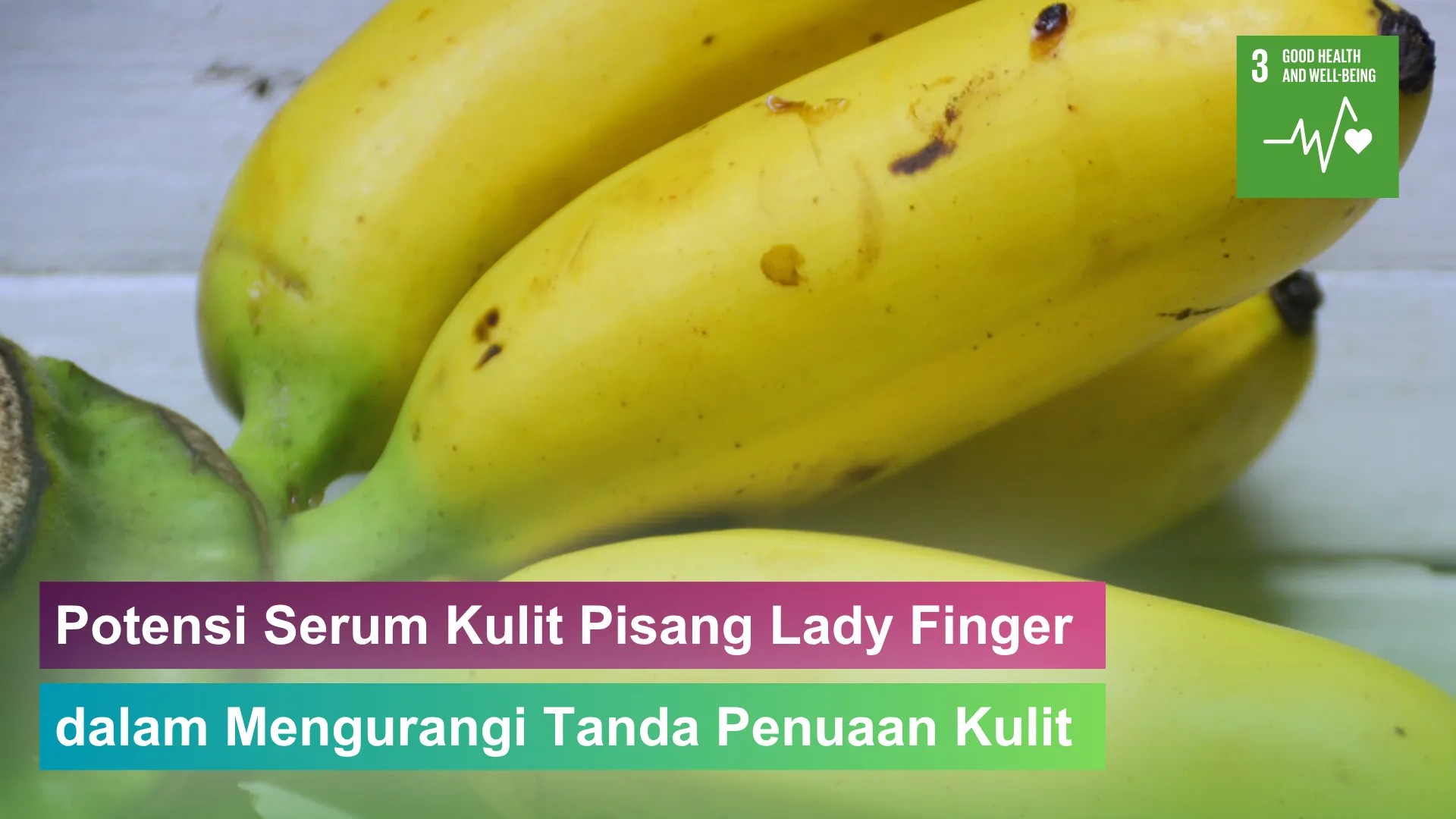
Lady finger banana peel (Musa acuminata Colla) is known to contain polyphenols, flavonoids, tannins, and carotenoids. However, evidence that this ingredient works on human facial skin when formulated as a topical preparation remains limited. The dermatology team from the Faculty of Medicine, Universitas Sumatera Utara (USU), attempted to address this gap by developing a nanoparticle serum formulation.
The study was conducted at the Dermatology and Venereology Polyclinic of Prof. Chairuddin P. Lubis Hospital, USU, from March 2025 to April 2026. The lead author was Khairina Nasution, together with colleagues from Universitas Hasanuddin, Universitas Sumatera Utara, and the Departments of Psychiatry and Obstetrics and Gynecology at Universitas Sumatera Utara.
How the Research Was Conducted
The participants were 50 women aged 25 to 50 who had signs of facial skin aging. One participant withdrew because she did not use the serum regularly, leaving 49 participants for analysis. All participants used the serum once every night for 12 weeks, along with SPF 30 sunscreen every morning.
Aging scores were measured using the Dermoscopy Photoaging Scale (DPAS) at weeks 0, 4, 8, and 12, across four facial areas. Serum MMP-1 levels were measured using ELISA at weeks 0 and 12. Side effects were assessed at every visit.
The serum was made using banana peel extract encapsulated in chitosan nanoparticles through the ionic gelation method. Particle size was measured using laser diffraction, with an average size of 37.58 nanometers.
What Was Found
The average serum MMP-1 level decreased from 0.48 to 0.26 ng/mL (p < 0.001). The DPAS score decreased from 12.69 to 9.51 (p < 0.001), with a reduction already visible by the fourth week. Changes in DPAS scores and MMP-1 levels were positively correlated, although the correlation was weak (r = 0.347; p = 0.015).
No side effects were reported among participants who completed the study. The participants had an average age of 37 years.
Why These Results Cannot Yet Be Concluded to Be an Effect of the Serum
The authors themselves emphasized that this was an early-stage, single-group study without a placebo group, vehicle group, or comparator. Without a comparison group, changes in the skin cannot be distinguished between the effects of the serum, the sunscreen given to all participants, the serum base, and changes in skincare behaviors.
Blood MMP-1 levels are also only a systemic marker. The authors did not measure MMP-1 in the skin, compound levels in the blood, or percutaneous absorption. Therefore, the association with MMP-1 inhibition in the skin remains speculative. The authors also acknowledged that the study was not registered in a clinical trial registry. The participants were exclusively women, and the observation period lasted only 12 weeks, meaning that long-term effects and safety could not be assessed.
Research Key Points
An early-stage, single-group study involving 49 women aged 25 to 50 in Medan, from March 2025 to April 2026.
Lady finger banana peel nanoparticle serum was used every night for 12 weeks.
The dermoscopic skin aging score (DPAS) decreased from 12.69 to 9.51, and serum MMP-1 levels decreased from 0.48 to 0.26 ng/mL.
No side effects were reported among participants who completed the study.
There was no comparison group, randomization, or blinding.
The authors described these results as preliminary findings that do not yet establish efficacy or causality.
Author
Khairul Azmi
Source/Researcher
dr. Khairina, Sp.D.V.E, Subsp. D.K.E, M.Ked (DV), FINSDV, FAADV