


Outer ear infection, or otitis externa, is inflammation of the external ear canal that is frequently encountered in ear, nose, and throat (ENT) healthcare services. This condition occurs more frequently in tropical regions because high humidity and temperatures damage the protective skin layer of the ear canal. People who frequently swim or are exposed to contaminated water are also more susceptible. Symptoms may include ear pain, itching, and discharge, all of which can interfere with quality of life.
Approximately 90 percent of otitis externa cases are caused by bacteria, and Pseudomonas aeruginosa is among the most difficult to treat. This bacterium can form a mucus layer or biofilm and produce pump systems that expel antibiotics from within its cells. The World Health Organization classifies resistant P. aeruginosa as a critical priority pathogen requiring new drugs.
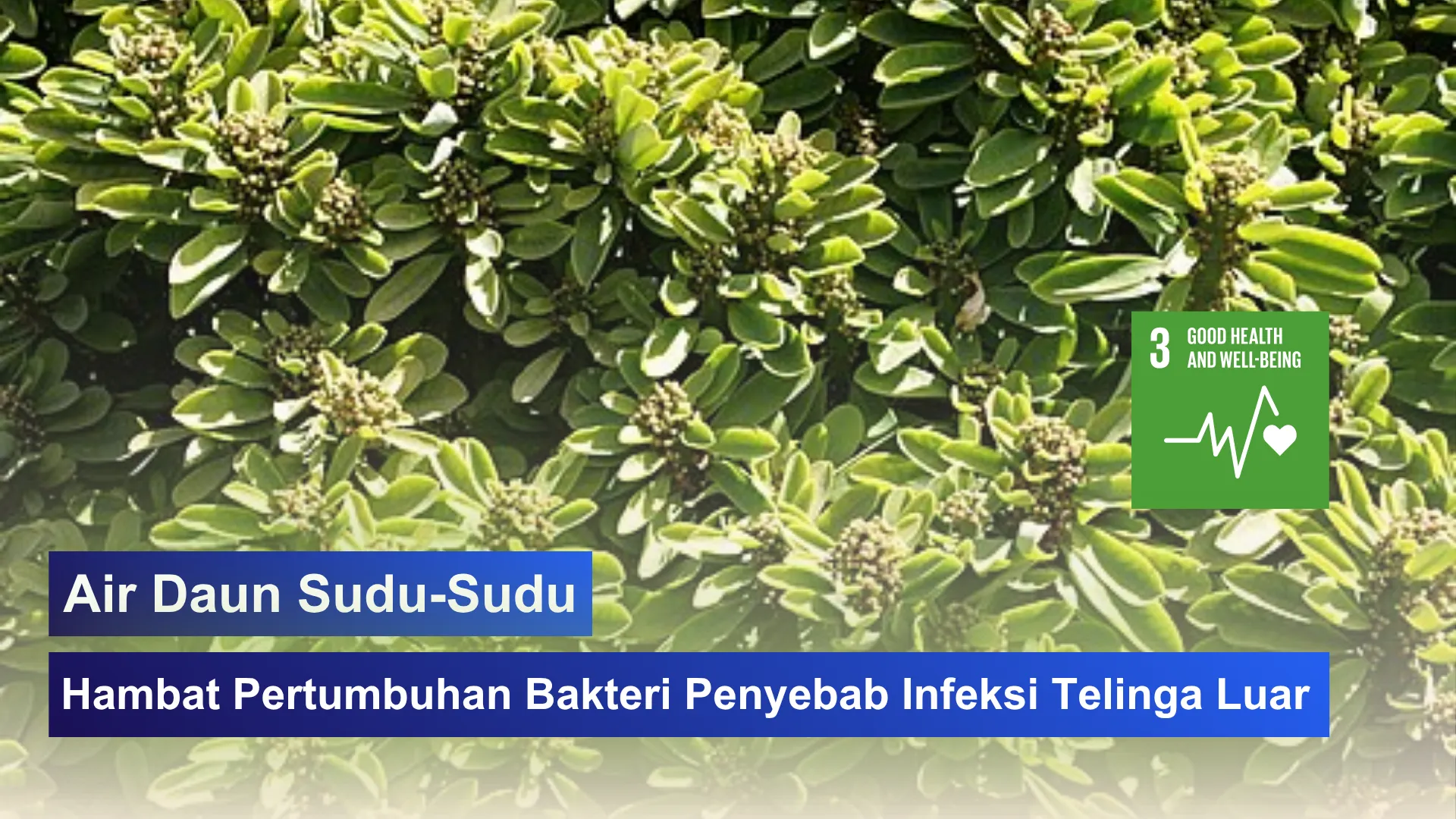
In this context, a research team from the Department of Otorhinolaryngology and the Department of Pharmacology and Therapeutics, Faculty of Medicine, Universitas Sumatera Utara (USU), studied sudu-sudu (Euphorbia neriifolia L.), a plant that grows in Medan and has long been used by the public to treat ear complaints.
How the Research Was Conducted
Sudu-sudu leaves were collected from cultivated plants in Medan and identified by a botanist from Universitas Sumatera Utara, then stored as herbarium specimens. The extracted juice was subsequently filtered and prepared at various concentrations, ranging from 10 to 100 percent.
The tests were conducted against three bacterial strains. The first was P. aeruginosa ATCC 27853, an internationally recognized standard reference strain. The second and third were two clinical isolates obtained from ear secretions of two patients with otitis externa at the ENT Outpatient Clinic of Haji Adam Malik General Hospital, Medan. The team tested two parameters: the minimum inhibitory concentration (MIC), which is the lowest concentration that inhibits bacterial growth, and the minimum bactericidal concentration (MBC), which is the lowest concentration that kills bacteria. They also measured the inhibition zones using paper discs. Ofloxacin, a commonly used antibiotic, was used as a comparison.
What the Research Found
For the standard strain and the first isolate, a concentration of 50 percent significantly inhibited bacterial growth, while a concentration of 60 percent completely killed the bacteria. The second isolate was more resistant, with an MIC of 60 percent and an MBC of 70 percent.
In the disc diffusion test, the inhibition zones increased with higher concentrations. For the standard strain, the inhibition zone increased from approximately 12 millimeters at 40 percent to approximately 23 millimeters at 60 percent. Ofloxacin produced a larger inhibition zone of approximately 36 millimeters. The authors concluded that the antibacterial activity of sudu-sudu juice was weaker than that of ofloxacin but sufficiently significant to warrant further investigation.
Chemical analysis using liquid chromatography and mass spectrometry detected several phenolic and flavonoid compounds, including quercetin, kaempferol, chlorogenic acid, gallic acid, and 7-hydroxycoumarin. These compounds are known in the scientific literature for their antibacterial activities, although the authors have not yet demonstrated a direct relationship between any specific compound and the observed effects.
Key Research Findings
Sudu-sudu leaf juice (Euphorbia neriifolia) was tested against Pseudomonas aeruginosa ATCC 27853 and two clinical isolates from patients with otitis externa in Medan.
The MIC was approximately 50 percent, and the MBC was 60 percent for the standard strain and the first isolate; for the second isolate, the MIC was 60 percent, and the MBC was 70 percent.
The inhibition zones in the disc diffusion test increased with higher concentrations but remained smaller than those produced by ofloxacin.
Chemical screening detected quercetin, kaempferol, chlorogenic acid, gallic acid, and 7-hydroxycoumarin.
The research was still conducted in vitro, involved a very limited number of clinical isolates, and did not yet examine biofilms.
Author: Khairul Azmi
Speaker/Researcher: Dr. dr. Devira Zahara, M.Ked(ORL-HNS), Sp.THT-KL(K)