


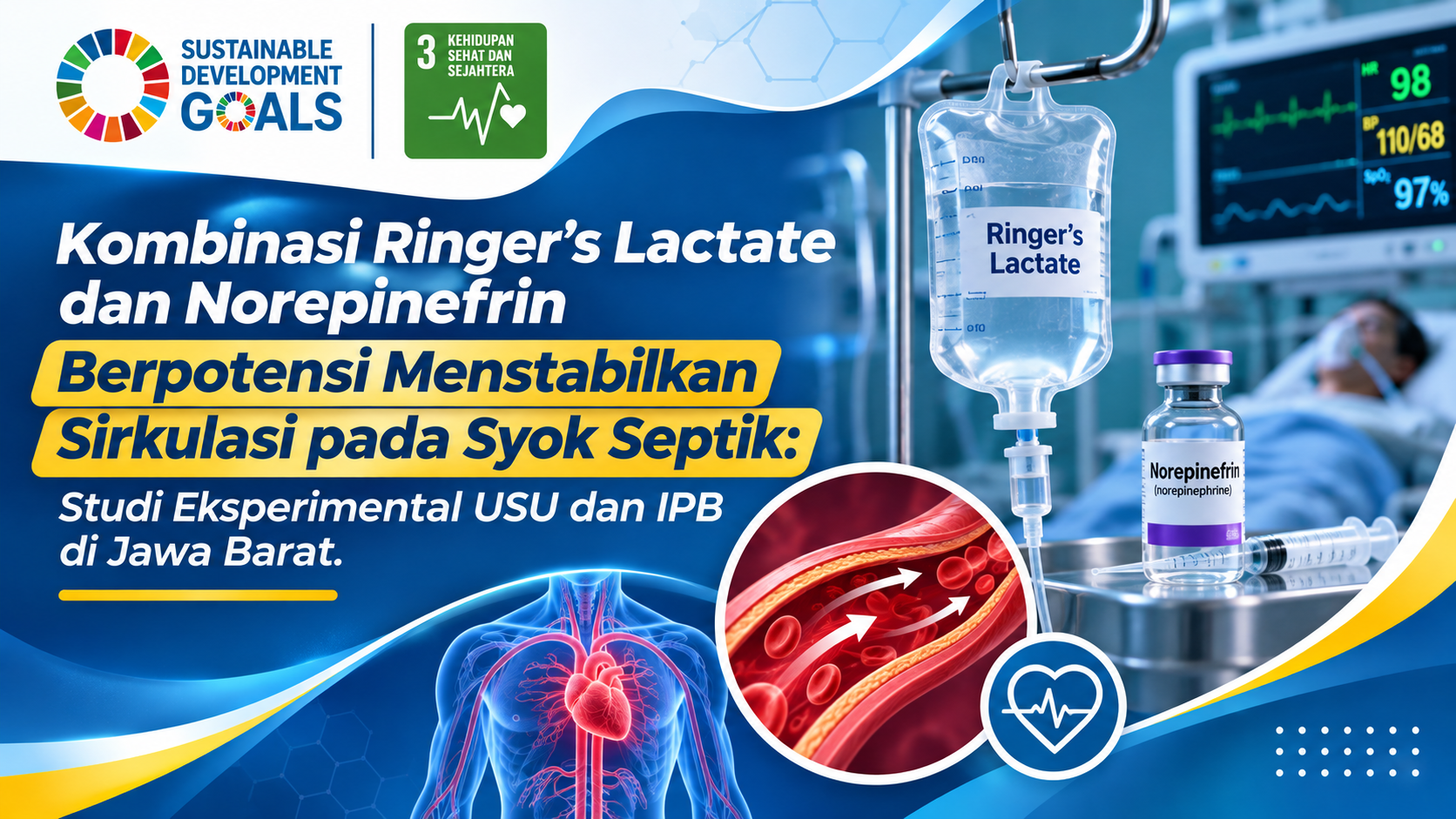
Sepsis is a medical emergency that can progress to septic shock, a condition in which circulatory dysfunction causes blood pressure to drop and blood flow to the organs to become insufficient. In this situation, medical personnel must act quickly to restore perfusion pressure while ensuring that the heart can continue pumping blood effectively. However, the choice of resuscitation strategy still requires careful consideration: should intravenous fluids be administered first, should blood pressure-raising medication be used earlier, or should both be administered simultaneously?
This question became the focus of a study entitled “Cardiac Index and Mean Arterial Pressure Responses to Ringer’s Lactate and Norepinephrine Therapy in Experimental Porcine Septic Shock Conducted in West Java, Indonesia”. Published in the Journal of Asian Scientific Research in 2026, the study compared hemodynamic responses to three approaches to managing septic shock using an animal model of pigs. The research provides experimental insights into how Ringer’s lactate and norepinephrine affect two important indicators, namely cardiac index (CI) and mean arterial pressure (MAP).
Septic shock occurs when the body's response to an infection triggers severe circulatory dysfunction. Blood vessels can dilate, fluid can move out of the blood vessels, and blood pressure can decrease. As a result, vital organs are at risk of receiving inadequate supplies of blood and oxygen. Therefore, hemodynamic monitoring is important during resuscitation. MAP represents the average pressure driving blood flow to tissues, while CI indicates the amount of blood pumped by the heart per minute, adjusted for body surface area. Assessing both provides a more complete picture than relying solely on blood pressure.
In the management of septic shock, Ringer’s lactate is a crystalloid fluid used to help replenish intravascular volume. Norepinephrine is a vasopressor that increases vascular tone, thereby helping restore arterial pressure. Fluids help increase venous return and cardiac filling, while norepinephrine addresses blood vessel dilation. However, excessive fluid administration carries the risk of volume overload, while vasopressors administered without adequate volume may not produce an optimal response.
To compare these three approaches, the researchers used a controlled, longitudinal experimental design. The study involved 12 male pigs (Sus scrofa) aged 14–18 weeks and weighing approximately 55–60 kilograms. The animals were divided into a control group and three treatment groups. The study was conducted at the Veterinary Teaching Hospital of the Bogor Agricultural Institute, West Java, Indonesia. Septic shock was induced using Escherichia coli endotoxin, and the shock condition was determined, among other criteria, based on a MAP below 65 mmHg.
After shock had been established, the treatment groups received different resuscitation strategies. The first group received Ringer’s lactate. The second group received a combination of Ringer’s lactate and norepinephrine. The third group received norepinephrine without a combination with resuscitation fluids as the primary intervention. The researchers monitored changes in hemodynamic parameters at several stages: before shock induction, during shock, and after the intervention. Monitoring was conducted to observe changes in CI and MAP, allowing the responses to each strategy to be compared over time.
The results showed that MAP decreased in all groups when septic shock occurred. After the interventions, blood pressure increased again, although the magnitude of the response differed between groups. The highest MAP increase reported in the study abstract occurred in the Ringer’s lactate group, with a change of approximately 15 mmHg. However, statistical comparisons found no significant differences between the groups. This finding is important because it shows that an increase in blood pressure alone is not sufficient to conclude definitively that one resuscitation strategy is superior to the others.
An interesting pattern was also observed in the cardiac index. During the shock phase, CI decreased, indicating that the circulatory system's ability to maintain blood flow was also impaired. After the interventions, the greatest average increase in CI was observed in the group receiving the combination of norepinephrine and Ringer’s lactate. The CI change in the combination group was recorded at 2.43 ± 1.47 L/min/m². By comparison, the Ringer’s lactate group recorded a change of 1.60 ± 0.46 L/min/m², while the norepinephrine-only group recorded 0.44 ± 0.46 L/min/m².
Although the figures for the combination group appeared to be the highest, the difference did not reach statistical significance. The reported p-value was approximately 0.1, meaning that the results were not sufficient to establish that the combination of the two therapies produced a statistically greater increase in CI than the other approaches. Therefore, these findings are more appropriately interpreted as a promising response trend in an animal model, rather than definitive evidence that this combination is necessarily the most effective approach for human patients.
The researchers interpreted the combination of fluids and vasopressors as potentially providing complementary support. Ringer’s lactate helps improve circulating volume, while norepinephrine helps maintain vascular tone and perfusion pressure. The balance between intravascular volume and vascular tone is considered important for supporting cardiac function and maintaining systemic blood flow. In contrast, norepinephrine without fluid support showed the smallest average increase in CI in this experiment. This result is consistent with the idea that the response to vasopressors can be influenced by the adequacy of circulating volume.
Although it provides important insights, this study has limitations that need to be considered. The number of experimental animals was relatively small, limiting the statistical power to detect differences between groups. Pigs are indeed used as models because they share certain similarities with the human cardiovascular system, but they cannot fully represent the diversity of patient conditions, types of infection, comorbidities, and biological responses in humans. In addition, the study focused on macrocirculatory parameters in the form of CI and MAP. Microcirculatory function and direct organ perfusion were not measured, even though both also play a role in determining the adequacy of oxygen supply to tissues.
Overall, this study by a research team affiliated with Universitas Sumatera Utara and the Bogor Agricultural Institute adds experimental evidence regarding the importance of assessing blood pressure and cardiac blood flow simultaneously in septic shock. The combination of Ringer’s lactate and norepinephrine showed the greatest average increase in CI, while all strategies resulted in an increase in MAP after the interventions. Although the differences between groups were not statistically significant, these results support the need for a measured, individualized resuscitation approach focused on restoring perfusion rather than simply targeting blood pressure readings in isolation.
Key Research Points
The study was conducted by Andriamuri Primaputra Lubis, Syah Mirsya Warli, Tasrif Hamdi, Gunanti, and Muhammad Rusda.
The study involved collaboration between researchers from Universitas Sumatera Utara and the Bogor Agricultural Institute.
The research subjects were 12 male pigs (Sus scrofa) used as an experimental model of septic shock.
The study compared three resuscitation strategies: Ringer’s lactate, a combination of Ringer’s lactate and norepinephrine, and norepinephrine alone.
The main parameters observed were cardiac index (CI) and mean arterial pressure (MAP).
The highest average increase in CI was found in the group receiving the combination of Ringer’s lactate and norepinephrine, at 2.43 ± 1.47 L/min/m².
The highest MAP increase reported in the study abstract was found in the Ringer’s lactate group, at approximately 15 mmHg.
Differences in CI responses between groups did not reach statistical significance (p approximately 0.1).
The study demonstrates the potential of combining fluids and vasopressors to support hemodynamic stabilization, but further research involving humans is still needed.
The findings emphasize the importance of monitoring blood pressure and cardiac blood flow simultaneously in the management of septic shock.
Author
Khairul Azmi
Source/Researcher
dr. Andriamuri Primaputra Lubis, M. Ked (An), SpAn-TI, Subsp. TI (K)