


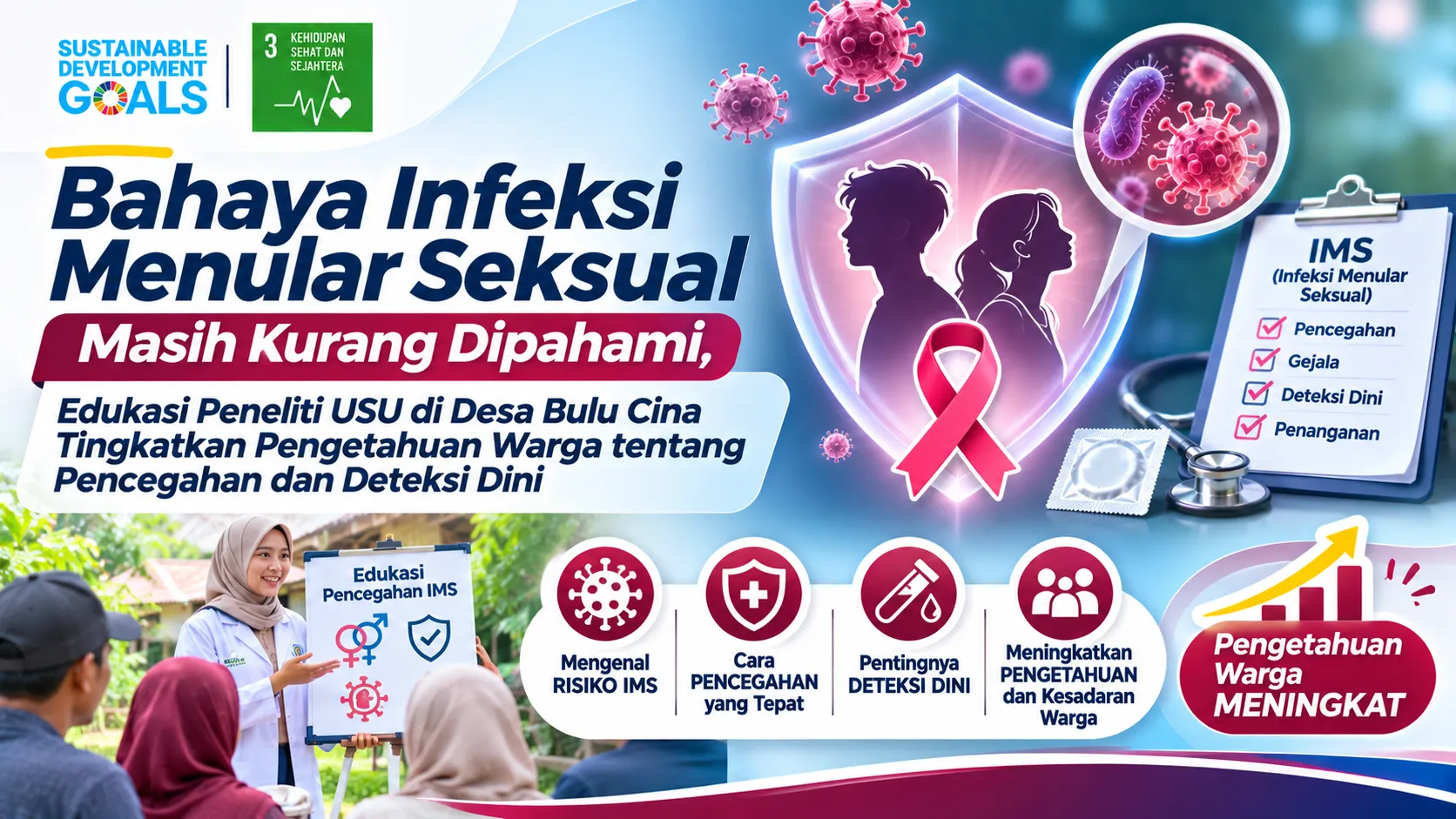
Sexually transmitted infections (STIs) remain a public health issue that is often hidden behind embarrassment, stigma, and limited information. Many people still do not understand the signs of infection, how it is transmitted, or the importance of getting tested as soon as symptoms first appear. In response to this challenge, the Universitas Sumatera Utara (USU) team introduced a family health education program in Bulu Cina Village, Deli Serdang Regency, which demonstrated an improvement in public knowledge about the prevention and early detection of sexually transmitted infections.
The activity was published in the Jurnal Pengabdian Masyarakat Kedokteran, Volume 5, Number 3, in 2026, through an article entitled Meningkatkan Pengetahuan Kesehatan Keluarga terhadap Infeksi Menular Seksual (IMS) di Desa Bulu Cina, Hamparan Perak, Deli Serdang. The program was conducted by Flora Marlita Lubis, Dina Arwina Dalimunthe, and Fithria Aldy from Universitas Sumatera Utara, combining approaches from dermatology and venereology and eye health.
Sexually transmitted infections are a group of diseases that can be transmitted through sexual contact and are caused by various microorganisms, including bacteria, viruses, and parasites. Some types of infections can cause noticeable symptoms, while others develop without easily recognizable signs.
In their publication, the USU team explained that STIs remain a global health problem due to high transmission rates and the potential for complications. A lack of knowledge about these diseases can lead to delayed examinations, inappropriate treatment, and an increased likelihood of transmission.
This issue becomes even more complex when people are reluctant to discuss reproductive health. Social stigma can cause individuals to postpone medical consultations even when they are experiencing symptoms that require attention.
One infection of concern is gonorrhea, a disease caused by the bacterium Neisseria gonorrhoeae. This infection can affect the reproductive tract and cause symptoms such as pain during urination or abnormal discharge from the genital organs.
However, the effects of gonorrhea are not always limited to the reproductive tract. Under certain conditions, the bacteria that cause it can also lead to eye infections, particularly through contact with infected secretions or transmission from mother to baby during childbirth.
Gonococcal eye infection in newborns is a particular concern because it can cause severe inflammation of the conjunctiva. If treatment is delayed, this condition can potentially cause eye damage and serious visual impairment.
In addition to gonorrhea, the educational material also highlighted genital ulcers, which are open sores that appear in the genital area. This condition can be associated with several sexually transmitted infections and therefore requires examination to determine the actual cause.
The community service team also discussed pathological vaginal discharge. Not all vaginal discharge indicates disease, as some is part of a normal physiological process. However, changes in color, odor, consistency, or certain accompanying symptoms may be reasons to seek a health examination.
In response to this need, the USU team organized an educational program in Bulu Cina Village, Hamparan Perak District, Deli Serdang Regency. This area was selected because public understanding of STIs and the importance of reproductive health remained limited.
The activity took place on September 25, 2025, involving 45 respondents from the local community. Most participants were homemakers who attended the educational session alongside community health volunteers and village community representatives.
The educational approach was designed to ensure that relatively sensitive medical information could be delivered simply, openly, and in an easily understandable manner. The team used interactive lectures, discussions, demonstrations, and learning materials in the form of posters and leaflets.
The program began with an assessment of participants' knowledge using a pretest. Participants were asked to answer questions about sexually transmitted diseases, genital ulcers, vaginal discharge, gonorrhea, and their effects on health.
After the material was presented, participants took a posttest using a questionnaire to measure changes in their understanding. This method provided an immediate picture of their knowledge levels before and after the educational session.
The first evaluation results showed an improvement in knowledge about genital ulcers. Before the educational session, 15 participants, or 33.3%, were in the poor knowledge category, while 29 participants, or 64.4%, had a moderate level of knowledge.
Only one participant, or 2.2%, was classified as having good knowledge in the initial assessment. This condition indicated that understanding sores on the genital organs remained an important educational need among the participants.
After the educational session, the results changed considerably. No participants remained in the poor knowledge category. A total of ten participants, or 22.2%, were in the moderate category, while 35 participants, or 77.8%, achieved the good knowledge category.
This improvement indicates that providing information about the signs of genital ulcers, their possible causes, and the importance of medical examinations can improve participants' understanding in the short-term evaluation.
Positive changes were also found in the material on pathological vaginal discharge and gonorrhea related to eye health. Before the educational session, two participants, or 4.4%, had poor knowledge, 22 participants, or 48.9%, were in the moderate category, and 21 participants, or 46.7%, were in the good category.
After receiving the education, 41 participants, or 91.1%, achieved the good knowledge category. The remaining four participants, or 8.9%, were in the moderate category, while no participants remained in the poor category.
These results demonstrate that health education can improve participants' understanding of the differences between normal and pathological vaginal discharge, the risks of gonorrhea, and the importance of early recognition of infections that may affect eye health.
In addition to demonstrating improved knowledge, this activity highlighted the importance of family involvement in STI prevention efforts. Families play a role in building health-related communication, providing support, and encouraging family members to seek medical assistance when they experience symptoms.
Community health volunteers can also serve as a link between residents and healthcare facilities. By obtaining accurate information, these volunteers have the potential to help reduce misunderstandings and encourage the public to become more open to reproductive health education.
Although the activity results showed positive progress, improved knowledge scores do not automatically prove changes in STI prevention behavior. The publication did not report long-term measurements of changes in infection rates, health practices, or the use of testing services.
Therefore, continuous education remains necessary to ensure that the knowledge gained can be applied in everyday life. Appropriate medical examinations, stigma-free communication, and easy access to healthcare services are important parts of preventing complications.
Ultimately, the Universitas Sumatera Utara community service program in Bulu Cina Village demonstrates that health education delivered directly to the community can improve public understanding of reproductive health issues that are often considered taboo.
Through the empowerment of families and community health volunteers, STI education can serve as an initial step toward strengthening awareness of prevention, symptom recognition, and early detection. This activity also supports the achievement of Sustainable Development Goals (SDGs) Goal 3, namely ensuring healthy lives and promoting well-being for all through improved health literacy and access to quality health information.
Key Research Points:
The community service program was conducted in Bulu Cina Village, Hamparan Perak District, Deli Serdang Regency, on September 25, 2025.
The activity involved 45 participants, most of whom were homemakers.
The educational material covered sexually transmitted infections, genital ulcers, pathological vaginal discharge, gonorrhea, and the possible effects of gonorrhea on eye health.
The educational sessions used interactive lectures, discussions, demonstrations, posters, and leaflets.
Before the genital ulcer education session, only 2.2% of participants were in the good knowledge category.
After the genital ulcer education session, the proportion of participants with good knowledge increased to 77.8%, representing an increase of 75.6 percentage points.
For the topics of pathological vaginal discharge and gonorrhea, the proportion in the good knowledge category increased from 46.7% to 91.1%, representing an increase of 44.4 percentage points.
After the educational sessions, no participants were in the poor knowledge category for either of the two evaluated topic groups.
The activity demonstrates the potential of community-based health education to improve knowledge about STIs.
The study did not measure changes in prevention behavior or reductions in STI incidence over the long term.
Author
Khairul Azmi
Source/Researcher
dr. Flora Marlita Lubis, Sp.D.V.E, Subsp. D.T, M.Ked (DV), FINSDV, FAADV