


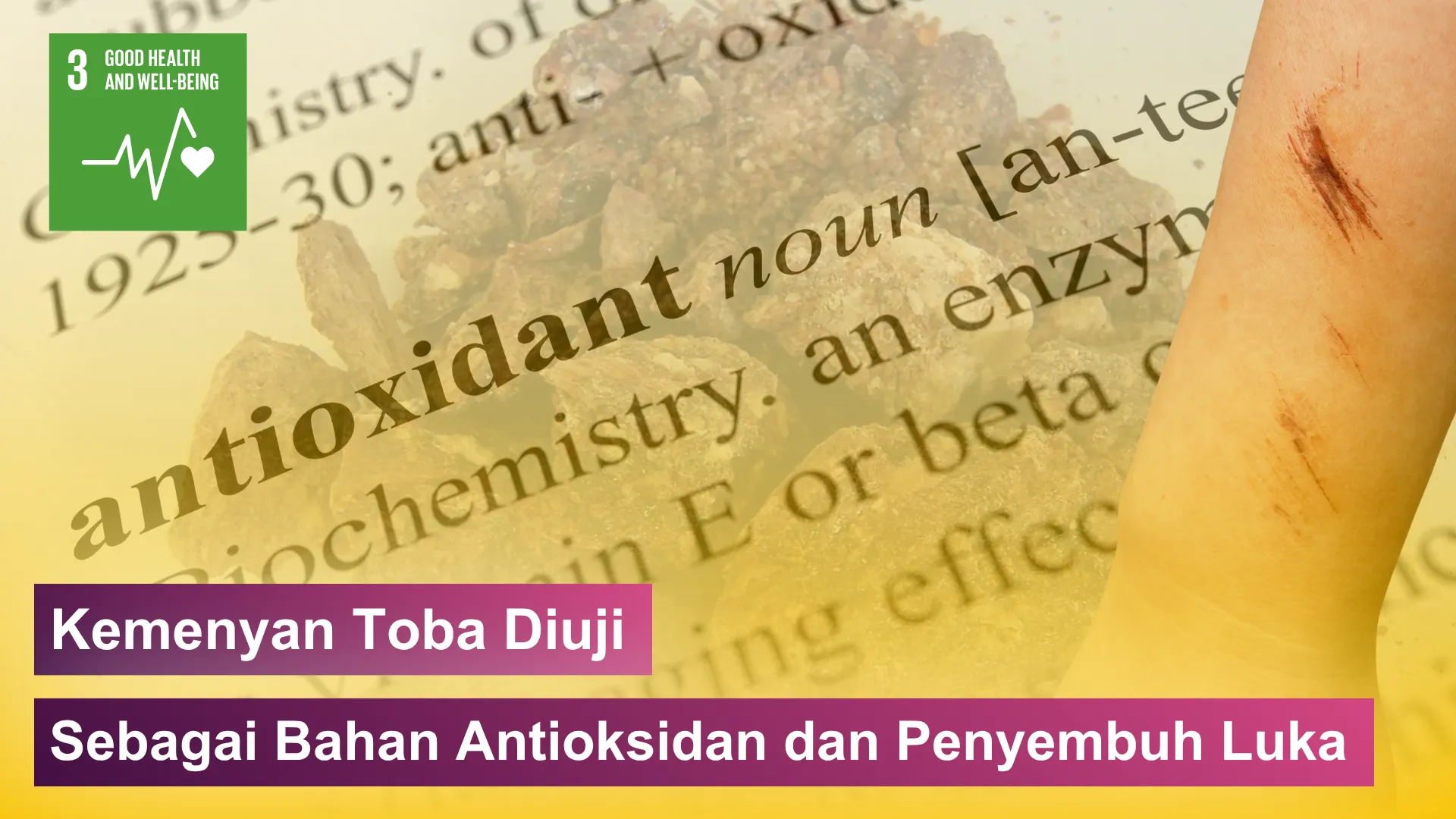
For centuries, frankincense tree resin has been used in many cultures for rituals, fragrances, and medicinal purposes. In North Sumatra, particularly around Lake Toba, a species known as Toba frankincense (Styrax sumatranus J.J.Sm.) is recognized. This tree grows in the natural forests of the Humbang Hasundutan area and has not been extensively studied scientifically in terms of its chemical composition. A research team from Universitas Sumatera Utara (USU) sought to address this gap. The study was led by Dina Arwina Dalimunthe from the Doctoral Program in Medical Science, Faculty of Medicine, USU, together with colleagues from the Departments of Dermatology and Venereology, Pharmacology, Neurosurgery, Histology, and Obstetrics and Gynecology at USU, as well as one researcher from Universitas Andalas, Padang.
From Resin to Extract
The material used was dried and powdered frankincense simplicia. A total of 1,800 grams of powder was soaked in 96 percent ethanol for several days, filtered, and then evaporated using a rotary evaporator until a concentrated extract was obtained. The extract was subsequently tested using three methods: phytochemical screening to identify compound groups, antioxidant testing, and bacterial inhibition testing.
Compound Groups Identified
Qualitative testing showed that the extract contained alkaloids, flavonoids, glycosides, and saponins. Tannins were not detected in the main results table, although the method for testing them was included in the manuscript. A more detailed analysis using liquid chromatography and high-resolution mass spectrometry (LC-HRMS/MS) identified eight compounds. The compound with the highest percentage was vanillin, recorded at approximately 43.7 percent, followed by trans-cinnamaldehyde at approximately 7.7 percent. Other compounds included ursolic acid, matairesinol, and 18β-glycyrrhetinic acid, which are recognized in plant research as compounds with antimicrobial and anti-inflammatory activities.
Free Radical Scavenging Capacity
The DPPH assay was used to determine how effectively the extract scavenged free radicals. At a concentration of 100 ppm, the extract inhibited approximately 50 percent of radical activity. The IC50 value, which represents the concentration required to inhibit half of the activity, was recorded at approximately 92 ppm. According to the authors, this value indicates strong activity.
Antibacterial Activity Remains Limited
Testing against three bacteria, namely Staphylococcus epidermidis, Staphylococcus aureus, and Escherichia coli, produced varying results. The extract at concentrations of 0.1 to 0.3 percent produced inhibition zones of only approximately 7 to 8 millimeters against E. coli, far below those of 1 percent silver sulfadiazine (approximately 14 millimeters) and Bioplacenton (approximately 17 millimeters). For the two Staphylococcus bacteria, extract data were not visible in the results table.
Computer Simulations of the Antioxidant Pathway
As a supplementary analysis, the team conducted molecular docking simulations to examine how strongly the compounds bound to the Keap1 protein. This protein plays a role in regulating cellular responses to oxidative stress. Two compounds showed the most negative binding values: ursolic acid at approximately -9.73 kcal/mol and 18β-glycyrrhetinic acid at approximately -9.61 kcal/mol. These results provide preliminary insights but do not demonstrate that the compounds work within cells or skin tissue.
Implications for Wound Treatment
The authors linked these findings to the traditional use of frankincense for treating burns. They also mentioned that cinnamic acid, a major component in the GC-MS analysis, can suppress inflammatory cytokines and increase TGF-β1. However, since wound healing has not yet been tested in animals or humans, this claim remains hypothetical. Further research is needed, including testing on wound models, standardization of compound concentrations, and safety testing.
Key Research Points
The ethanol extract of Toba frankincense (Styrax sumatranus) from Humbang Hasundutan, North Sumatra, was tested through phytochemical screening, DPPH assays, bacterial inhibition tests, and docking simulations.
Phytochemical screening identified alkaloids, flavonoids, glycosides, and saponins.
LC-HRMS/MS identified eight compounds, with vanillin as the most abundant component according to the reported percentages.
The antioxidant IC50 value was approximately 92 ppm, classified as strong by the authors.
The inhibition zone against E. coli was only approximately 7 to 8 millimeters, considerably weaker than the comparators.
Docking simulations identified ursolic acid and 18β-glycyrrhetinic acid as potential Keap1-binding candidates, but these results have not yet been tested in the laboratory.
The manuscript is still a preprint and has not undergone peer review.
Author
Khairul Azmi
Resource Person/Researcher
Dr. dr. Dina Arwina Dalimunthe, M.Ked(KK), Sp.D.V.E., Subsp. D.T., FINSDV, FAADV