


Not all errors in scientific journals have major consequences, but in the field of forensics, an incorrect figure can affect how officers interpret discovered human remains. This is why a research team from Universitas Sumatera Utara (USU) decided to correct a table in their publication.
What Was Wrong
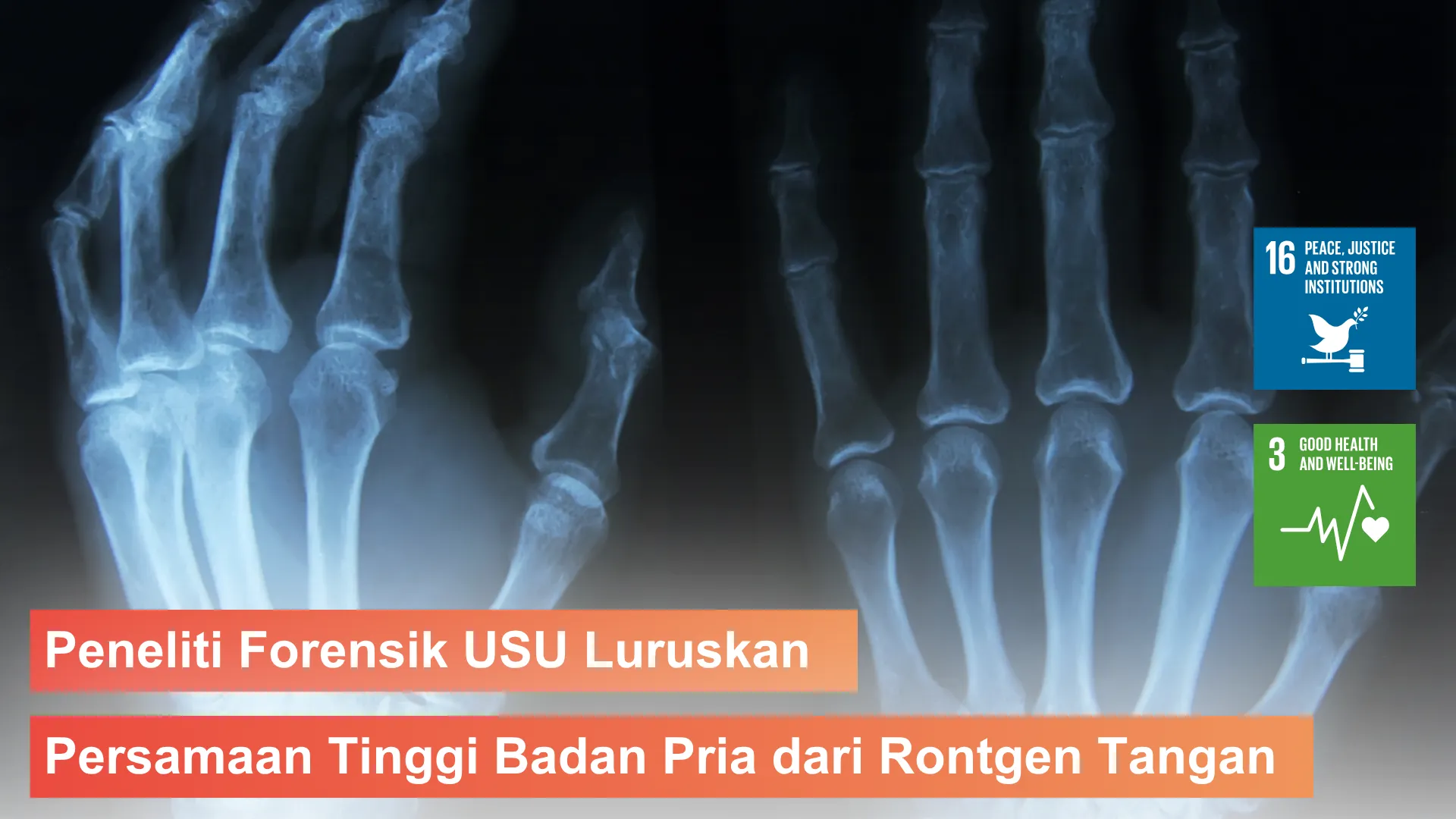
The original study examined how to estimate a person's height from the length of the metacarpal bones visible on X-rays, with the aim of assisting in the identification of bodies when other body parts are incomplete. The regression equations were presented in Table 7, which separated the data for females and males. In the published version, three rows of the male equations contained a plus sign after the coefficient value, for example, “TB = 115,491 + 11,626 (M1RM) + 7,765”. However, the subsequent figure, 7,765, represents the standard error of estimate, which should have been displayed using the ± symbol. With a plus sign, readers might assume that this value should also be added to the estimated height, even though its function is to indicate the uncertainty of the estimate.
The fourth row for males in the table was already correct in the original version, so only three rows were revised. The authors described the error as a typographical mistake, not a change to the data.
The Correction
In the correction, the plus signs in the three rows were replaced with ± signs. The following equations are now listed:
TB = 115,491 + 11,626 (M1RM) ± 7,765
TB = 117,033 + 11,414 (M1LM) ± 4,9001
TB = 106,546 + 9,220 (M2RM) ± 7,903
TB = 110,446 + 7,111 (M2LM) ± 4,916
This correction does not change the coefficients or the study's main conclusions. The authors apologized for any inconvenience caused.
Why This Matters
Height estimation equations are used to help officers estimate a victim's identity when a body is difficult to identify. An incorrectly placed sign can mislead the interpretation of results, particularly when the equations are used directly by other practitioners. With this correction, readers can use the accurate formulas as a reference.
Key Points
Official correction to Table 7 in Forensic Imaging Vol. 44 (2026), 200655.
Three rows of the male equations were corrected by replacing plus signs with ± signs because the figures that follow represent the standard error of estimate.
The regression coefficients and study conclusions remain unchanged.
The study used metacarpal lengths from X-rays to estimate height for postmortem identification.
Author
Khairul Azmi
Resource Person/Researcher
Dr. dr. Asan Petrus, M.Ked(For), Sp.F