


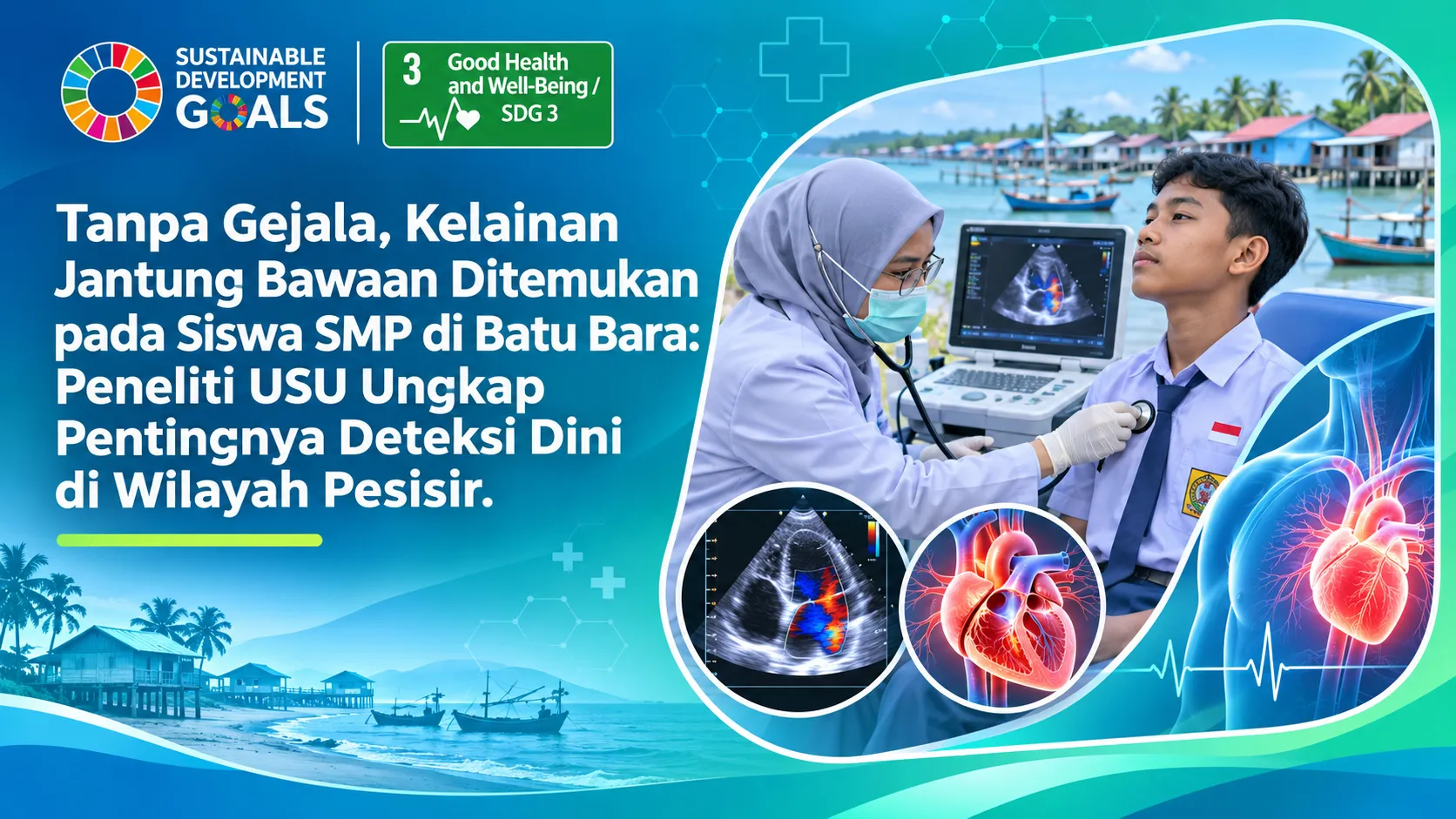
A child may appear healthy, actively participate in lessons, and carry out school activities just like their peers, yet have a congenital heart defect that has never been detected. This is what a research team from the Faculty of Medicine, Universitas Sumatera Utara (USU), discovered while conducting heart health screening among junior high school students in the coastal area of Batu Bara Regency, North Sumatra. The findings serve as a reminder that not all heart conditions show symptoms that are easily recognized at an early stage.
The study, entitled Early Detection Screening for Congenital Heart Disease (CHD) in the Junior High School Student Population in the Coastal Area of Batu Bara Regency, North Sumatra, was published in the Sumatera Medical Journal (SUMEJ), Volume 9, Number 3, September 2026. The study, conducted by Ali Nafiah Nasution, Refli Hasan, Muhammad Rusda, Mustafa Mahmud Amin, Rodiah Rahmawaty Lubis, and Harisa Mardiah, evaluated the implementation of school-based congenital heart disease screening using portable cardiac examination technology.
Congenital Heart Disease (CHD) refers to structural abnormalities of the heart that are present from birth. These conditions can affect blood flow and heart function, with varying degrees of severity. Globally, congenital heart disease is estimated to occur in eight to ten out of every 1,000 live births. Some defects can be identified during infancy, but others are only detected when children reach school age or even adulthood.
The challenges are even greater in coastal areas and regions with limited healthcare facilities. Access to cardiologists, echocardiography examinations, and advanced diagnostic services is not always readily available. As a result, heart defects that do not cause obvious symptoms can remain undetected for years. Delayed diagnosis may increase the risk of complications and the need for more complex medical treatment.
To address this issue, the USU team conducted a descriptive observational study with a cross-sectional approach at SMP Negeri 1 Tanjung Tiram, Batu Bara Regency. The activity targeted 200 students, but ten did not undergo the examination because they were absent on the day it was conducted. Consequently, 190 students aged 10–15 successfully completed the entire series of cardiac health screening procedures.
The examinations were conducted in two stages. The first stage involved collecting demographic information, interviewing participants about their medical histories, and conducting physical examinations to assess their general condition and identify possible symptoms of heart problems. The second stage involved a 12-lead electrocardiogram (ECG) and portable echocardiography. Echocardiography allows medical personnel to observe the heart's structure directly, making it possible to identify anatomical abnormalities that may not be detected through routine examinations.
Of the 190 participants, 104 students, or 54.7%, were male, while 86 students, or 45.3%, were female. The participants' average age was 13.21 years. Based on demographic characteristics, the majority came from the Malay ethnic group (72.1%), followed by Javanese (14.2%) and Batak (7.4%). These figures provide information about the characteristics of the student group participating in the screening in the coastal area of Tanjung Tiram.
The initial examination results showed that most participants were in stable clinical condition. Their average oxygen saturation was 98.16%, while the average systolic blood pressure was recorded at 104.38 mmHg. A total of 185 students, or 97.4%, reported no heart-related health symptoms. Only three students, or 1.6%, complained of easily becoming tired, while two students, or 1.1%, experienced shortness of breath.
Interestingly, all participants showed normal sinus rhythm on their ECG examinations. However, this result does not mean that all students were confirmed to be free of structural heart defects. Further examinations using portable echocardiography instead revealed one case of congenital heart disease in the form of an Atrial Septal Defect (ASD), a condition involving a hole in the wall separating the right and left atria of the heart.
The case was identified in a 13-year-old student who had previously shown no prominent symptoms. In general, the student appeared healthy and had no complaints directly suggesting a heart problem. This finding demonstrates that certain congenital heart defects may remain undetected when examinations rely solely on physical complaints or symptoms experienced by patients.
Among all 190 students, the single ASD case identified represented a detection rate of 0.5%. Meanwhile, the examinations found no cases of Ventricular Septal Defect (VSD), a defect in the wall separating the heart's ventricles, or Patent Ductus Arteriosus (PDA), a condition in which a particular blood vessel that should close after birth remains open.
The researchers emphasized that identifying this asymptomatic case has important implications for preventive healthcare strategies. Echocardiography successfully identified a structural heart defect that had not been revealed through reported symptoms or routine ECG results. After the initial diagnosis was established, the identified student received specialized health education and was referred to a cardiologist at a regional hospital for further examination and treatment.
The successful use of portable devices also demonstrates opportunities for developing community-based healthcare services. By bringing examination technology directly into schools, geographical barriers and the need to travel to referral hospitals can be reduced. This approach is considered relevant for coastal areas, remote regions, and communities with limited access to specialist healthcare services.
However, this study has several limitations. The examination involved only 190 students from one school, so the 0.5% figure cannot be considered representative of the prevalence of congenital heart disease throughout Batu Bara Regency. The cross-sectional design also did not allow the researchers to evaluate changes in patients' conditions over the long term. In addition, the study did not include younger children or children who do not attend school.
Based on these findings, the research team recommends integrating congenital heart disease screening into the School Health Program (UKS), particularly in areas with limited healthcare facilities. Physical examinations can be supplemented with non-invasive diagnostic technology according to needs and available resources. Improving the capacity of healthcare workers at community health centers and strengthening referral systems are also important components of developing this program.
Further studies involving larger numbers of participants and multiple coastal areas are needed to obtain a more representative epidemiological picture. Monitoring students who receive positive screening results is also important to assess their health progress and ensure continuity of medical care following referral.
This study demonstrates USU's contribution to promoting equitable access to children's healthcare services through the application of diagnostic technology in school settings. These efforts are aligned with Sustainable Development Goal (SDG) 3, which emphasizes the importance of healthy lives and well-being for people of all ages.
Ultimately, the findings from Tanjung Tiram convey a simple but important message: children who appear healthy are not necessarily free from congenital heart defects. Through appropriate screening, early examinations, and more equitable access to healthcare services, previously undetected abnormalities can be identified before they develop into more serious health problems.
Key Research Points:
The study used a descriptive observational design with a cross-sectional approach involving 190 students from SMP Negeri 1 Tanjung Tiram, Batu Bara Regency, North Sumatra.
Participants were aged 10–15 years, with an average age of 13.21 ± 0.64 years.
A total of 104 students (54.7%) were male and 86 students (45.3%) were female.
A total of 185 students (97.4%) reported no symptoms of heart problems, while three students (1.6%) experienced fatigue and two students (1.1%) experienced shortness of breath.
All participants (100%) showed normal sinus rhythm based on electrocardiogram (ECG) examinations.
Portable echocardiography successfully identified one case of Atrial Septal Defect (ASD) in a 13-year-old student who had previously shown no symptoms.
The detection rate of congenital heart disease was 0.5% (1 out of 190 participants), but this figure cannot be generalized as the prevalence for the entire population of Batu Bara Regency.
No cases of Ventricular Septal Defect (VSD) or Patent Ductus Arteriosus (PDA) were found among the screened participants.
The student diagnosed with ASD received health education and was referred to a cardiologist at a regional hospital for further evaluation and treatment.
The researchers recommend integrating congenital heart disease screening into the School Health Program (UKS), improving primary healthcare workers' capabilities, and conducting further research involving a wider range of participants.
The study supports the achievement of SDG 3 through stronger early detection of noncommunicable diseases, more equitable access to healthcare services, and the prevention of complications from congenital heart disease in children.
Writer
Khairul Azmi
Source/Researcher