


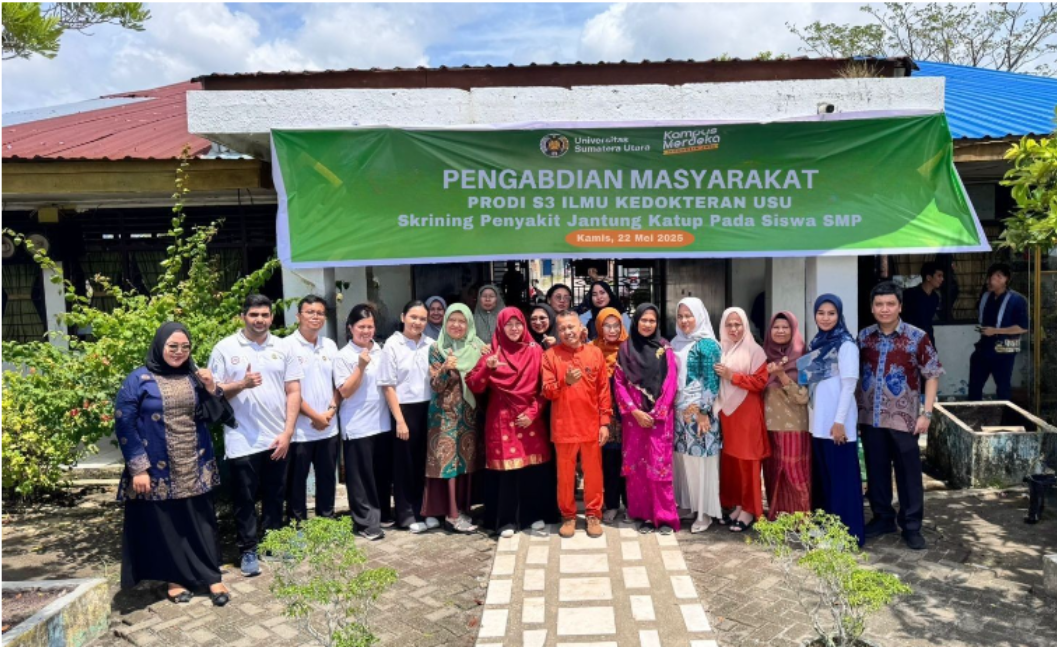
Heart disease is not only a health issue affecting adults and the elderly, but can also occur in children and adolescents, including heart valve disorders that sometimes do not present clear symptoms. This condition requires attention because heart valve abnormalities can affect blood flow and heart function if they develop without appropriate treatment. As an effort to support the early detection of cardiovascular disorders in educational settings, the Doctoral Program in Medical Sciences, Faculty of Medicine, Universitas Sumatera Utara (USU), carried out a community service activity entitled “Heart Valve Disease Screening for Students of SMP Negeri 1 Tanjung Tiram, Batu Bara Regency” on May 22, 2025. The activity was led by Prof. Opim Salim Sitompul, together with a team involving Tengku Winda Ardini, Refli Hasan, Elmeida Effendy, and Muhammad Rusda. Conducting screening at the school demonstrated attention to the importance of heart health from adolescence, particularly because some heart abnormalities may go unnoticed until certain symptoms appear. Heart valve disease is a condition in which one or more of the heart valves cannot open or close normally. These disorders may involve valve narrowing or leakage, causing blood flow to function improperly. In children and adolescents, valve abnormalities may be associated with congenital conditions or acquired diseases, including rheumatic heart disease resulting from complications of rheumatic fever.
Early detection of heart valve disease plays an important role because some patients may experience mild symptoms or even show no complaints in the early stages. Symptoms that require attention include easily becoming tired, shortness of breath during physical activity, chest pain, palpitations, and a decline in the ability to perform physical activities compared with usual. However, these symptoms do not always indicate a heart valve abnormality, so examination by healthcare professionals is necessary to determine the cause. In medical services, an initial evaluation may include a review of medical history and a physical examination, including listening to heart sounds using a stethoscope. If indications of an abnormality are found, further examinations such as echocardiography can help assess the structure and function of the heart valves. The community service activity at SMP Negeri 1 Tanjung Tiram highlighted the importance of screening as an initial step in identifying potential health problems that require further attention. A school-based approach is relevant because educational settings are places where students engage in various activities that require optimal physical condition. Unidentified heart health problems may potentially affect students' comfort during activities, physical fitness, and quality of life. Therefore, awareness of heart health needs to be strengthened through the support of families, schools, and healthcare facilities. The involvement of academics from the Faculty of Medicine, USU, demonstrates the university's contribution to expanding attention to health examinations for children and adolescents in the community.
Through this community service activity, the Doctoral Program in Medical Sciences, Faculty of Medicine, USU, demonstrated the importance of preventive and early detection approaches in supporting the health of younger generations. Heart valve disease screening in the school environment is expected to serve as a step toward increasing awareness of health disorders that may affect students' growth, activities, and well-being. Support from teachers and parents is also necessary to ensure that students experiencing suspicious symptoms can receive examinations and medical treatment according to their needs. In addition, adopting healthy lifestyle habits, monitoring health conditions, and appropriately treating certain infections can form part of efforts to maintain heart health. The success of the screening program needs to be evaluated based on the number of participants examined, findings requiring follow-up, and the continuity of healthcare services for students. Through collaboration between the university and the educational environment, this activity is expected to strengthen awareness of the importance of heart health from school age. The program also aligns with the achievement of the Sustainable Development Goals (SDGs), particularly SDG 3 on Good Health and Well-Being and SDG 4 on Quality Education. By increasing attention to the early detection of heart disease, Universitas Sumatera Utara also supports the development of a healthier, more active younger generation with opportunities to thrive optimally.