


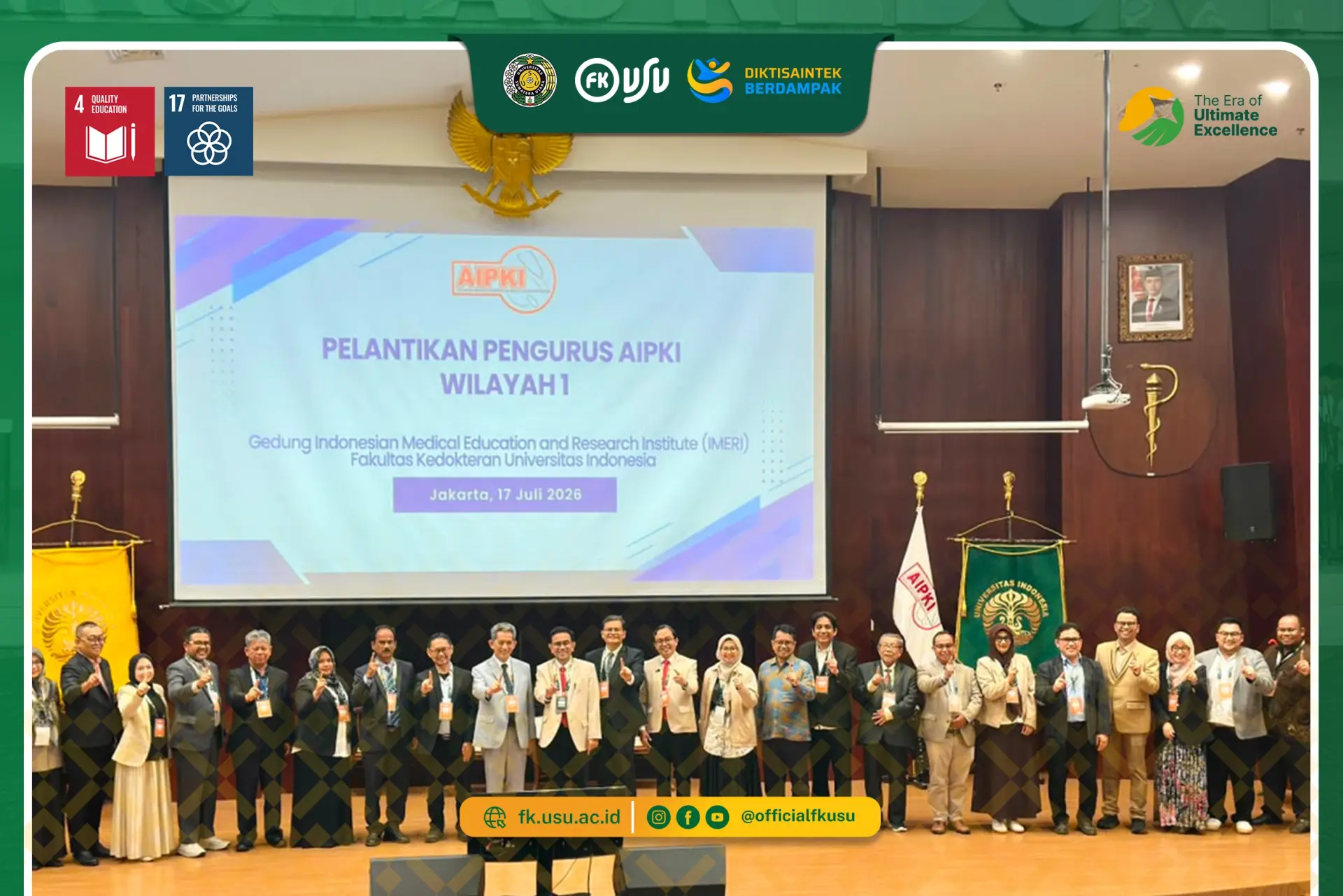
Jakarta – The Faculty of Medicine, Universitas Sumatera Utara (FK USU), participated in the inauguration ceremony of the Executive Board of the Association of Indonesian Medical Education Institutions (AIPKI) Region I, held on 17 July 2026 at the Indonesian Medical Education and Research Institute (IMERI), Faculty of Medicine, Universitas Indonesia, Jakarta. FK USU was represented by its Dean, Dr. dr. Muara Panusunan Lubis, M.Ked(OG), Sp.OG., Subsp.K.Fm., demonstrating the faculty's commitment to strengthening collaboration and advancing medical education in Indonesia.
The inauguration marked an important milestone for medical faculties across Sumatra, providing a platform to reinforce synergy in improving the quality of medical education, strengthening institutional governance, and expanding inter-university collaboration. Through its newly inaugurated leadership, AIPKI Region I is expected to initiate strategic programs that support the continuous enhancement of medical education in line with advances in science, technology, and the evolving needs of Indonesia's healthcare system.
FK USU's participation reflects its ongoing commitment to actively contributing to academic forums and professional organizations dedicated to the advancement of medical education. Through AIPKI, member institutions are expected to exchange best practices, share experiences, and develop innovative approaches to delivering adaptive, high-quality, and globally competitive medical education.
As an institution committed to producing competent and professional medical graduates, FK USU continues to support initiatives aimed at enhancing educational quality through stronger institutional partnerships, academic collaboration, and sustainable improvements in educational governance. Its involvement in AIPKI also demonstrates FK USU's contribution to building a medical education ecosystem capable of addressing healthcare challenges at both the national and global levels.
This activity also supports the achievement of the Sustainable Development Goals (SDGs), particularly SDG 4 (Quality Education), through efforts to improve the quality of medical education and develop highly qualified human resources, as well as SDG 17 (Partnerships for the Goals) by strengthening strategic partnerships among higher education institutions to foster collaborative, innovative, and sustainable medical education.