


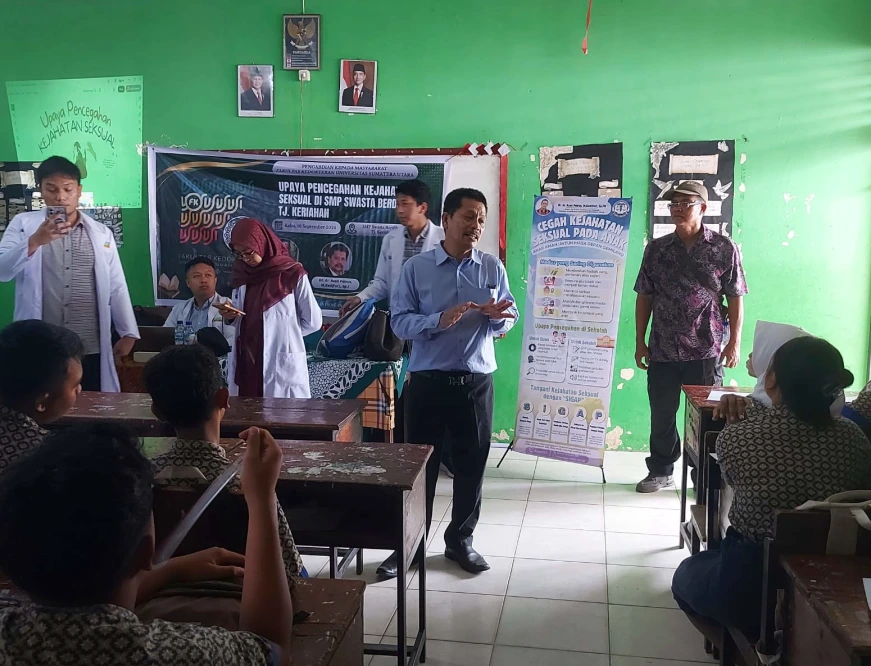
Sexual crimes against children and adolescents are a serious issue that requires collective attention, particularly in educational environments, which should be safe places for students to learn and develop. A lack of understanding of personal boundaries, forms of sexual harassment, and ways to seek help can increase children's vulnerability to actions that endanger their physical and psychological safety. In response to the importance of this issue, the Department/Study Program of Forensic Medicine, Faculty of Medicine, Universitas Sumatera Utara (USU), conducted a community service activity entitled “Socialization on Efforts to Prevent Sexual Crimes in School Environments at Berdikari Tj. Keriahan Private Junior High School” on September 16, 2026. The activity was led by dr. M. Yusuf Rachmatsyah, M.Ked(OG), Sp.OG, Subsp.KFm., together with a team involving Dr. dr. Asan Petrus, M.Ked(For), Sp.FM and dr. Esther Reny Deswani Sitorus, M.Ked(PA), Sp.PA. The program addressed child protection and the prevention of sexual crimes as important aspects of building awareness within the school community. During adolescence, students experience various physical, emotional, and social changes that require guidance and accurate health information. Education on self-protection is essential so that students understand their right to bodily safety, are able to recognize inappropriate actions, and know that all forms of sexual harassment and violence are violations that cannot be justified.
Through this socialization activity, efforts to prevent sexual crimes were positioned as a shared responsibility among schools, families, educators, and the community. Education on bodily boundaries and consent in social interactions is one relevant aspect of strengthening student protection. Children and adolescents need to understand that no one has the right to force, threaten, or engage in sexual acts against them, including individuals they know or those in positions of authority. This awareness is important in helping students recognize unsafe situations and seek assistance from trusted adults or relevant authorities. Preventing sexual crimes also requires a school environment that provides a safe space for students to share their experiences and concerns without fear of being blamed or stigmatized. From a forensic medicine perspective, handling sexual violence cases is not only related to medical examinations but also requires attention to victim safety, medical documentation in accordance with procedures, and coordination with child protection services and the relevant authorities when necessary. Therefore, understanding prevention and initial response is an important part of strengthening the protection system in educational environments. The involvement of academics from the Faculty of Medicine, USU, through this community service activity demonstrates the university's contribution to disseminating health and safety knowledge directly relevant to students' lives.
In addition to increasing awareness of self-protection, this activity is expected to encourage the development of a school culture that is more attentive to preventing sexual violence. These efforts require ongoing support through open communication among teachers, students, and parents; the provision of safe and confidential reporting mechanisms; and assistance that prioritizes victim safety. Prevention education should also be delivered in age-appropriate language, without causing excessive fear or placing the responsibility for prevention solely on children. Schools play an important role in ensuring that every report is taken seriously, while families are expected to build relationships that make children feel safe sharing their experiences. Through collaboration among various parties, awareness of sexual crimes can be strengthened into more concrete prevention measures. The community service activity conducted by the Department/Study Program of Forensic Medicine, Faculty of Medicine, USU, at Berdikari Tanjung Keriahan Private Junior High School represents one form of academic involvement in supporting the protection of the younger generation. This program is in line with the achievement of the Sustainable Development Goals (SDGs), particularly SDG 3 – Good Health and Well-Being, SDG 4 – Quality Education, and SDG 16 – Peace, Justice, and Strong Institutions. By strengthening education and collective awareness, the school environment is expected to become increasingly capable of providing a sense of safety, respecting the dignity of every student, and supporting children's growth and development without the threat of sexual violence.