


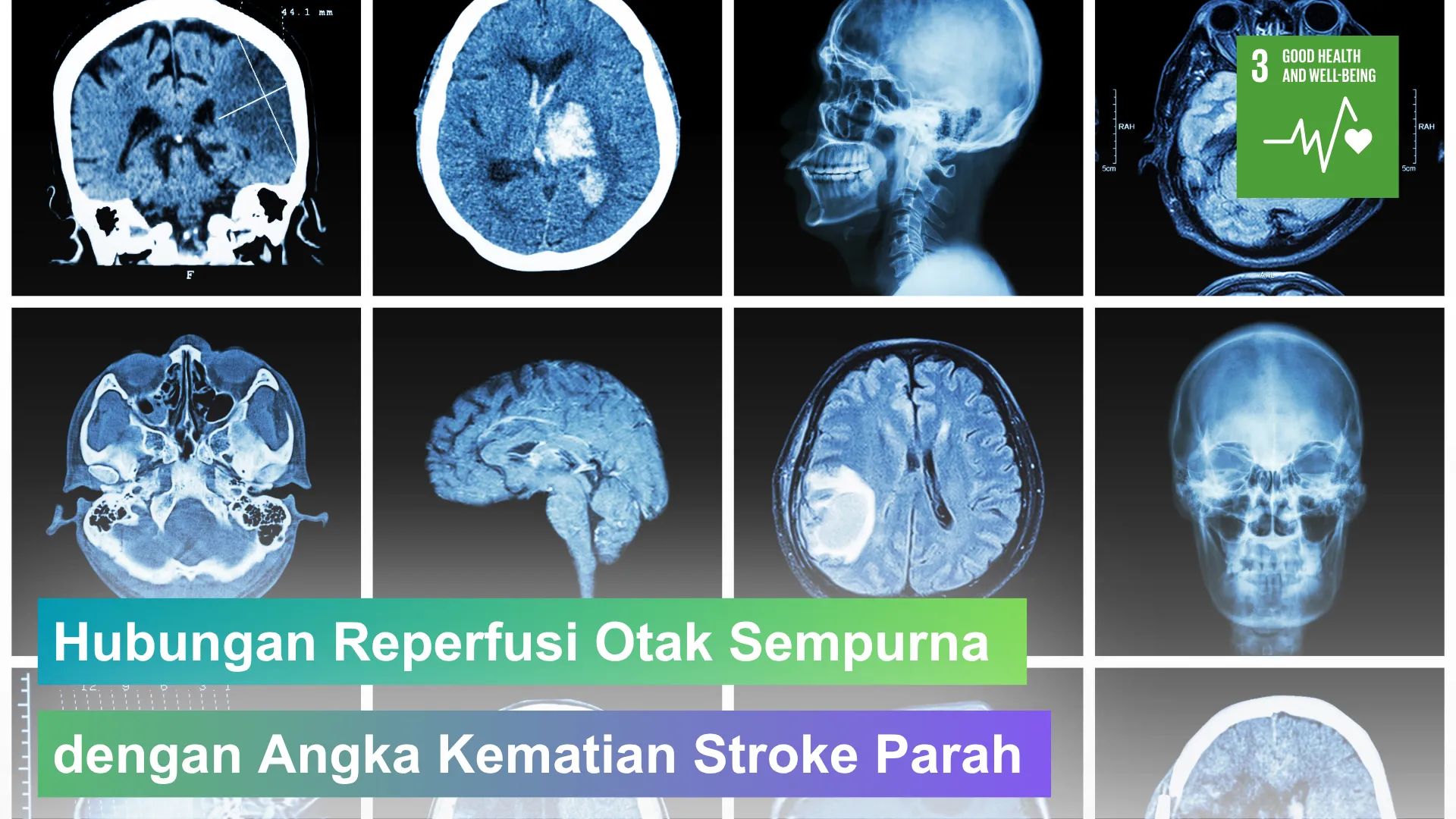
Ischemic stroke occurs when blood flow to the brain is blocked. The longer the blood flow is interrupted, the more brain tissue dies. The ASPECTS (Alberta Stroke Program Early CT Score) is used by doctors to assess the extent of early damage on brain scans. A score of 10 indicates minimal damage, while a score below 6 or 7 indicates extensive damage and a poorer prognosis.
Mechanical thrombectomy, which involves removing blood clots through a catheter, has been proven beneficial for many stroke patients. However, patients with low ASPECTS scores have often been excluded because they are considered high-risk. In this group, doctors face a difficult decision during the procedure: whether to settle for partially opening the blood vessel or continue clot removal until complete reperfusion is achieved.
A research team from the Department of Neurosurgery, Faculty of Medicine, Universitas Sumatera Utara (USU), together with Siloam Hospitals Dhirga Surya Medan and colleagues from Tangerang, Surabaya, and Universitas Methodist Indonesia, reviewed the available evidence.
How the Review Was Conducted
This review followed the PRISMA 2020 guidelines and was registered with PROSPERO (CRD420251126680). Searches were conducted in PubMed, Google Scholar, and the Cochrane Library for studies published from January 2005 to August 2025. Of the initial 1,618 records, eight studies involving a total of 2,780 patients met the eligibility criteria. The treatment group consisted of patients with complete reperfusion (mTICI 3), compared with patients with partial reperfusion (mTICI 2a or 2b). The primary outcomes were mortality and functional independence at 90 days (mRS 0 to 2), while intracranial hemorrhage was assessed as a safety outcome.
What Was Found
Patients with complete reperfusion had a lower risk of death than those with partial reperfusion (risk ratio 0.67; 95 percent confidence interval 0.59 to 0.77). This reduction was observed in the anterior circulation stroke subgroup, while the difference in posterior circulation stroke was not significant.
Regarding intracranial hemorrhage, six studies involving 2,192 patients found no statistically significant overall difference (risk ratio 0.72; confidence interval 0.44 to 1.19). In the analysis based on imaging modalities, studies using CT showed lower rates of hemorrhage with complete reperfusion, while studies using DWI showed no difference.
Regarding functional independence, complete reperfusion was associated with a higher likelihood of achieving mRS 0 to 2 (risk ratio 2.4; confidence interval 1.41 to 4.07). Heterogeneity among the studies was relatively high.
Implications for Healthcare Services
The authors believe that in stroke cases involving extensive areas of damage, achieving complete reperfusion can reduce mortality without significantly increasing the risk of hemorrhage. However, they emphasize that these findings do not mean clot removal should be continued without limits. Decisions during the procedure need to be tailored to the patient's condition.
Research Key Points
A systematic review and meta-analysis of eight studies involving 2,780 ischemic stroke patients with low ASPECTS scores who underwent thrombectomy.
Complete reperfusion (mTICI 3) was associated with a lower risk of death (RR 0.67; 95 percent CI 0.59 to 0.77).
There was no significant overall difference in intracranial hemorrhage (RR 0.72; 95 percent CI 0.44 to 1.19).
Complete reperfusion was associated with higher functional independence (mRS 0 to 2; RR 2.4; 95 percent CI 1.41 to 4.07), with high heterogeneity.
Author
Khairul Azmi
Source/Researcher
Dr. dr. Steven Tandean, M.Ked(Neurosurg), Sp.BS