


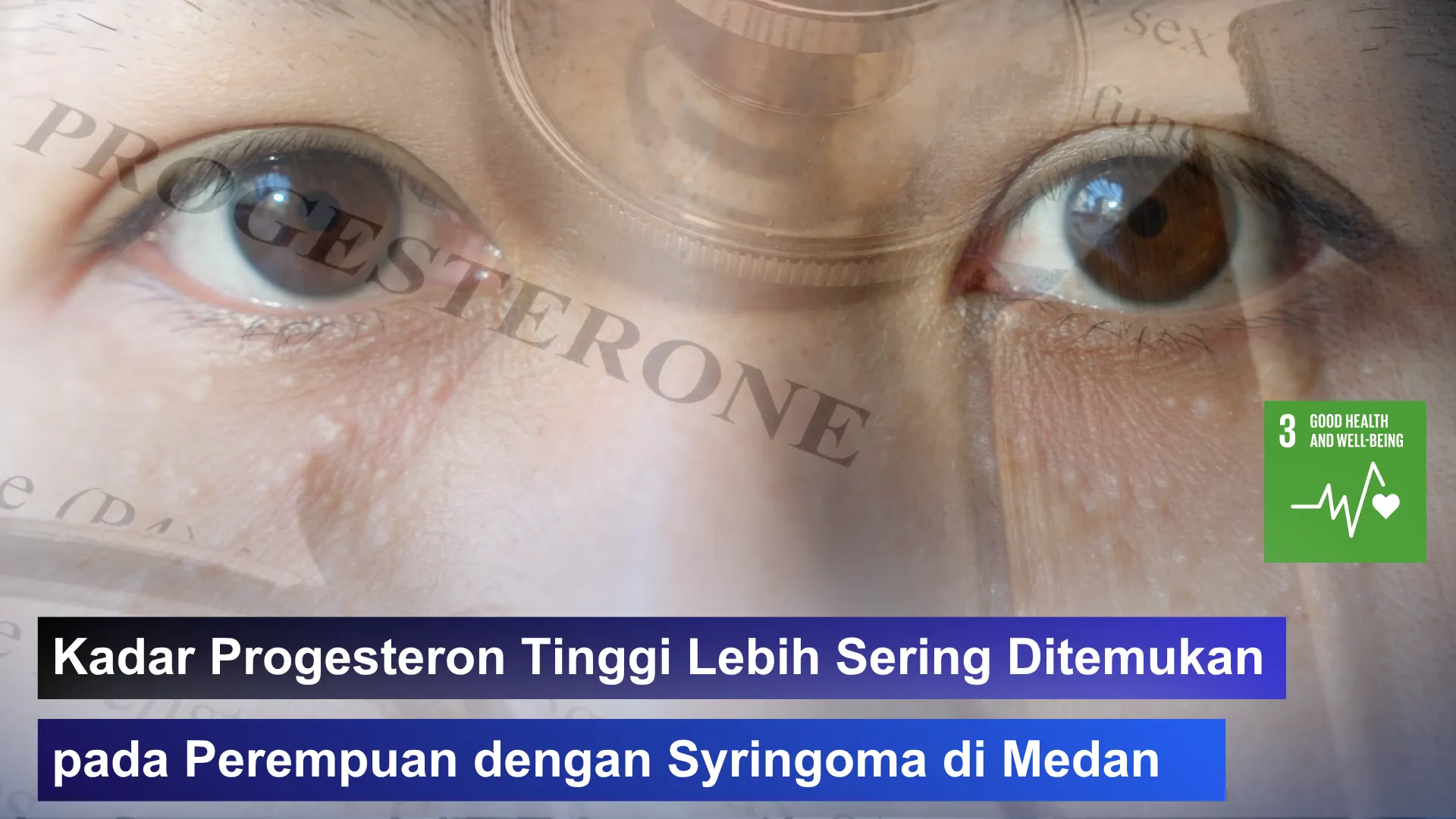
Syringoma originates from the eccrine sweat glands, which play a role in regulating body temperature. Its lesions appear as small papules measuring one to five millimeters, usually skin-colored or yellowish, and most commonly occur around the lower eyelids. Syringoma is not malignant, but it can affect appearance and make sufferers feel less confident.
The cause of syringoma is not yet fully understood. Hormonal, genetic, and autoimmune factors, as well as sun exposure, are suspected to play a role. Progesterone is known to interact with receptors in the skin, and previous immunohistochemical studies have found progesterone receptor expression in most syringoma patients. However, the direct relationship between blood progesterone levels and syringoma has not been widely studied.
The dermatology team from the Faculty of Medicine, Universitas Sumatera Utara (USU), sought to answer this question in Medan. The study was conducted at Padang Bulan Community Health Center in collaboration with services at Haji Adam Malik General Hospital.
Who Was Studied and How
This cross-sectional study involved 70 women over the age of 18, consisting of 35 patients with syringoma and 35 women without syringoma, who were examined from October 2023 to August 2024. Only women were included to reduce hormonal variations. Participants with normal menstrual cycles, ranging from 21 to 38 days, were eligible. Participants who were pregnant, breastfeeding, had used hormonal contraceptives or hormonal medication within the previous three months, or had reached menopause were excluded.
Syringoma was diagnosed based on medical history, clinical examination, and dermoscopy by a dermatologist. Biopsies were not routinely performed because they were considered cosmetically inappropriate for lesions around the eyes. Blood samples were collected during the luteal phase, and progesterone levels were measured using ELISA. Levels below 2 ng/mL were considered low, while levels of 22 ng/mL or higher were considered high.
What Was Found
Most syringoma patients were aged 26 to 35 years (48.6 percent), with an average age of 34.2 years. The most common type was localized (51.4 percent), followed by the familial type (25.7 percent) and generalized type (22.9 percent). The most common location was the lower eyelids.
High progesterone levels were found in 10 of the 35 syringoma patients (28.6 percent), compared with 2 of the 35 controls (5.7 percent). The odds ratio was 6.6, with a 95 percent confidence interval between 1.33 and 32.8, and a p-value of 0.023. The highest progesterone level in the syringoma group was recorded at 37.9 ng/mL.
The authors consider these findings to support the involvement of hormonal factors in syringoma, particularly through their effects on the activity and structure of sweat glands. They recommend that further studies assess progesterone receptor expression and consider hormonal therapy if hormonal involvement is confirmed.
Key Research Points
A cross-sectional study involving 35 women with syringoma and 35 women without syringoma in Medan, from October 2023 to August 2024.
High progesterone levels were more frequent in the syringoma group (28.6 percent) than in the control group (5.7 percent).
Odds ratio of 6.6 (95 percent CI 1.33 to 32.8; p = 0.023).
Syringoma was most commonly found in women aged 26 to 35 years and around the lower eyelids.
Diagnosis was based on clinical examination and dermoscopy, without routine histopathology.
The study has not yet been able to establish a causal relationship between progesterone and syringoma.
Author
Khairul Azmi
Source/Researcher
Dr. dr. Imam Budi Putra, MHA, Sp.D.V.E., Subsp. O.B.K, FINSDV, FAADV