


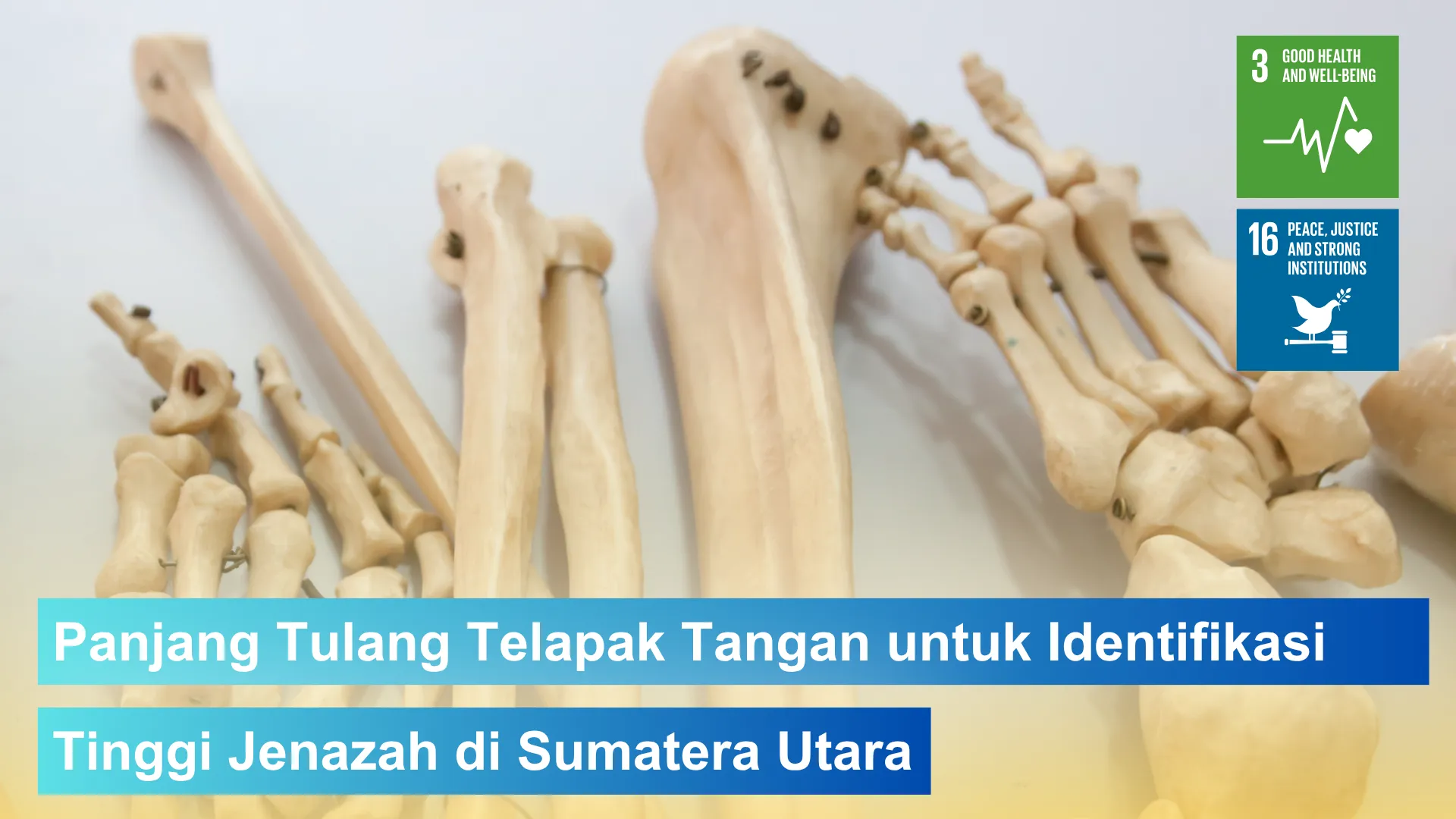
Natural disasters and crimes in Indonesia have increased over the past two decades, and quite several victims have suffered such severe bodily destruction that they cannot be visually identified. Under these circumstances, identification becomes very important, both for legal purposes and for the victims' families. One biological characteristic that helps with identification is height.
Anatomical methods for calculating height require complete bones, and such conditions are rarely found. Therefore, many researchers have developed mathematical equations that use measurements of one or several bones. Small bones, such as the metacarpal bones, are considered more resistant to postmortem changes. However, equations derived from one population are not necessarily suitable for another population, and in Indonesia, there is no official formula for metacarpal bones. A research team from the Department of Forensic Medicine and Medicolegal Sciences, Faculty of Medicine, USU, together with colleagues from Universitas Indonesia, IPB, and Universitas Airlangga, addressed this gap using data from North Sumatra.
How the Research Was Conducted
This analytical cross-sectional study was conducted from March to May 2024, involving 138 participants aged 21 to 25 years, consisting of 59 men and 79 women. Participants were selected through cluster random sampling to ensure representation of several ethnic groups. Participants had to be healthy adults who could stand, with no congenital bone abnormalities, history of fractures, physical disabilities, or scoliosis. The study was approved by the ethics committee of the Faculty of Medicine, USU, in February 2024.
Height was measured using a wireless digital stadiometer. The right and left hands were examined using digital posteroanterior X-rays. The lengths of metacarpals I to V were measured directly on the X-ray images using a digital caliper, from the base to the head of each bone. The analysis used SPSS version 26 with Pearson correlation and linear regression tests.
What Was Found
Among women, the length of the right second metacarpal had the strongest correlation with height, with a coefficient of 0.691 and an R² value of approximately 47 percent. A combination of four right-hand bones (metacarpals I to IV) produced a correlation of 0.725. Among men, the right fourth metacarpal had the strongest correlation, at 0.654, with an R² of approximately 42 percent. A combination of four bones yielded a correlation of 0.690.
When both sexes were combined, the correlation increased. The right second metacarpal alone produced a correlation of 0.754, while a combination of five right-hand bones reached 0.763. The smallest standard error of estimate was approximately 4.1 centimeters for women and 4.5 centimeters for men.
The authors also developed equations for each bone and their combinations, then compared them with equations from studies in Turkey, India, Egypt, and England. According to the authors, their findings indicate a greater influence of metacarpal measurements compared with previous studies.
Implications for Identification
The authors believe these equations can help forensic personnel estimate the height of a deceased person when only the metacarpal bones remain. They recommend considering metacarpal bones as one of the indicators in identification, alongside other data.
Research Key Points
A cross-sectional study involving 138 young adults (59 men, 79 women) in North Sumatra, from March to May 2024.
Metacarpal lengths were measured from digital X-rays of both hands and correlated with height.
For women, the right second metacarpal had a correlation of 0.691; for men, the right fourth metacarpal had a correlation of 0.654; and for the combined group, the right second metacarpal had a correlation of 0.754.
Combining several bones increased the correlation, with the highest correlation of 0.781 obtained from a combination of five left-hand bones in the combined group.
The authors developed regression equations for women, men, and the combined group.
The equations have not been validated using a separate sample, and the ethnic composition of the sample does not correspond to census data.
Author
Khairul Azmi
Source/Researcher
Dr. dr. Asan Petrus, M.Ked(For), Sp.F