


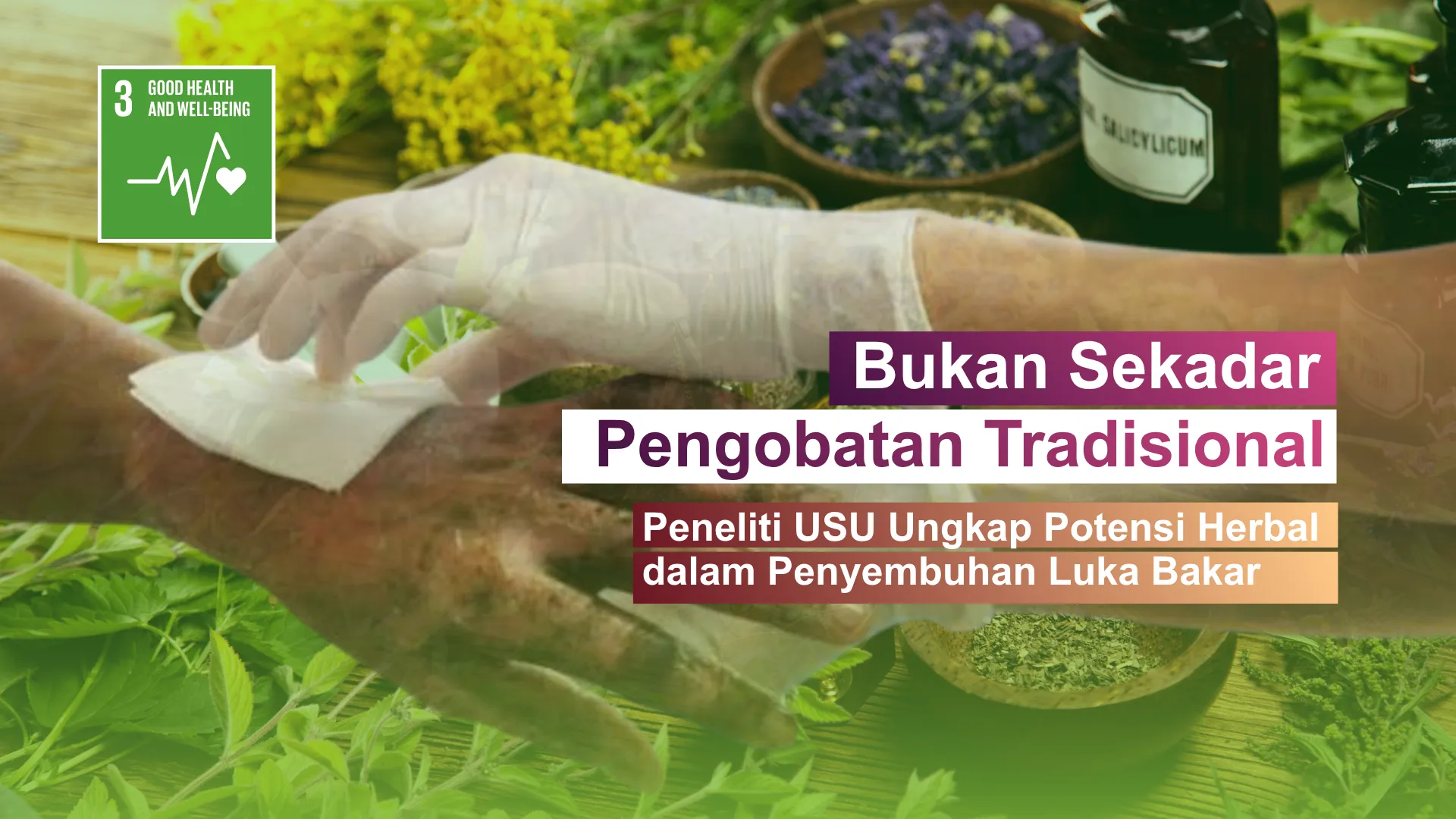
Can Herbal Remedies Help Treat Burns? USU Researchers Review the Potential of Medicinal Plants for Wound Healing
MEDAN – A research team from Universitas Sumatera Utara (USU) examined the potential use of various herbal ingredients to support the burn wound healing process. This study reviewed a number of scientific publications to evaluate the benefits of medicinal plants in supporting skin tissue recovery, reducing inflammation, and accelerating wound healing.
Using a scoping review approach, the study identified 16 scientific publications discussing the use of herbal medicine for burn wounds. The findings showed that Aloe vera is the plant most frequently found in research related to burn wound healing.
The study, entitled “Efficacy of Herbal Remedies for Burn: A Scoping Review,” was published in the international journal Complementary Medicine Research on August 20, 2026. The article discusses the potential of herbal medicine as one approach that can be further developed in burn wound care.
Burns and the Challenges of the Healing Process
Burns are a type of injury that can occur due to exposure to fire, hot liquids, contact with hot objects, electricity, or chemicals. This condition can cause damage to skin tissue with varying degrees of severity. The burn wound healing process involves several biological stages, ranging from inflammation control and the formation of new tissue to the restoration of skin structure. Therefore, burn treatment requires an approach that can support tissue regeneration while preventing complications.
One approach that continues to be studied is the use of herbal ingredients. Various plants are known to contain bioactive compounds that have the potential to provide anti-inflammatory, antimicrobial, and regenerative effects. This potential has encouraged researchers to evaluate scientific evidence regarding the use of medicinal plants in supporting burn wound healing.
Reviewing 16 Scientific Publications on Herbal Medicine
To evaluate this potential, the research team conducted a literature review based on the PRISMA (Preferred Reporting Items for Systematic Reviews and Meta-Analyses) guidelines. Searches were conducted across six scientific literature databases, identifying 1,282 publications. After 50 duplicate articles were removed, the titles and abstracts of the remaining publications were examined for relevance to the research criteria. A total of 1,216 publications did not meet the inclusion criteria. Following a further eligibility assessment, 16 articles were ultimately selected for inclusion in the review. Through these publications, the researchers examined various types of plants and herbal ingredients that have been studied in relation to the burn wound healing process.
Aloe Vera Is the Most Widely Studied Plant
One of the main findings of this study was that Aloe vera is the plant most frequently used in research on burn wounds. This plant has several potential benefits in the wound healing process, including helping to reduce inflammation, supporting cell proliferation, and contributing to tissue remodeling. In addition to Aloe vera, this review also covered various other herbal plants that have been studied in burn wound care, such as licorice, Boswellia carteri, Andrographis paniculata, green tea, Plantago major, sea buckthorn, and Calendula officinalis. The diversity of these herbal ingredients demonstrates the broad potential of medicinal plants that can be further explored in wound care and the development of complementary therapies.
How Do Herbal Remedies Support Burn Wound Healing?
The review findings showed that various herbal ingredients have the potential to support the wound healing process through several biological mechanisms. Bioactive compounds contained in herbal plants may help reduce inflammation and provide antimicrobial activity. In addition, several herbal ingredients also have the potential to support re-epithelialization, the process of regenerating the damaged outer layer of the skin. The healing process is also associated with collagen synthesis and angiogenesis, or the formation of new blood vessels. Both processes play a role in tissue formation and recovery during wound healing.
Thus, the potential of herbal medicine is not limited to reducing inflammation but also includes supporting the regeneration and recovery of skin tissue.
Further Research Needed to Standardize Their Use
Although the findings indicate promising potential, this study emphasizes that further investigations are still needed to understand the mechanisms of action of each herbal ingredient and establish standards for their use in clinical practice. Standardization is important because each plant may have different bioactive compound contents, concentrations, and usage characteristics. Further research is needed to establish appropriate efficacy, safety, dosages, and methods of use. The development of stronger scientific evidence is expected to help integrate herbal therapies more systematically into burn wound care without neglecting safety principles and medical service standards.
Research Contributions to the Development of Herbal Medicine
This publication contributes to the development of complementary medicine, particularly in the use of medicinal plants to support burn wound healing. Through a review of various previous studies, this research demonstrates the potential of herbal ingredients to support tissue regeneration, reduce inflammation, and aid wound recovery.
The study was authored by Dina Arwina Dalimunthe, Poppy Anjelisa Zaitun Hasibuan, Ramona Dumasari Lubis, Andre Marolop Pangihutan Siahaan, Satya Wydya Yenny, Nelva Karmila Jusuf, Muhammad Rusda, and Zulham Yamamoto. The researchers are from several institutions, namely Universitas Sumatera Utara and Universitas Andalas. This publication also strengthens the contribution of research in exploring the potential of natural resources as part of the development of scientific knowledge and healthcare service innovation.
Key Research Points
This scoping review examined the effectiveness of various herbal treatments in supporting burn wound healing based on the PRISMA guidelines.
Literature searches were conducted across six scientific databases and identified a total of 1,282 publications.
A total of 50 duplicate publications were removed, followed by the exclusion of 1,216 publications that did not meet the inclusion criteria, leaving 16 articles for review.
Aloe vera is the plant most frequently identified in research on herbal medicine for burn wounds.
Aloe vera has the potential to help reduce inflammation, support cell proliferation, and promote tissue remodeling.
Various herbal ingredients have the potential to support wound healing through re-epithelialization, collagen synthesis, and angiogenesis.
Bioactive compounds in herbal plants have the potential to provide anti-inflammatory, antimicrobial, and regenerative benefits during the wound healing process.
The study recommends further investigations to understand the mechanisms of action of herbal ingredients and develop standards for their use in clinical practice.
Author
Khairul Azmi
Suggested Resource Person:
Dina Arwina Dalimunthe