


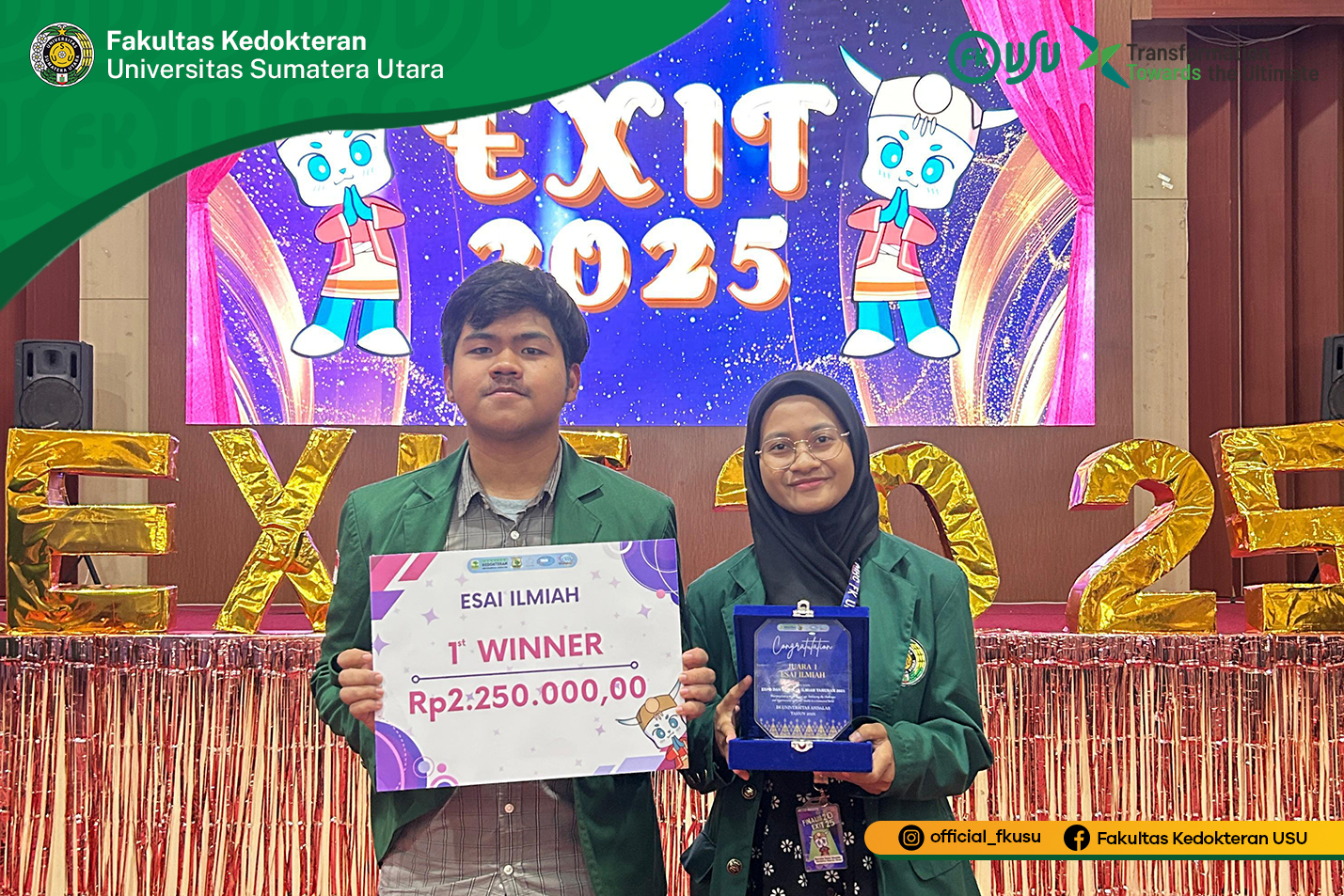
A delegation from the Faculty of Medicine, Universitas Sumatera Utara (FK USU), successfully won First Place in the Scientific Essay Competition at the 2025 Expo & Seminar Ilmiah Tahunan (EXIT) MRC, organized by the Faculty of Medicine, Universitas Andalas (FK Unand). The event was held on 14–16 February 2025 under the theme “Bridging Science and Treatment: Making Advancements in the Treatment of Neuropsychiatric Disorders”.
EXIT MRC 2025 aimed to enhance medical students’ research and innovation skills while promoting high-quality scientific works. Through this event, medical students were provided with opportunities to develop their abilities in conducting research, analyzing data, and effectively presenting research findings. The event featured several competition categories, including Literature Review, Public Poster, Educational Video, Scientific Essay, as well as a National Seminar.
Expo & Seminar Ilmiah Tahunan (EXIT) is an annual scientific event organized by the Medical Research Club (MRC) of BEM-KM, Faculty of Medicine, Universitas Andalas, serving as a platform for students to develop their academic, research, and innovation skills in the field of healthcare.
The achievement was secured by two FK USU delegates, Masyithoh Sausan Amjaddina and Afiq Triyandi Hakam. They participated in the Scientific Essay Competition with their work entitled “The Potential of Magnetoelectric Nanoparticle-Based Levodopa Delivery as a Minimal Non-Invasive Therapy for Parkinson’s Disease Patients”.
This achievement reflects the commitment of FK USU students to strengthening their research capabilities and developing innovative ideas that can contribute to the advancement of medical science, particularly in the field of neuropsychiatry.
The activity aligns with Sustainable Development Goal (SDG) 4: Quality Education by strengthening research culture, scientific analytical skills, and students’ competencies in producing high-quality academic works.
Furthermore, the innovative approach presented in the essay regarding Parkinson’s therapy also supports SDG 3: Good Health and Well-being. The development of innovative therapeutic approaches is expected to contribute to improving healthcare quality and promoting better health outcomes, particularly for individuals affected by neurodegenerative disorders.