


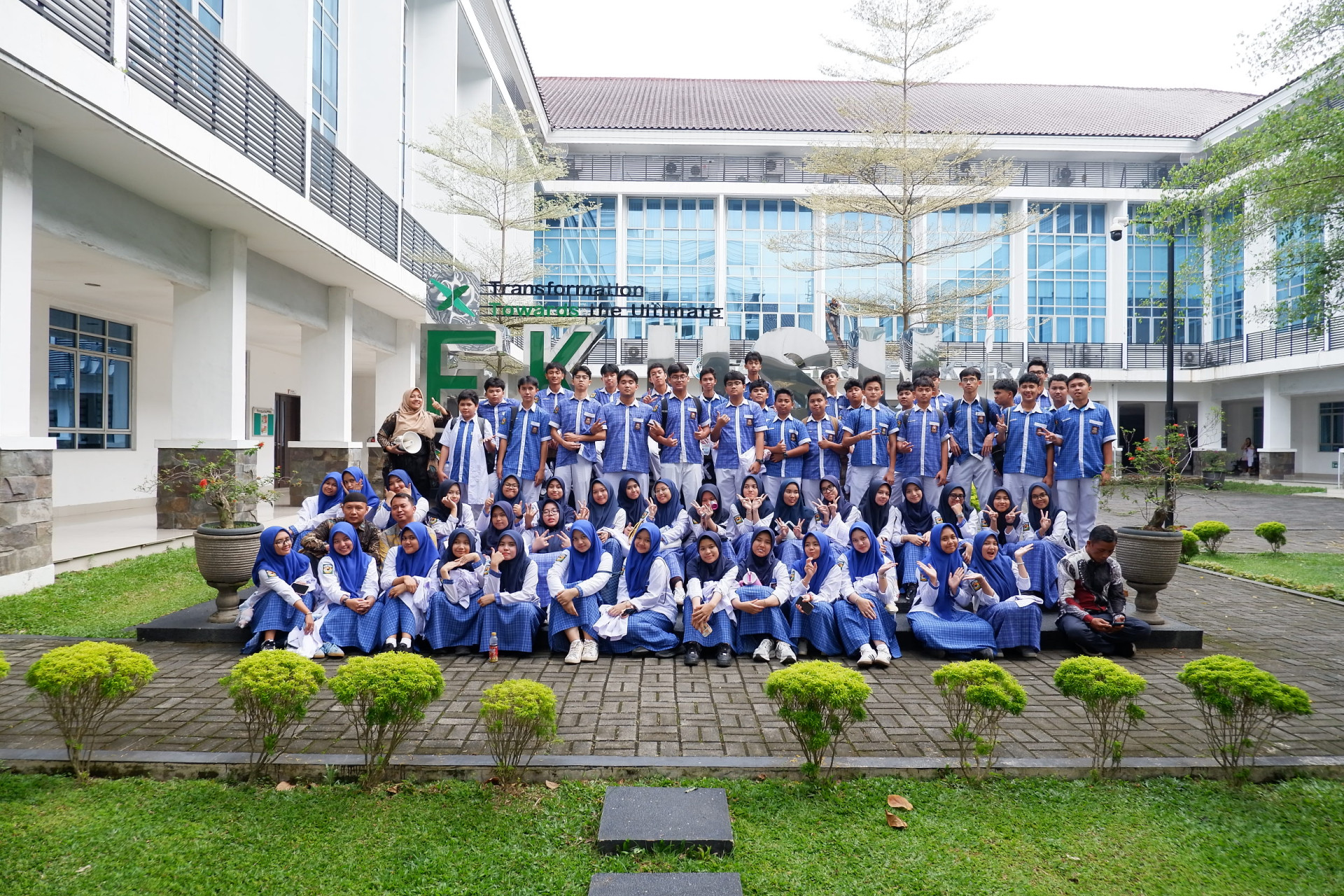
The Faculty of Medicine, Universitas Sumatera Utara (USU), welcomed students from Yayasan Pendidikan Harapan – SMA Harapan 3 Medan on Wednesday, October 15, 2025, at the third-floor auditorium of the USU Faculty of Medicine. The visit aimed to introduce students to the field of medical education at an early stage and provide firsthand insight into the learning process and academic environment of a medical school.
The student delegation was warmly welcomed by dr. Zulham, M.Biomed., Ph.D., Permanent Coordinator for Academic Affairs, Student Affairs, and Alumni, who also serves as Head of the Department of Histology; dr. Hidayat, M.Biomed., Advisor to Vice Dean III for Information Technology; and Enni Susianti, S.P., M.Si., Head of Administrative Affairs.
In his welcoming remarks, dr. Zulham expressed his appreciation for the visit and hoped that activities of this kind would inspire students to develop a passion for learning and motivate them to pursue higher education, particularly in the healthcare field.
“We are delighted to share our experiences with the students of SMA Harapan 3 Medan. We hope this visit will broaden their understanding of the medical profession and inspire them to pursue their dreams of becoming competent healthcare professionals in the future,” said dr. Zulham.
He also explained the history of the establishment of the USU Faculty of Medicine, including the development of its academic staff and student population since its early years. In addition, he provided information about the admission procedures and selection pathways available to prospective students interested in pursuing medical education at the faculty.
Meanwhile, dr. Hidayat emphasized that introducing students to the university’s academic environment is an important step in helping them shape their educational aspirations and future career goals.
“A Faculty of Medicine is not merely a place to learn theoretical knowledge; it is also an environment where character, discipline, and empathy for others are developed. We hope this visit will serve as an inspiration for the students,” he remarked.
This educational visit also supports the United Nations Sustainable Development Goals (SDGs), particularly SDG 3: Good Health and Well-being. By introducing medical education and health sciences at an early stage, students are encouraged to understand the importance of maintaining health, preventing disease, and developing a sense of responsibility toward their own health and the well-being of their communities. The visit also provides an opportunity to introduce the role of healthcare professionals in improving quality of life and promoting healthier communities.
Teachers from SMA Harapan 3 Medan also expressed their gratitude to the USU Faculty of Medicine for the warm welcome and the opportunity for students to learn directly within a university environment. Notably, according to an internal school survey, approximately 80% of the students participating in the visit expressed an interest in pursuing their studies at the USU Faculty of Medicine. This finding reflects the students’ strong enthusiasm for medical education and their interest in USU as one of the leading medical education institutions in North Sumatra.
During the visit, the students were guided through various campus facilities that support the academic activities of medical students. At the computer laboratory, they were introduced to digital learning systems used to support coursework and computer-based examinations. The laboratory is also used for student examinations and the administration of the Computer-Based Written Test (UTBK).
The students then visited the Skills Laboratory, where they observed how medical students practice basic clinical skills using mannequins and medical simulation equipment. Demonstrations included vital signs assessment, intravenous infusion procedures, and doctor-patient communication techniques. Through these demonstrations, the students gained insight into the importance of clinical skills, precision, and effective communication in delivering safe and high-quality healthcare.
The delegation subsequently visited the Anatomy Laboratory, where medical students study the structure of the human body in detail. The students were introduced to anatomical bone models, organ specimens, and cadavers used as learning materials to deepen their understanding of human anatomy. Through explanations provided by accompanying lecturers, they gained a greater appreciation of the importance of anatomy as a fundamental component of medical education and the development of future physicians.
In addition to SDG 3, this educational initiative can also be linked to SDG 6: Clean Water and Sanitation, particularly through raising awareness of the relationship between water quality, sanitation, environmental hygiene, and public health. Understanding access to clean water, proper sanitation, and clean and healthy living practices is essential for disease prevention, especially for illnesses transmitted through contaminated water and unhygienic environments. By introducing health sciences at an early stage, students are encouraged to become agents of change who promote clean and healthy living practices within their families, schools, and communities.
The connection with SDG 6 further highlights that improving public health depends not only on medical services but also on disease prevention through healthy environments, access to clean water, and proper sanitation practices. Therefore, early health education can serve as an important first step toward building collective awareness of the importance of human health and environmental sustainability.
Through this activity, students are expected to gain valuable experiences and a deeper understanding of the educational process and professional development involved in becoming a physician. The USU Faculty of Medicine remains committed to providing educational opportunities for schools seeking to explore medical education and health sciences more closely.
Through this educational visit, the USU Faculty of Medicine contributes to the advancement of SDG 3 and SDG 6 by introducing younger generations to the importance of health, disease prevention, clean water, and proper sanitation. This initiative is expected to foster a generation that is more health-conscious, environmentally responsible, and motivated to contribute to the development of healthier and more sustainable communities.