


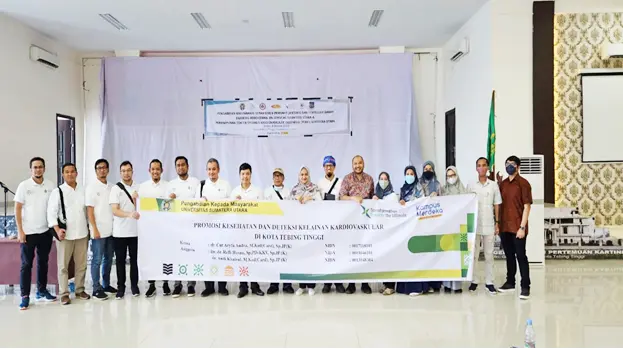
The Department of Heart and Vascular Diseases, Faculty of Medicine Universitas Sumatera Utara, in collaboration with the Association of Indonesian Cardiovascular Specialists (PERKI) North Sumatra, the Indonesian Doctors Association (IDI) North Sumatra, the Central General Hospital (RSUP) Haji Adam Malik Medan, the Integrated Heart Center, and the Indonesian Heart Foundation, held a Social Service activity on Monday, March 8, 2023 in Tebingtinggi City, North Sumatra.
The activities carried out were:
Examination of TB, weight, and electrocardiogram (ECG) by interpreting ECG readings by trained officers.
Laboratory examinations in the form of blood sugar and cholesterol levels.
Carotid doppler examination by heart and blood vessel specialists.
Consultation on heart health by heart and blood vessel specialists.Counseling conducted by heart and blood vessel specialists.
The activity took the theme “HEALTH PROMOTION AND DETECTION OF CARDIOVASCULAR FAMILIES IN THE CITY OF TEBING TINGGI” with the location of the activity at the Multipurpose Building Balai Kartini Kota Tebingtinggi. The event took place for 1 day on March 8, 2023. The event involved several institutions including the Department of Heart and Blood Vessels FK USU, PERKI, and Universitas Sumatera Utara. Several participants attended the activity, some of whom were the Head of the Department of Cardiology and Vascular Medicine FKUSU, 16 doctors of Heart and Vascular Specialists, 20 members of the Cardiology Assistant Group of the Department of Cardiology and Vascular Medicine, Faculty of Medicine, University of North Sumatra, and 77 participants of ECG, carotid doppler and Heart Health Examination.
Cardiovascular disease is still a global health problem. Data from the World Health Organization (WHO) states that the death rate due to cardiovascular disease (CVD) is 17.7 million people each year and plays a role in 31% of all global deaths. Heart disease in Indonesia is a complex issue. It can occur in the community due to a sedentary lifestyle or due to heart infections, which are still high in prevalence in developing countries such as Indonesia. Based on doctor's diagnosis, the prevalence of coronary heart disease in Indonesia in 2013 was 0.5% or an estimated 883,447 people, while based on doctor's diagnosis/symptoms it was 1.5%.
For heart infections, the most common problems in Indonesia are rheumatic heart disease and infective endocarditis. Rheumatic fever (DR) is still common in children in developing countries and often affects children between the ages of 5 - 15 years. In 1944 it was estimated that worldwide there were 12 million patients with DR and PJR and about 3 million had heart failure and required repeated hospitalizations. Its prevalence in developing countries ranges from 7.9 to 12.6 per 1000 school children and is relatively stable. The latest data on the prevalence of rheumatic fever in Indonesia for 1981 - 1990 was found to be 0.3-0.8 among 1000 school children and much lower than other developing countries. The prevalence of infective endocarditis remains unclear in Indonesia.
Until January 2023, the preventive program in the cardiometabolic field has been implemented 5 times in Langkat Regency and Medan City. The total samples obtained were 252 children and 393 adults. For this reason, we plan to develop a preventive program in the field of cardiometabolics to the people of Tebing Tinggi City.
The event began with patient data collection by filling out the form provided by the committee. The community that had registered came to the place, and the date had been determined. Then, it continued with examining BB, TB, blood sugar, and carotid doppler for 77 registered participants. After that, the consultation continued with a discussion on heart disease problems. This activity was carried out while adhering to health protocols.
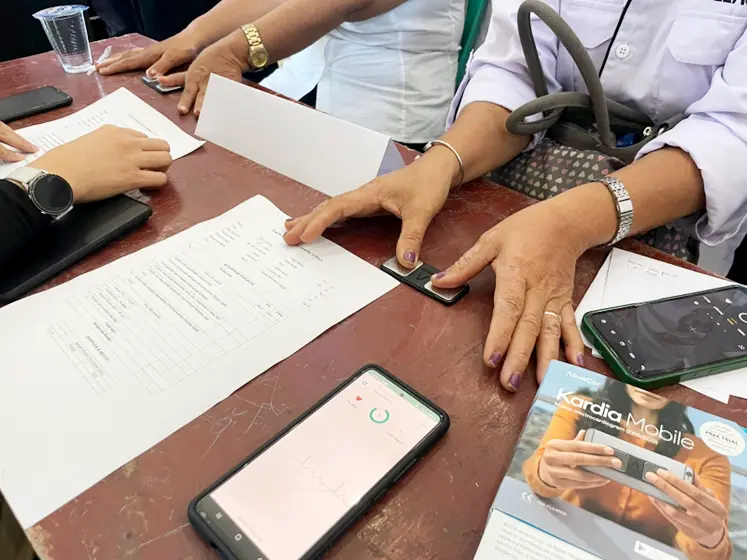
Participants registered through the formula prepared by the committee, and the response to the event was quite good. Participants from the community reached 77 people. Participants comprised 28 men (36.3%) and 49 women (63.6%). Participants ranged in age from 21 years old to 75 years old. This shows a good response from the community who need health checks in the heart and blood vessels section.
We perform echocardiography examinations as part of screening to assess the function and structure of the heart and blood vessels. By detecting heart abnormalities early, we aim to avoid the development of more serious heart diseases in the future. In addition, we screen for rheumatic heart disease, pulmonary hypertension, and arrhythmia.
The community service team conducted ECG, laboratory and cardiovascular health screening activities. On this occasion, information about heart disease in the present time was also explained and risk screening for heart disease in adults was carried out. This activity has met the target to be achieved where the community has more awareness in maintaining their health, taking routine medication, and maintaining a diet. Participants also received a clear explanation of the problems of heart disease, hypertension, heart failure, and how to prevent the occurrence of these heart diseases among the community.
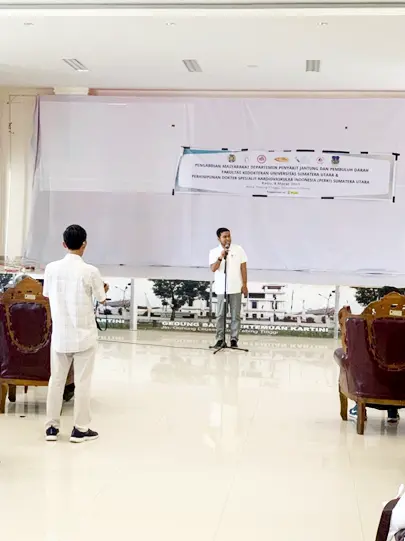
Furthermore, we also provided health education to the general public at the same venue. We provided information on Coronary Heart Disease, Diabetes Mellitus, and Congenital Heart Disease. This knowledge means a lot to the community as some of the risk factors associated with these conditions can be prevented and modified, thus reducing the potential for poor health. We are eager to know how many participants are actively involved in this education program. Through these efforts, we aim to increase public awareness and understanding of these health conditions.