


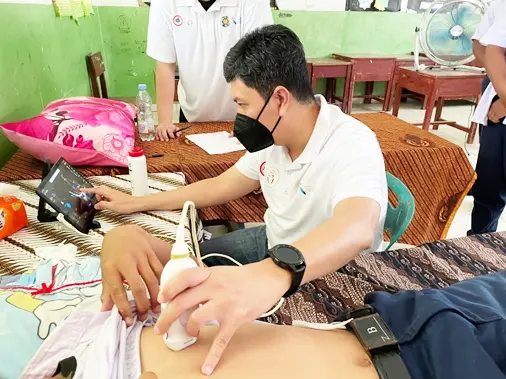
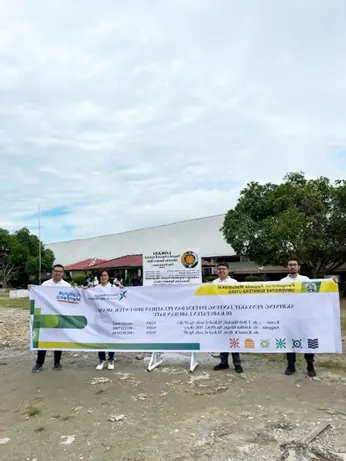
The Department of Heart and Vascular Diseases, Faculty of Medicine Universitas Sumatera Utara, in collaboration with the Association of Indonesian Cardiovascular Specialists (PERKI) North Sumatra, the Indonesian Doctors Association (IDI) North Sumatra, the Central General Hospital (RSUP) Haji Adam Malik Medan, the Integrated Heart Center, and the Indonesian Heart Foundation, held a social service activity on Monday, June 12, 2023 in Labuhan Batu Regency, North Sumatra.
The activities carried out are:
Valvular Heart Disease Screening, Rheumatic Heart Disease, Pulmonary Hypertension, and Arrhythmia.
Basic Life Support Training.
Lay Counseling.
Metabolic Screening Examination.
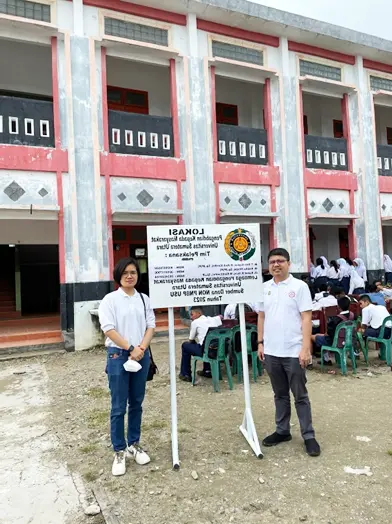
This community service activity was carried out by a Community Service team consisting of staff of the Department of Heart and Vascular Diseases FK USU, PPDS Heart and Vascular Diseases FK USU, members of PERKI SUMUT, and the Labuhan Batu Regional Government. Community service was carried out simultaneously on Monday, June 12, 2023 in two places, namely SMP N 1 Rantauprapat and Asrama Haji Rantauprapat. Activities carried out in this community service in the form of rheumatic/valvular heart disease screening, pulmonary hypertension, and BHD training.
Cardiovascular disease is still a global health problem. Data from the World Health Organization (WHO) states that the death rate due to cardiovascular disease (CVD) is 17.7 million people each year and accounts for 31% of all global deaths. Heart disease in Indonesia is a complex issue. It can occur in the community due to a sedentary lifestyle or due to heart infections which are still high in prevalence in developing countries such as Indonesia. Based on doctor's diagnosis, the prevalence of coronary heart disease in Indonesia in 2013 was 0.5% or an estimated 883,447 people, while based on doctor's diagnosis/symptoms it was 1.5%.
Prevention and management of cardiovascular disease in the community is one of the efforts to achieve the 3rd goal of Sustainable Development Goals (SDGs), which is a healthy and prosperous life. In this goal, the government must ensure a healthy life and improve the welfare of all residents of all ages.
The diverse levels of education, economy, socio-culture, and inadequate road access in the people of North Sumatra are challenges in preventing infectious cardiology diseases. This is believed to cause a lack of public awareness to check their health at health service units such as Puskesmas and Hospitals.
Promotive and preventive programs in Indonesia and North Sumatra are still unstructured. Meanwhile, an understanding of the real situation in North Sumatra has not yet been identified.
The community service was attended by both child and adult participants. The demographic characteristics of the child participants showed that they were 13-15 years old. Male 62 people (68%) and female 34 people (32%). The characteristics of adult participants showed the age of 21-58 years old. 55 males (39%) and 83 females (63%).
Of the 96 pediatric participants who participated in the rheumatic/valvular heart disease screening, several had rheumatic/valvular heart defects, such as 1 male patient with prolapsed AML with moderate mitral regurgitation. In addition, there was also 1 patient with mild circumferential pericardial effusion.
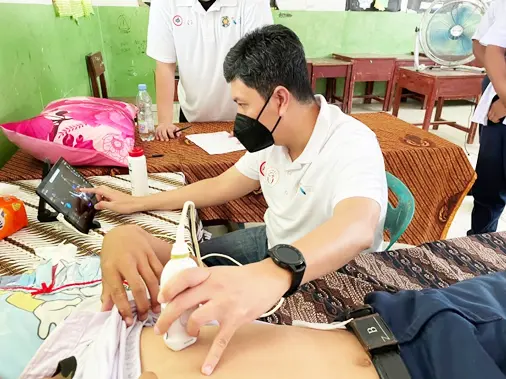
As part of the screening, we performed an echocardiography examination to assess the function and structure of the heart and cardiac blood vessels. By detecting heart abnormalities early, we aim to avoid the development of more serious heart diseases in the future. In addition, we screen for rheumatic heart disease, pulmonary hypertension, and arrhythmia.
In addition, we organize Basic Life Support (BHD) training at this location. It is important for the community to realize how important BHD training is. BHD is a very vital skill and can make a difference in saving lives during emergency situations or life-threatening conditions. BHD training is open to both medical personnel and individuals who have received appropriate training. It includes a series of steps aimed at restoring respiratory and circulatory function to someone facing cardiac arrest, breathing difficulties, respiratory failure or airway obstruction.
Providing basic life support quickly to someone who is unconscious and not breathing is critical. This initiative aims to equip the community with these life-saving skills, which can be used in emergency situations before professional medical assistance is available.
Furthermore, we also provided health education to the general public at the same venue. We provided information on Coronary Heart Disease, Diabetes Mellitus, and Congenital Heart Disease. This knowledge means a lot to the community as some of the risk factors associated with these conditions are preventable and modifiable, thus reducing the potential for poor health in the future. We are eager to know how many participants are actively involved in this educational program. Through these efforts, we aim to increase public awareness and understanding of these health conditions.
In addition, we also conducted a metabolic screening on the participants. This involves measuring blood sugar and cholesterol levels. If uncontrolled, high blood sugar and cholesterol levels can increase the risk of diseases such as heart attack, stroke, coronary heart disease, carotid artery disease, sudden cardiac arrest, peripheral artery disease, and microvascular disease in the future. We not only conduct examinations, but also provide education to participants about risk factors that need to be avoided, such as obesity, inactive lifestyle, lack of regular physical activity, alcohol use, smoking, illegal drugs, type 2 diabetes, thyroid disease, chronic kidney or liver disease, advanced age, fatty and high-sugar diet, and family history of dyslipidemia. With this activity, we hope that participants will adopt a healthier lifestyle and diet to prevent these diseases in the future.